
A hot brake smell after driving often follows hard stops, long downhill braking, or the first miles on new pads. If it lingers for more than a few minutes, seems to come from one wheel, or the car pulls, a brake may be dragging and should be inspected. Ignoring that smell can overheat pads, warp rotors, and damage a caliper. Use the smell, location, and how long it lasts to separate normal heat from a fault.
This guide is part of our Power steering and brake problems series.
Brake smell decision table

This table gives you the quickest smell-to-diagnosis check. Match when the odor appears, what it smells like, and where the heat seems strongest before you decide whether the brakes are simply hot or one part of the system is not releasing correctly.
| Smell timing | Odor character | Likely source | Urgency |
|---|---|---|---|
| After hard downhill driving | Acrid, hot metal, or burnt carpet | Normal brake heat from prolonged pad and rotor use | Usually normal if it fades after cooling |
| After new brake installation | Light burning smell during the first few dozen miles | Brake bedding-in of new pads and rotors | Usually normal if braking feels even and the smell fades |
| After a highway exit | Burning rubber or hot lining smell that lingers | Possible dragging pad, parking brake drag, or a nearby tire issue | Check soon, especially if one wheel is hotter |
| After driving with one wheel much hotter than the others | Sharp burning smell near one wheel | Sticking caliper, dry guide pins, or partially applied parking brake | Stop driving and inspect before more heat builds |
Why do my brakes smell hot after driving?
Brakes smell hot because pad friction converts motion into heat. Hydraulic pressure pushes the pads into the spinning rotors, and that contact slows the car. A mild odor after hard stops, fast driving, or a long descent can be normal if it fades as the brakes cool.
What hot brakes normally smell like
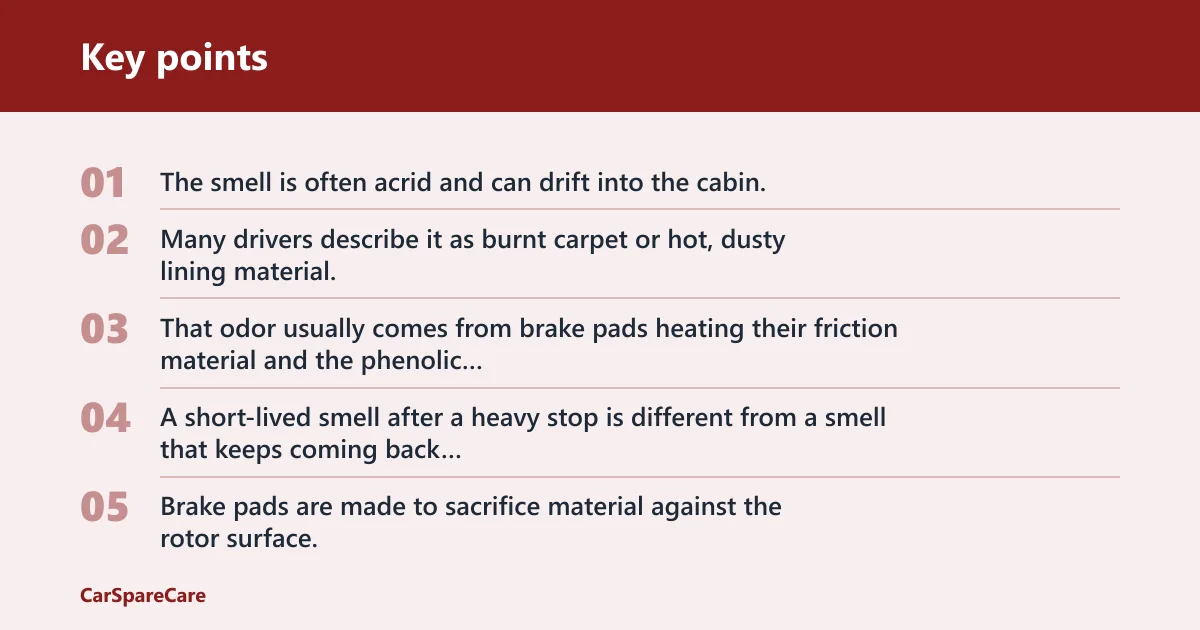
The smell is often acrid and can drift into the cabin. Many drivers describe it as burnt carpet or hot, dusty lining material. That odor usually comes from brake pads heating their friction material and the phenolic resins that bind it. A short-lived smell after a heavy stop is different from a smell that keeps coming back during normal commuting.
Why friction makes heat and odor
Brake pads are made to sacrifice material against the rotor surface. The rotors convert kinetic energy to heat every time you slow down. If the heat gets high enough, the pad material and its resins can release gases that smell burned. That does not automatically mean failure, but it does mean the brake system has been worked hard.
Picture a 10-mile downhill exit where the driver rides the pedal the whole way. The smell may be strongest when the car stops, then fade after a short cool-down. That pattern points to heat, not a fault, unless the odor returns on the next normal drive or one wheel stays hotter than the others.
What do burning brakes smell like?
Burning brakes can smell like hot metal, burnt carpet, or sometimes burning rubber. Hot metal usually points to very hot rotors or calipers. A burnt carpet smell often fits overheated pad material. A rubber-like smell can come from a nearby tire or a parking brake dragging a rear wheel, so smell alone is not enough.
Burning rubber versus hot metal
If the odor is closer to rubber, check whether the smell is strongest near one tire or one rear corner. A tire rubbing, a wheel bearing running hot, or a drivetrain issue can copy a brake smell. If it is more like hot metal or burnt dust near the wheel, the brakes move higher on the list.
When the smell points to pad material
Brake pads can smell during bedding-in because the friction material is heating in a controlled way. That is most likely after new pads and rotors are installed, and it often shows up during the first few dozen miles. If the smell appears later, or only at one corner, suspect drag rather than normal break-in.
Is it normal for brakes to smell after driving downhill?
Yes, a brake smell after downhill driving can be normal because long braking loads heat the rotors and pads. The key is what happens next. If the odor fades once the brakes cool, the pedal still feels normal, and all four corners cool at a similar rate, the system may simply have been worked hard.
How prolonged braking heats rotors and pads
On a long descent, the pads stay in contact with the rotors more often and for longer periods. That raises temperature across the friction surfaces and can create an acrid smell that wafts into the cabin. Severe overheating is different. It can lead to brake fade, which means stopping power has dropped and the system needs attention.
When downhill heat becomes brake fade
Brake fade is a safety warning sign. If the pedal feels longer, stopping distance grows, or the brakes smell hot and then seem weak, pull over and let them cool. Severe overheating can also leave uneven deposits on the rotor if the bedding-in or heat cycle was poor, which can cause vibration later.
Why do my brakes smell after replacement?
After new brake work, a brief smell can be normal during bedding-in. New brake pads and rotors can smell during break-in, often during the first few dozen miles. The smell should be light and temporary. If it stays strong, gets worse, or one wheel is much hotter, the new parts may not be releasing correctly.
Brake bedding-in and temporary odor
Bedding-in is the break-in procedure for new pads and rotors. It helps transfer pad material evenly onto the rotor surface. A mild odor can appear while this process is happening. That is expected if the stops were done correctly and the smell drops off after the first drive or two.
Uneven deposits from poor break-in
Improper bedding-in can create uneven deposits on the rotor. Those deposits can make the brake feel rough, noisy, or shaky later. They can also create a lingering hot smell after normal commuting because parts of the pad are running hotter than they should. That is not the same as a short, controlled break-in odor.
Suppose a sedan gets new front pads and rotors, then smells hot for 15 miles after the first few stops. If the smell fades and both front wheels cool at nearly the same rate, that fits bedding-in. If the left front stays much hotter after a short local drive, the diagnosis shifts toward a sticking brake part.
One hot wheel diagnosis
One wheel that is much hotter than the others usually points to drag at that corner. A brake caliper must slide and release fully. If it sticks, or if the guide pins are corroded or dry, the pad can stay in contact with the rotor after you lift off the pedal. That keeps making heat and odor.
How to compare wheel heat safely
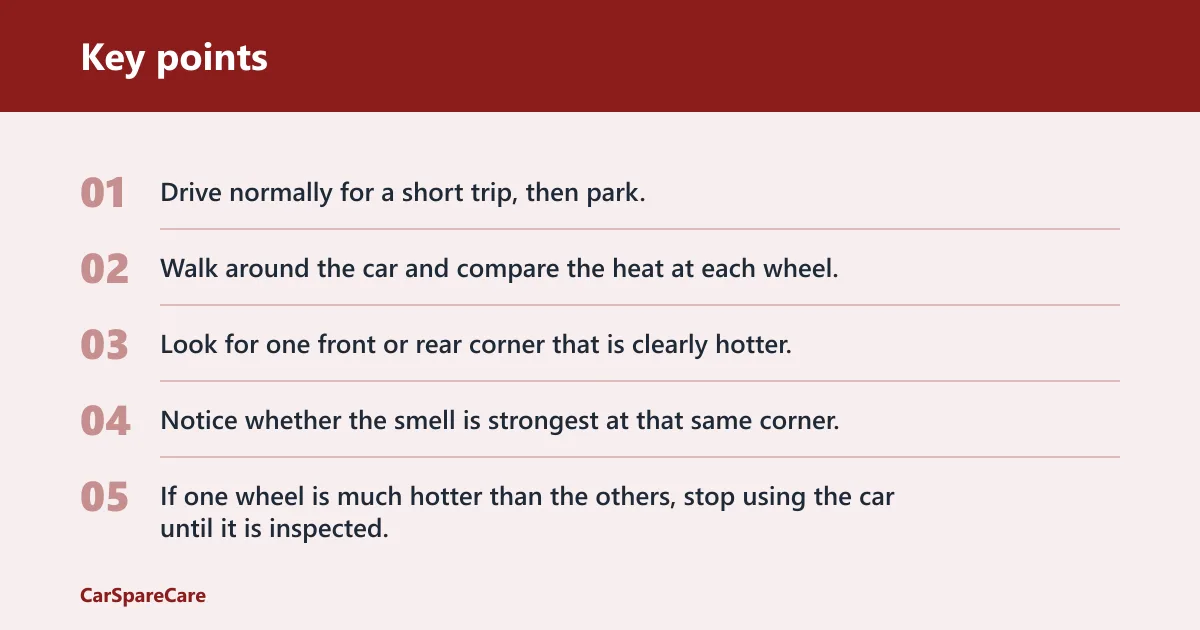
Park on level ground, shift to Park or gear, set the car securely, and let it sit long enough to avoid burns. Then compare the wheels by hand near, not on, the wheel face. You want to feel for one wheel that is much hotter than the others. A quick touch near each wheel can reveal a drag problem without tools.
- Drive normally for a short trip, then park.
- Walk around the car and compare the heat at each wheel.
- Look for one front or rear corner that is clearly hotter.
- Notice whether the smell is strongest at that same corner.
- If one wheel is much hotter than the others, stop using the car until it is inspected.
Sticking caliper or dry guide pins
A sticking brake caliper is one of the most likely causes of one-wheel heat. Corroded or dry guide pins can keep the caliper from sliding back after braking. That means the pad keeps rubbing the rotor, which wears the pad faster and can create a persistent burning smell after even a short drive.
Parking brake drag on the rear wheels
A partially engaged parking brake can create enough friction to smell. This often shows up at the rear wheels, and the rear corner may feel hotter than the front. If the smell is strongest after slow city driving or a short highway exit, and the rear wheels are the hot ones, check that the parking brake is fully released.
When the smell is not the brakes
Not every hot smell near a wheel comes from the brake system. A tire, wheel bearing, or drivetrain component can overheat and smell similar to a brake odor. That is why location matters. If the smell is strongest near the tire sidewall, the hub, or under the floor rather than at the brake corner, widen the diagnosis before replacing pads.
Tire, wheel bearing, or drivetrain heat
A tire rubbing the inner liner, a wheel bearing running hot, or a drivetrain part under load can each give off a burning smell. These smells can resemble hot rubber or hot oil more than pad material. Do not assume every odor near a wheel is a brake fault, especially if the brake pedal feels normal and the wheel heat is even.
Why brake fluid is part of the check if odor persists
Brake fluid is the hydraulic force medium that helps apply braking pressure. It is not a common direct source of smell, but if the odor persists and the brakes feel odd, the whole system should be checked. That includes leaks, hose condition, and whether the fluid has been overheated as part of a larger brake problem.
What to do if the smell does not fade
If the smell fades after cooling and the heat seems even at all four wheels, it can usually be monitored. If the smell lasts beyond normal cooling time, returns after ordinary driving, or comes from one wheel, schedule service promptly. If you also feel brake fade, a pull to one side, or a very hot wheel, stop driving and get help.
Stop driving immediately if you notice these signs
- One wheel is much hotter than the others.
- The car pulls hard while braking.
- The pedal feels soft, long, or weak.
- The smell gets stronger instead of fading.
- You suspect the parking brake is still partly on and the rear wheels are heating up.
What to do next after a mild, short smell
If the odor followed a long hill, a hard stop, or the first miles after new pads, let the brakes cool and watch for a repeat on the next normal drive. If the smell returns without hard braking, or the same corner keeps running hotter, arrange an inspection of the caliper, guide pins, pads, rotors, and parking brake hardware.
Frequently asked questions
Do brakes smell like burning rubber?
They can, but that smell is not specific to brakes. Burning rubber can come from a tire rubbing, a parking brake dragging a rear wheel, or another hot component near the wheel. If the smell is strongest at one corner and that wheel is hotter, the brake system moves higher on the list.
When is a hot brake smell dangerous?
It becomes dangerous when the smell lasts after normal cooling time, gets stronger with each stop, comes from one wheel, or comes with brake fade. A partially engaged parking brake, sticking caliper, or dry guide pins can keep making heat. In that case, stop driving and inspect the car.

Hi, I’m Melvin, an automobile engineer with extensive experience in automobile equipment. I currently work for a local automobile firm, where I specialize in the car parts industry. I’ve had the opportunity to collaborate with seasoned inspectors, gaining invaluable hands-on experience that goes beyond just theory.
My passion for automotive care started at a young age, which led me to create CarSpareCare. Through CarSpareCare, I share the knowledge and skills I’ve acquired over the years to help others navigate the world of car maintenance and repairs.
My goal is to provide practical tutorials, essential safety advice, and the latest industry insights so that anyone—whether a beginner or an expert—can confidently tackle their automotive projects.

