Remove paint transfer from interior car panels by using the gentlest method that fits the trim type: dry microfiber first, then diluted mild soap for plastic or vinyl, and only use isopropyl alcohol or a plastic-safe cleaner on stubborn marks after a spot test. Strong solvent or abrasives can haze soft-touch trim, strip coating, or leave a shiny patch that stands out more than the original scuff. This guide shows a panel-by-panel decision tree, the safest cleaning order, and how to stop before a cleaner turns a surface repair into a permanent finish problem.
How to spot paint transfer
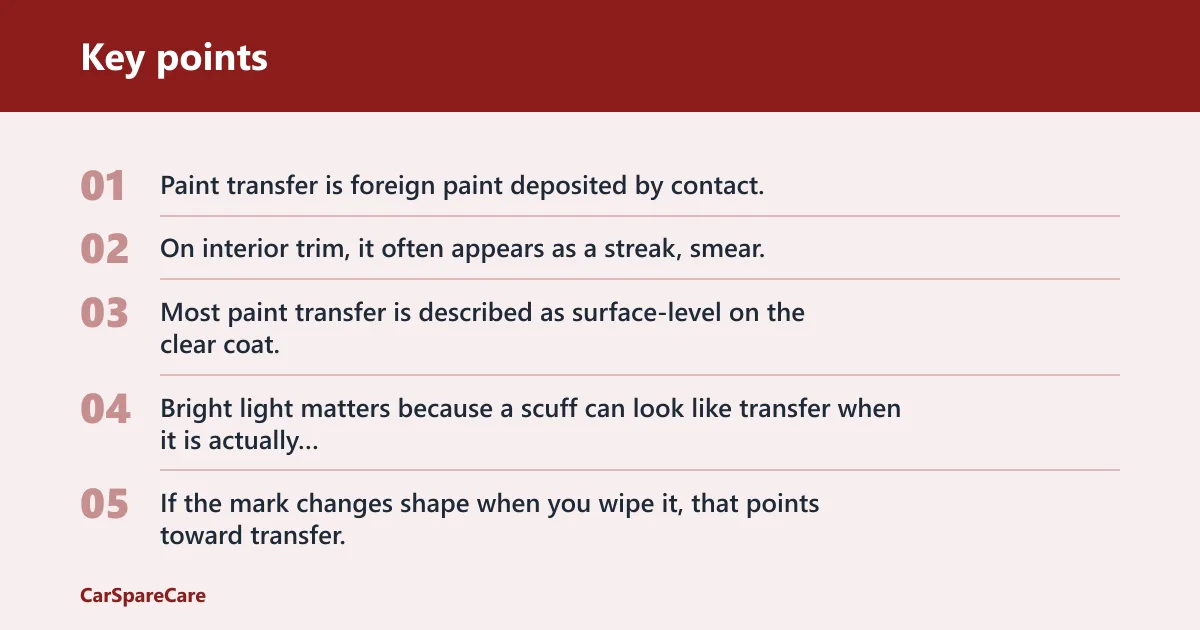


Paint transfer is foreign paint deposited by contact. On interior trim, it often appears as a streak, smear, or patch that sits on top of the panel rather than cutting through it. Most paint transfer is described as surface-level on the clear coat, but interior panels add more failure modes because the material itself may be textured, soft-touch, vinyl, painted, or already repainted.
Bright light matters because a scuff can look like transfer when it is actually through-coat damage, a scratch, or color loss. If the mark changes shape when you wipe it, that points toward transfer. If the line stays sharp and catches a fingernail, treat it as damage instead of residue.
Can you remove it safely?
Yes, if the mark is surface transfer and the panel can tolerate gentle cleaning. The safe approach is to identify the material first, then match the least aggressive method to that surface. Hard plastic and some painted trim can take more than soft-touch coatings or unknown aftermarket panels. Interior-care guidance from detailing brands and OEM finishing standards consistently points to the same rule: start mild, test in a hidden spot, and stop at the first sign of finish change.
Check the panel in bright light
Use bright lighting to see whether the mark sits on top of the surface or breaks the finish. Move the light at an angle. Transfer usually shows a smeared edge, while a scratch has a cleaner groove or a white line that stays put.
Identify the material before touching it
Hard plastic, soft-touch plastic, vinyl door cards, piano-black trim, factory painted trim, and repainted panels all react differently. If the finish feels rubbery or looks satin and coated, assume it is more sensitive. If it looks glossy and uniform, treat it as painted until you know otherwise. This distinction matters because factory painted trim may tolerate measured cleaning and polishing, while raw plastic, vinyl, and soft-touch coatings can haze, gloss up, or discolor with the wrong product.
What you’ll need
- Clean microfiber towels, ideally white for transfer checks
- Mild interior cleaner or diluted soap solution for plastic and vinyl
- Clay bar with clay lubricant for suitable smooth surfaces
- Optional polish or compound for suitable painted or hard, glossy trim
- Plastic-safe cleaner or isopropyl alcohol for spot testing on tough residue
- Protective finish, such as wax or sealant, for final protection on appropriate surfaces
- Bright inspection light
How do you remove paint transfer from interior car panels without damaging the plastic?
Start with a clean towel and very light pressure, then move only as far as the material allows. The safest path is: remove grit, wipe with microfiber, use mild cleaner if needed, then try clay on suitable surfaces, and only step up to polish or a careful solvent test when the panel is known to tolerate it. Clay is a finishing step for smooth, sound surfaces only; it is not a fix for damaged coating, deep texture, or soft-touch trim that is already breaking down.
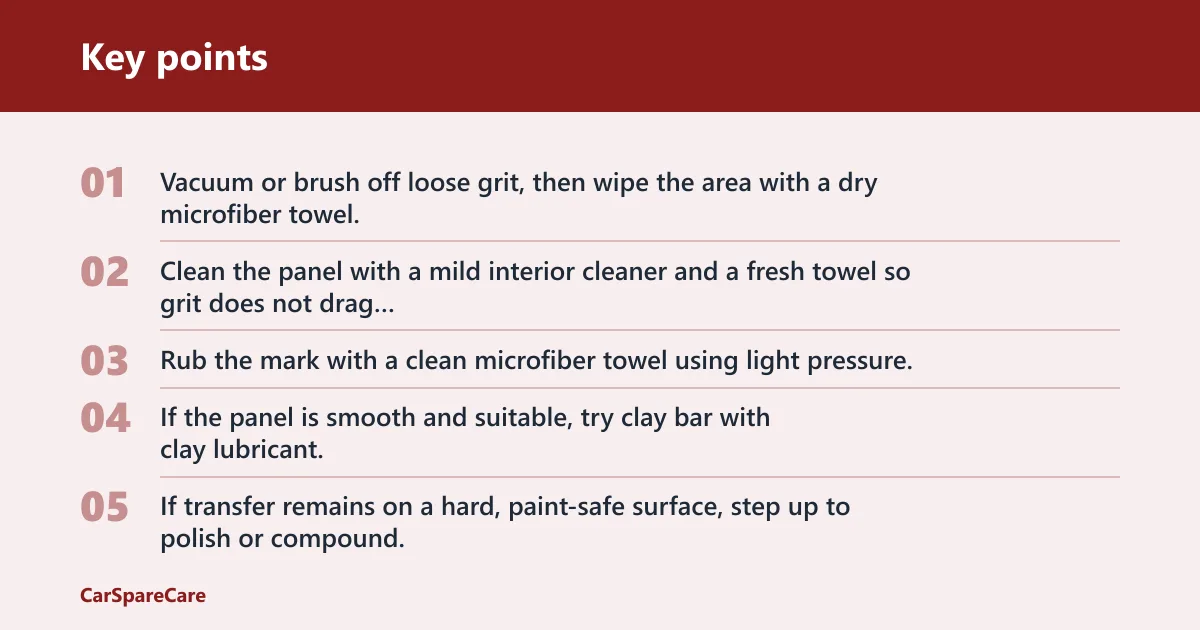
- Vacuum or brush off loose grit, then wipe the area with a dry microfiber towel.
- Clean the panel with a mild interior cleaner and a fresh towel so grit does not drag across the finish.
- Rub the mark with a clean microfiber towel using light pressure. A white microfiber towel is often useful for seeing whether color is transferring, but the goal is simply to use a clean towel that will not add grit back to the panel.
- If the panel is smooth and suitable, try clay bar with clay lubricant. Clay should be used only on paint-safe, non-porous, non-soft-touch surfaces, and only with plenty of lubricant so the bar glides rather than drags.
- If transfer remains on a hard, paint-safe surface, step up to polish or compound. Polishing is appropriate only when the finish is painted or a hard glossy trim piece that can safely accept light correction; it is not a cure for soft-touch coatings, vinyl grain, or raw plastic texture.
- Use solvent only as a near-last resort on factory painted trim, and only with extreme caution. Lacquer thinner is a near-never option for interior panels because it can attack plastic, vinyl, soft-touch coatings, and many repainted surfaces very quickly. If you ever consider it at all, limit it to a confirmed factory-painted surface and stop at the first sign of softening, color transfer, or gloss change.
- Reclean the area, then inspect for residue, staining, or ghosting before you decide the job is done.
Say your door pull has a 2-inch white smear from a shoe scuff on black hard plastic. If the towel removes most of it, stop there and check it under light. Do not jump straight to solvent because what remains may be a faint stain, not more transfer.
What if the panel is textured or repainted?
Texture changes the risk because paint transfer can lodge in valleys, and pressure can flatten the pattern if you scrub too hard. Repainted panels are more fragile because the new finish may be thinner, less bonded, or a different chemistry from the factory surface. That makes solvent choice and pressure control more important than speed.
Why texture changes the risk
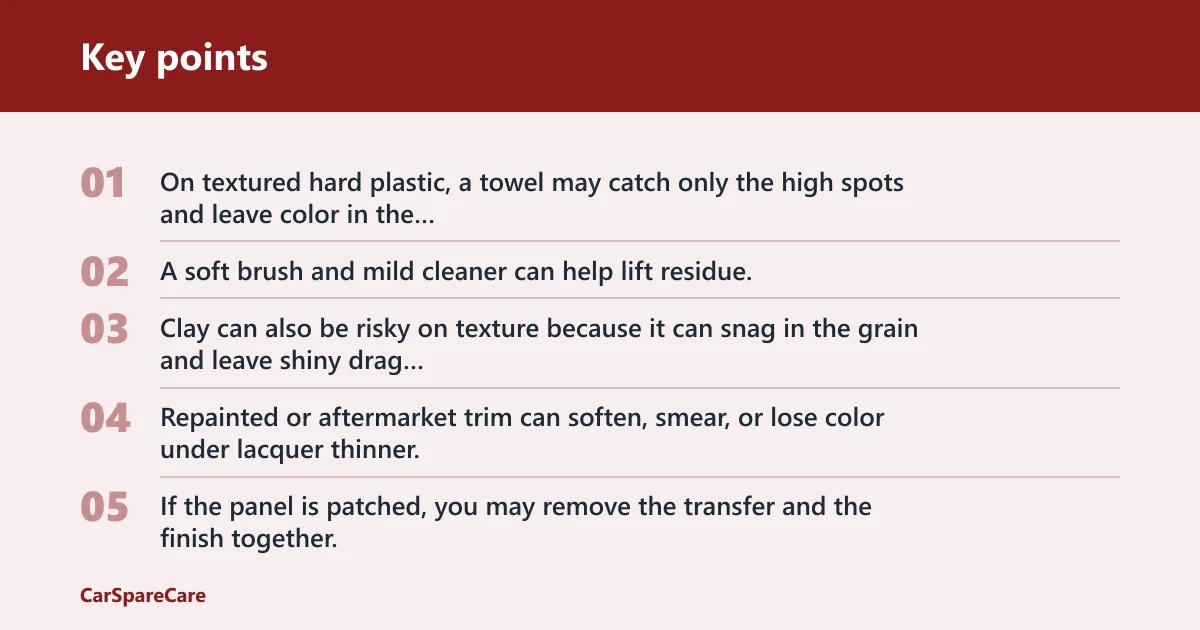
On textured hard plastic, a towel may catch only the high spots and leave color in the low spots. A soft brush and mild cleaner can help lift residue, but heavy rubbing can polish the texture or make it look uneven. Clay can also be risky on texture because it can snag in the grain and leave shiny drag marks if the surface is not smooth enough.
Why repaint adds solvent and color-loss risk
Repainted or aftermarket trim can soften, smear, or lose color under lacquer thinner, alcohol, or aggressive cleaner. If the panel is patched, you may remove the transfer and the finish together. That is a stop point, not a reason to push harder.
When to stop and hand it off
If the coating turns sticky, the color comes off on the towel, or the panel already shows cracking or flaking, stop. A professional refinish is safer than stripping the surface layer on an interior panel that cannot tolerate another round of cleaning.
| panel material | transfer severity | safest first product | stop point | red-flag warnings |
|---|---|---|---|---|
| Textured hard plastic | Light streak | Dry microfiber towel | When the streak lightens but texture stays unchanged | Do not scrub hard enough to flatten texture |
| Soft-touch dash trim | Light smear | Mild interior cleaner on a towel | When residue lifts without sheen change | Avoid solvent, Magic Eraser, and heavy pressure |
| Vinyl door cards | Patch or streak | Diluted mild soap or interior cleaner | When color stops transferring to the towel | Watch for dull spots and coating softening |
| Piano-black trim | Fine smear | Clean microfiber towel, then clay on lubricant | When haze starts to improve but before polishing dust builds | Very easy to mar; use only the lightest pressure |
| Repainted panels | Any visible transfer | Spot test with plastic-safe cleaner | At the first sign of softening or color loss | Solvent can strip or wrinkle the new finish |
| Scratched-through transfer | Line plus color smear | Clean only the smear, not the groove | When the transfer is gone and the scratch remains | Do not expect cleaner to fix exposed substrate |
| Sticky residue after transfer | Tacky patch | Clay lubricant or mild interior cleaner | When the surface feels dry, not greasy | Do not chase tackiness with harsh solvent first |
| Unknown plastic type | Any visible mark | Dry microfiber towel | When the mark lightens and the finish looks unchanged | Test in a hidden spot before any liquid cleaner |
Common mistakes
Most bad outcomes come from too much pressure, the wrong towel, or a cleaner that is too strong for the surface. A dirty towel can drag grit back into the finish. A Magic Eraser can act like a very fine abrasive, which may be too aggressive for soft-touch or glossy interior trim. On coated trim, aggressive rubbing can also create a larger sheen change than the original scuff.
A common mistake is scrubbing a streak of white scuff paint off textured door panel plastic with a dry melamine pad. The spot may fade, but the surrounding area can turn shiny and uneven. If the surface changes gloss before the mark is gone, stop.
- Do not start with lacquer thinner unless the panel is confirmed factory paint and the risk is acceptable.
- Do not use a dirty towel on visible trim.
- Do not treat soft-touch, vinyl, and hard plastic the same.
- Do not keep rubbing once the towel stops picking up color.
How do I restore protection after removing transfer marks?
After correction, clean the area again and apply a protective finish only where the material allows it. For painted or gloss trim, a light interior-safe protectant can help reduce future scuffing and maintain appearance. For raw plastic, vinyl, and soft-touch surfaces, use only products labeled for interior trim; avoid blanket wax or exterior-style sealant recommendations because they can leave unwanted shine, residue, or uneven feel.
Choose the lightest finish that fits the surface. If the panel is textured, apply sparingly so residue does not collect in the grain. If the panel is repainted, confirm the finish will not alter the color or sheen before you cover the area.
Frequently asked questions
Will lacquer thinner damage car interior plastic panels?
Yes, it can. Lacquer thinner is a near-never choice for interior panels because it can attack plastic, vinyl, soft-touch coatings, and repainted trim very quickly. If a factory-painted piece is the only candidate and you still decide to test it, use the smallest possible amount on a hidden edge and stop immediately if the towel picks up color or the sheen changes.
Can a clay bar remove paint transfer from interior surfaces?
Yes, on suitable smooth surfaces. Clay is useful for paint-safe, non-porous trim when residue sits on top of the finish. It is not appropriate for soft-touch coatings, deep grain, or surfaces that already feel sticky or tacky. Use generous clay lubricant and light pressure so the bar glides rather than abrades.
What is the safest cleaner for paint scuffs on car door panels?
The safest first cleaner is a mild interior cleaner or diluted soap on a microfiber towel. Start there because it is less likely to haze or strip the finish than solvent-based products. If the panel is factory painted and still needs more, use a plastic-safe cleaner only after a spot test; if it is soft-touch or vinyl, stay conservative and avoid strong solvents.
How do I tell if the mark is paint transfer or a scratch?
Inspect it in bright light and wipe it with a clean towel. Transfer often changes shape or lightens, while a scratch stays in the same line and may catch a fingernail. If the finish is broken or the color is missing, treat it as damage, not residue.
Should I use a microfiber towel or magic eraser on interior panels?
Start with a clean microfiber towel. It is the safest first tool because it can lift loose transfer without adding abrasion. A Magic Eraser can be too abrasive for soft-touch, satin, or glossy interior trim and can create a larger dull spot than the original scuff.
What if the panel is textured, soft-touch, or repainted?
Use extra caution. Texture can trap transfer in low spots, soft-touch can haze or go shiny, and repainted trim can react badly to solvent or pressure. Start with microfiber only, then pause if the finish changes before the mark does. That is the stop point.

Hi, I’m Melvin, an automobile engineer with extensive experience in automobile equipment. I currently work for a local automobile firm, where I specialize in the car parts industry. I’ve had the opportunity to collaborate with seasoned inspectors, gaining invaluable hands-on experience that goes beyond just theory.
My passion for automotive care started at a young age, which led me to create CarSpareCare. Through CarSpareCare, I share the knowledge and skills I’ve acquired over the years to help others navigate the world of car maintenance and repairs.
My goal is to provide practical tutorials, essential safety advice, and the latest industry insights so that anyone—whether a beginner or an expert—can confidently tackle their automotive projects.