
Use a light cleaner wax or finishing polish for mild oxidation, a medium-cut compound for moderate chalkiness, and stop polishing if the panel still looks dull, rough, or patchy after a small test spot. Oxidation is the breakdown of the paint surface; clear coat failure is a separate problem where the protective layer is already peeling or missing. This guide helps you judge severity, choose the right product type, and stop before you waste time or thin the finish too far.
Quick picks
The safest general pick for light oxidation is Meguiar’s Professional Cleaner Wax M06, because it is intended to remove light oxidation and mild surface marks on glossy paint while adding protection in the same step.
- Best for light oxidation: cleaner wax
- Best for moderate oxidation: paint polish
- Best for heavy oxidation on clear coat: paint compound
- Best if the clear coat has failed: repaint territory
Quick comparison
| Product | Badge | Best for | Price | ||
|---|---|---|---|---|---|
 | Meguiar’s Ultimate Compound 15.2 oz 6 Pack Rubbing CompoundMeguiar’s | Our pick | 15.2 oz 6-pack · rubbing compound · clear coat safe | $64.99 Price as of 4 Nov 2026 | View |
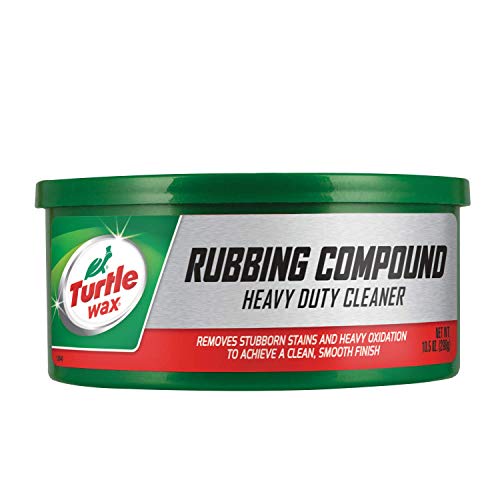 | Turtle Wax T-230A Rubbing Compound & Heavy Duty CleanerTurtle Wax | Budget pick | 10.5 oz · paste compound · oxidized finishes | $7.99 Price as of 4 Nov 2026 | View |
 | 3M Perfect-It Ultrafine Machine Polish3M | Pair with it | 32 fl oz · ultrafine polish · final-step finish | $52.48 Price as of 4 Nov 2026 | View |
 | Chemical Guys, VSS One-Step Scratch & Swirl Remover, CutChemical Guys | Also great | 16 oz · one-step compound · high-gloss finish | $21.97 Price as of 4 Nov 2026 | View |
Use the table below as a severity guide, not a product hype list. The right answer depends on how the paint looks and feels after washing, then checking a small test spot.
How we chose
The choices here follow four checks: cut level matched to paint condition, hand use versus dual-action polisher use, clear coat safety, and whether the product still leaves value after correction. That keeps you from overcutting paint that only needs cleaning.
We also favored products and methods that fit a first test spot. If a cleaner cannot move the problem after a small section, the next step should be more aggressive only if the clear coat still has enough thickness left.
Oxidation decision table
| Paint condition | Safe first-step product | Machine or hand option | Expected outcome | Stop signals |
|---|---|---|---|---|
| Light oxidation: dull but still smooth, with only mild chalking | Cleaner wax or finishing polish | Hand pad or dual-action polisher | Gloss returns, haze softens, and light surface oxidation lifts | Color still looks flat after two passes, or the surface feels rough and gritty after cleaning |
| Moderate oxidation: obvious dullness, light chalk on the towel, some micro-marring | Paint polish with light cut, then protection | Hand work for a small area; DA polisher for larger panels | Noticeable clarity improvement, less chalky residue, more uniform shine | Paint still looks dry and faded in the same spots, or the color stays uneven |
| Heavy oxidation on clear coat: severe dulling, weathered look, stronger chalking | Paint compound, then a finer polish if needed | Dual-action polisher is the safer practical choice | Top damaged layer is reduced; gloss may return in part | Still dull after controlled test spot work, or clear coat looks thin, uneven, or patchy |
| Failed clear coat: white blotches, peeling, flaking, or missing shine in patches | No cleaner will fully fix it; plan repainting | Do not keep cutting | Temporary cosmetic cleanup only | When the clear coat is peeling, missing, or turned chalky in a pattern that does not respond to correction |
| Single-stage paint note | Cleaner wax, polish, or compound depending on severity | Hand or DA, but start mild | Oxidized pigment can transfer to the towel; gloss may return faster than on clear coat | Color transfer continues after cleaning and the finish stays dull despite correction |
Which product matches your paint?
Light oxidation: cleaner wax
Use a cleaner wax when the paint looks dull but not deeply damaged. It cleans, removes light oxidation, and leaves a protective layer in one step. Meguiar’s Cleaner Wax is intended for all glossy paint finishes, including clear coats and single-stage paints, and Meguiar’s Professional Cleaner Wax M06 removes light oxidation, swirls, and mild surface imperfections.
This is the least risky starting point for a DIY owner. It works well on paint that still has a consistent color and only needs the chalky top film removed. It also fits hand use or a dual-action polisher, since M06 can be applied by hand or with polishing tools.
Moderate oxidation: paint polish
Use a paint polish when cleaning alone is not enough and the finish needs real correction. Polish has finer abrasive action than compound, so it is the least aggressive effective method once oxidation has moved beyond simple surface haze. A finishing polish is useful when the paint looks dull but not heavily damaged.
Guide to Detailing says a cutting polish and a finishing polish are both needed for proper correction, and it recommends a dual-action car polisher. That matters because hand polishing can work on a small panel, but it is slow on larger areas and often leaves uneven correction.
Heavy oxidation on clear coat: paint compound
Use a compound when the clear coat still exists but the oxidation is too severe for polish alone. Compound removes more of the damaged top layer than polish, so it can bring back clarity on weathered paint that still has enough clear coat left to correct safely.
That extra cut is also the warning sign. Compound carries more paint-thickness loss risk, so work a test spot first and stop as soon as the panel stops improving. The goal is not to chase perfect gloss at any cost; it is to remove only enough damaged material to restore a stable finish.
Failed clear coat: repaint territory
If the surface shows white blotches, peeling, or flaking, polishing will not restore the missing layer. That is clear coat failure, and it often requires repainting rather than more correction. Continued compounding may only make the failure larger.
A quick rule helps here: if the dull area stays rough, patchy, and visually uneven after washing, claying, and a small test spot with a mild product, treat it as a stop point. The finish may look a little better for a short time, but it is not a repair.
How do you know if the clear coat is failing?
Clear coat failure usually shows up as white blotches, peeling edges, or areas that stay chalky even after washing and polishing. If the top layer looks patchy or flakes when rubbed lightly, the problem is no longer simple oxidation. At that point, polishing can improve appearance only in the intact areas around the damage.
White blotches and peeling
Look for spots that are visibly different from the rest of the panel. White blotches often mean the clear coat has broken down from UV exposure, and peeling means the protective layer is already separating. Those are repaint signals, not polish signals.
What polishing can still fix
Polishing can still clean up surrounding oxidation and improve gloss where the clear coat remains intact. A clay bar can remove bonded contamination before correction, but its role is limited to surface contamination, not true oxidation repair. Manufacturer guidance from clay-bar systems and detailing training sources consistently treats clay as a decontamination step, not a correction substitute.
When to stop correcting
Stop when the panel still looks faded after a small test spot, or when the surface shows uneven color, roughness, or continued chalking after two passes. Professional paint-repair training sources note that severe oxidation may be beyond complete restoration; once the clear coat is compromised, more cutting usually wastes paint instead of restoring it.
Say your hood has a chalky gray haze on top but the color still looks even underneath. That is a good candidate for a cleaner wax or light polish. Suppose the same hood still shows white islands after washing, claying, and a test spot with a compound; that points to clear coat failure, not just oxidation.
Do you need a dual-action polisher?
A dual-action polisher is not mandatory for every dull panel, but it is the better choice when you need more than gentle cleaning. It spreads pressure more evenly than hand work, speeds up correction on larger panels, and is the safer machine option for most beginners compared with a rotary tool.
When hand work is enough
Hand application is fine for small areas, very light oxidation, or a test spot. Cleaner waxes and mild polishes can be worked by hand, especially on trim-adjacent spots, mirror caps, or a single door panel. The tradeoff is time, especially if the paint is moderately weathered.
When a DA polisher is the safer choice
Use a DA polisher when the oxidation covers a hood, roof, trunk, or several panels. Established paint-correction training references favor dual-action polishers because they reduce the risk of creating localized damage compared with aggressive rotary polishing. That makes them the practical choice for beginners doing correction on intact clear coat.
Pad and product pairing basics
Start with the least aggressive pad and product that can still move the defect. Cleaner wax pairs with a finishing or light polishing pad. Polishes work with polishing pads. Compounds usually need a firmer cutting pad, but only after a test spot shows that mild correction will not do the job.
How to choose
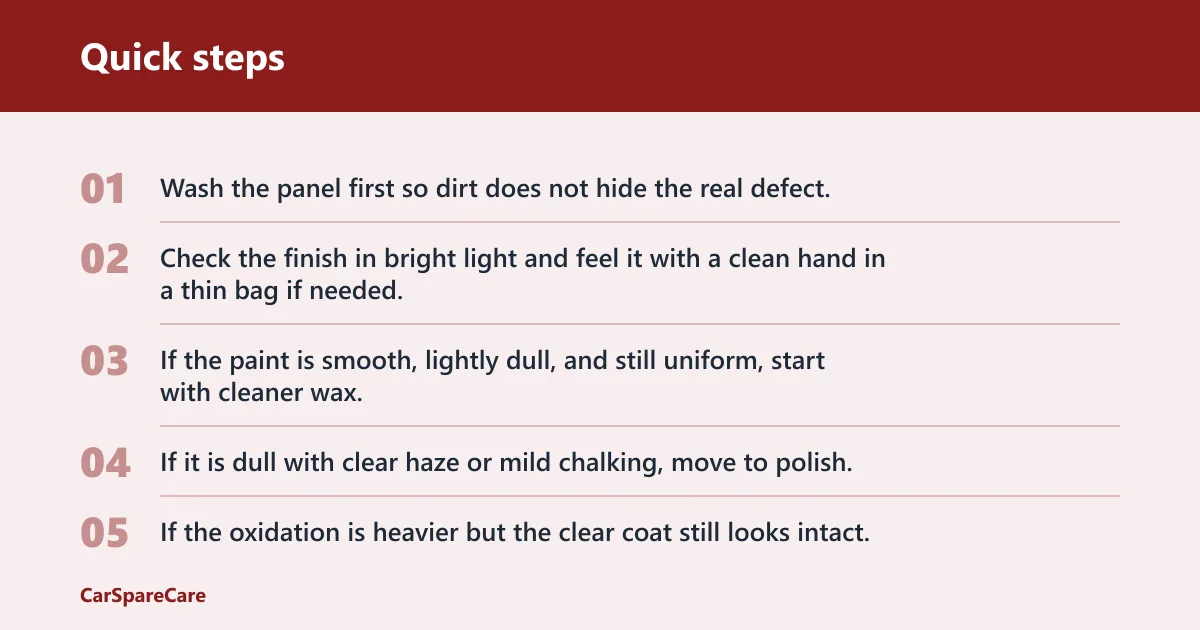
- Wash the panel first so dirt does not hide the real defect.
- Check the finish in bright light and feel it with a clean hand in a thin bag if needed.
- If the paint is smooth, lightly dull, and still uniform, start with cleaner wax.
- If it is dull with clear haze or mild chalking, move to polish.
- If the oxidation is heavier but the clear coat still looks intact, use compound on a test spot first.
- If the surface has white blotches, flaking, or missing clear coat, stop and plan repainting.
- After correction, protect the finish with wax or sealant to slow future oxidation and add gloss.
Clay bar belongs before polishing when the paint has bonded contamination that washing will not remove. It helps restore slickness and clears away embedded grime, but it does not replace a polish when oxidation has actually damaged the top layer. A clay bar removes bonded contamination; it does not correct true oxidation by itself.
What cleaner to use before painting car? Clean the panel first, then remove anything left that would interfere with correction or repaint prep. Before paint work, use a proper wash and decontamination process first, then a prep solvent or panel wipe if the surface is being readied for coating, polishing, or repainting. As a general rule, dish soap is not the go-to paint-prep step because it is inconsistent and can leave you guessing about residue.
What cleans car paint best depends on the problem. For surface grime, a proper car wash soap is enough. For bonded contamination, clay. For oxidation, choose the mildest product that still moves the defect, then protect the paint afterward so UV exposure does not bring the problem back quickly.
Best paint cleaner for oxidized car paint
The best paint cleaner for oxidized car paint is the one that matches the damage level, not the one with the strongest label. For mild oxidation, Meguiar’s Professional Cleaner Wax M06 is the safest first step. For heavier chalkiness, a compound is better. If the clear coat has failed, stop and repaint.
That is why severity matters more than brand hype. A cleaner wax can revive glossy paint with light haze, a polish can recover moderate dullness, and a compound can cut through more weathered top material on intact clear coat. Past that point, correction becomes repaint prep, not restoration.
Frequently asked questions
What removes oxidation from car paint?
Cleaner wax, polish, or compound removes oxidation depending on how severe the damage is. Light oxidation can often be removed with a cleaner wax or proper wash and decontamination prep, while moderate to heavy oxidation usually needs polishing or compounding. If the clear coat is failing, no cleaner will fully restore it.
Is oxidation removable on clear coat?
Yes, if the clear coat is still intact. Light to moderate oxidation on clear coat can often be corrected with cleaner wax, polish, or compound. If the clear coat has turned white, started peeling, or is missing in spots, polishing will not bring back what is gone.
When is oxidized paint too far gone to restore?
It is too far gone when the surface shows white blotches, peeling, flaking, or patchy areas that remain dull after washing, claying, and a careful test spot. Heavy oxidation can be beyond complete restoration, especially when the clear coat has failed and more cutting would only thin what is left.
Should I use a polish, compound, or cleaner wax for oxidation?
Use cleaner wax for light oxidation, polish for moderate oxidation, and compound for heavier oxidation on still-intact clear coat. Cleaner wax is the least aggressive starting point. Compound cuts more than polish, so it should be reserved for cases where milder products cannot restore clarity.

Hi, I’m Melvin, an automobile engineer with extensive experience in automobile equipment. I currently work for a local automobile firm, where I specialize in the car parts industry. I’ve had the opportunity to collaborate with seasoned inspectors, gaining invaluable hands-on experience that goes beyond just theory.
My passion for automotive care started at a young age, which led me to create CarSpareCare. Through CarSpareCare, I share the knowledge and skills I’ve acquired over the years to help others navigate the world of car maintenance and repairs.
My goal is to provide practical tutorials, essential safety advice, and the latest industry insights so that anyone—whether a beginner or an expert—can confidently tackle their automotive projects.

