
Check tread depth at home with a 1/32-inch gauge or a coin. Measure the lowest point on each tire, then replace at 2/32 inch. Treat about 4/32 inch or less as a warning sign for wet grip. Worn tread can lengthen braking distance, raise hydroplaning risk, and hide alignment or suspension problems. Use these at-home checks to read uneven wear and decide when to rotate, monitor, or replace tires.
What you’ll need


- A penny and a quarter
- A tire tread depth gauge that reads in 32nds of an inch or millimeters
- A bright flashlight or work light
- A safe, level parking spot
- A paper towel or rag for wiping grooves clean
How do I check tread depth?
Check the deepest-worn groove on each tire, not the best-looking spot. Use a coin for a quick screen, then confirm with a gauge in the inner, center, and outer grooves. The lowest reading on the tire is the one that matters, because a worn area can make that part of the tire the limiting factor.
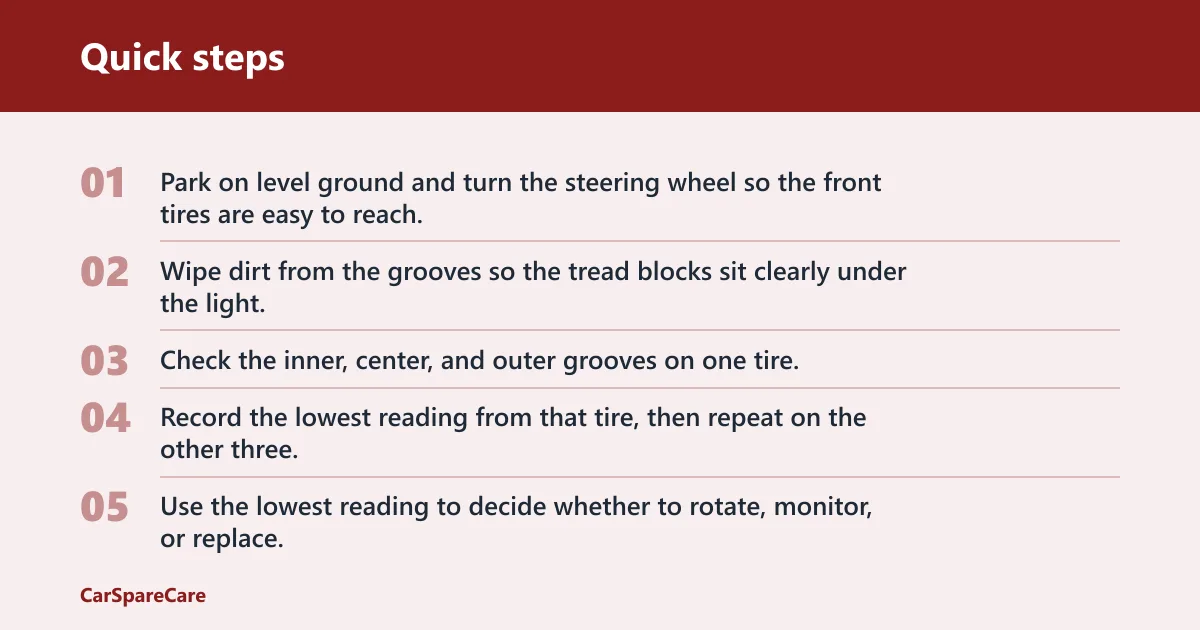
- Park on level ground and turn the steering wheel so the front tires are easy to reach.
- Wipe dirt from the grooves so the tread blocks sit clearly under the light.
- Check the inner, center, and outer grooves on one tire.
- Record the lowest reading from that tire, then repeat on the other three.
- Use the lowest reading to decide whether to rotate, monitor, or replace.
Say your left front tire reads 6/32 in the center groove, but 4/32 on the inner edge. The 4/32 reading is the one to trust, because that groove will lose wet grip first. A gauge makes that difference easy to see.
Read the lowest tread point, not the best spot
Many drivers check only the center groove or only one spot. That can miss edge wear, center wear, or cupping. A tire with one worn shoulder may still show a safe-looking number in the middle, but the weaker groove controls real-world traction. That is why multiple spots matter.
Repeat the check on all four tires
Front and rear tires often wear at different rates. Front tires usually work harder during steering and braking, so they can lose depth sooner. Check all four tires in the same way and compare them. A large gap between tires often points to rotation timing or an underlying wear issue.
How do you measure the lowest tread point?
Measure the lowest tread point by placing the gauge into the groove until the base rests on the tread blocks, then read the number where the plunger stops. Check several grooves across the tread face. The lowest of those readings is the tire’s true useful depth, not the highest number you find.
Use the inner, center, and outer grooves
Look at all three zones across the tread face. Inner-groove wear can come from alignment. Center wear often points to overinflation. Outer-edge wear often points to underinflation or hard cornering. Cupping or scalloping shows up as dips and high spots, which a single center reading can miss.
Check several spots around the tire
Take readings at two or three points around the circumference, especially if the tread looks irregular. A smooth tire should not swing wildly from one reading to the next. A noticeable spread on one tire is a warning to inspect pressure, rotation history, and suspension parts.
Use the lowest reading to decide the next step
If one groove is lower than the rest, follow that lower number. A tire is only as good as its shallowest usable groove. That rule helps you choose between rotation, monitoring, and replacement without guessing from a single coin test or a single center measurement.
How does the penny and quarter test work?
The penny test and quarter test give you a fast visual check when you do not have a gauge. Use Lincoln’s head upside down for the penny and Washington’s head upside down for the quarter. The penny points to 2/32 inch; the quarter is the more cautious 4/32 inch check. (Thedrive)
Penny test for a quick 2/32 inch check
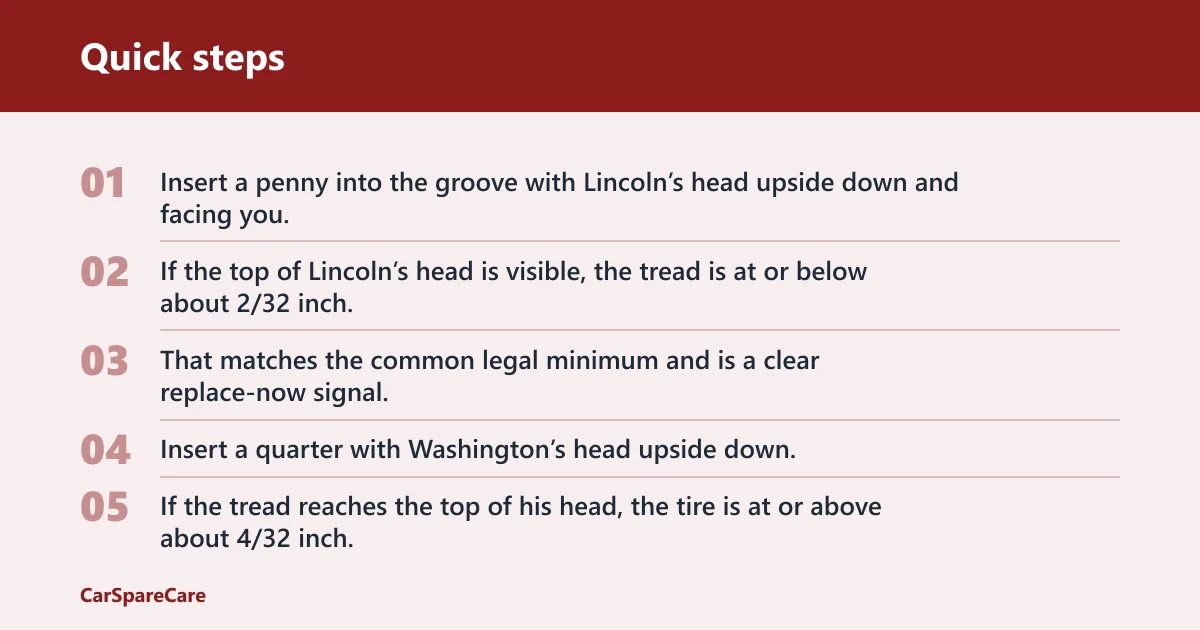
Insert a penny into the groove with Lincoln’s head upside down and facing you. If the top of Lincoln’s head is visible, the tread is at or below about 2/32 inch. That matches the common legal minimum and is a clear replace-now signal.
Quarter test for a more cautious 4/32 inch check
Insert a quarter with Washington’s head upside down. If the tread reaches the top of his head, the tire is at or above about 4/32 inch. If the top of the head is exposed, grip in rain and slush is already falling off, so this is a sensible early-warning check.
When coin tests are useful, and when they are not
Coins are useful for a quick screen, especially when you want a rough answer in seconds. They are not enough when wear is uneven, when winter driving matters, or when two grooves disagree. In those cases, a gauge gives the more dependable number.
Picture a rear tire with one groove at 5/32 and another at 3/32. A penny may still look borderline in one spot, but the 3/32 groove tells you the tire is already below the safer replacement range for wet weather.
How do tread wear bars and gauges compare?
Wear bars and gauges answer different questions. Wear bars tell you when a tire has reached the end of useful tread. A gauge tells you how much depth remains and whether the wear is even. For decision-making, the gauge is better; for a quick warning, the bars are useful.
What flush wear bars mean
Wear bars sit across the grooves. When the surrounding tread is flush with them, the tire is at the wear limit, commonly around 2/32 inch. That is the point where replacement is due. They do not tell you whether the tire is healthy above that line. (Consumerreports)
Why a gauge is more accurate
A tread depth gauge reads in 32nds of an inch or millimeters, so you can compare tires and track wear over time. It also lets you measure more than one groove. That matters because a tire can have good-looking tread in one place and a weak spot in another.
What a numbered system like DSI tells you
Some tires use a numbered indicator system, such as Nokian’s Driving Safety Indicator. The markings help show how much tread remains without a separate tool. A number on the tread is still only a guide, though. You should still check the shallowest groove on the tire.
Tire tread depth decision table
| Lowest tread reading | What it means | What to do next | Failure cause to suspect |
|---|---|---|---|
| 6/32+ inch | Usable depth remains for normal driving, with more room before winter and wet grip fall off. | Keep checking monthly and rotate on schedule. | Normal wear, unless one tire is much lower than the others. |
| 4/32 to 5/32 inch | Still legal in many places, but wet and cold-weather grip is starting to fall away. | Plan replacement soon if you drive in rain, snow, or standing water; rotate if wear is even. | Late rotation, mixed driving, or mild inflation drift. |
| 2/32 to 3/32 inch | Near or at the usual wear limit; braking and hydroplaning resistance are poor. | Replace now. | End-of-life tread wear, possibly made worse by long intervals between checks. |
| Uneven wear | One area is wearing faster than the rest, so the lowest groove controls the decision. | Inspect pressure, rotation history, alignment, and suspension; replace if the lowest spot is too shallow. | Overinflation, underinflation, alignment error, imbalance, or worn suspension parts. |
What does uneven tire wear mean?
Uneven wear means the tread is not disappearing at the same rate across the tire. Center wear often points to too much air pressure. Edge wear often points to too little air pressure. Cupping or scalloping usually suggests balance, alignment, or suspension trouble. The lowest spot still sets the decision.
Center wear and overinflation
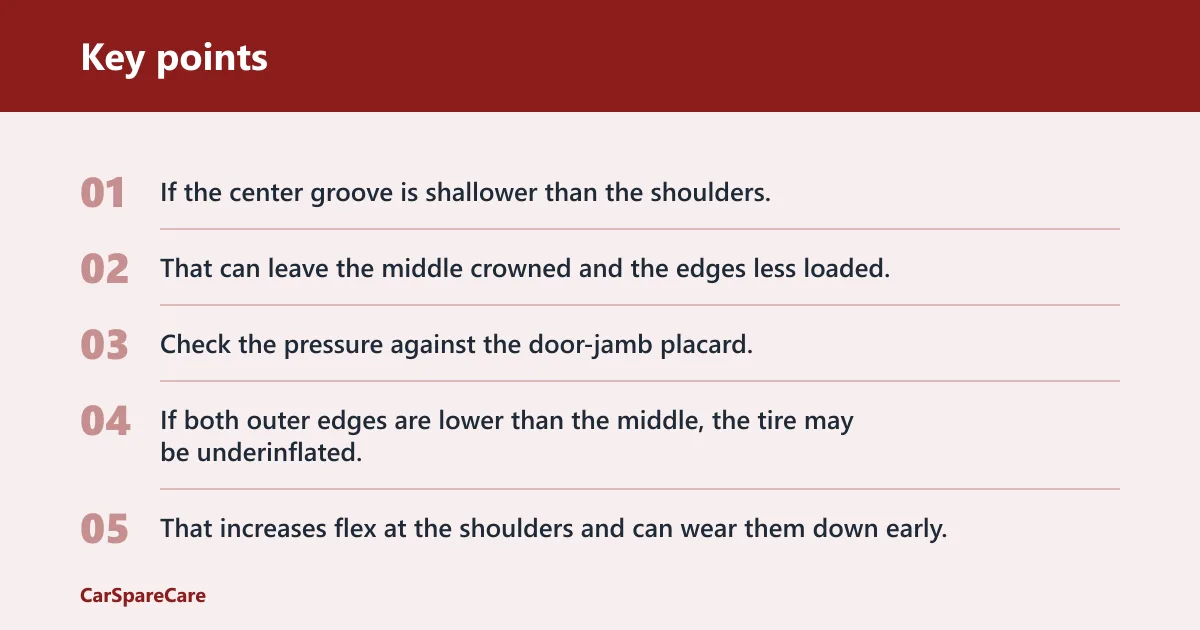
If the center groove is shallower than the shoulders, the tire may be carrying too much pressure. That can leave the middle crowned and the edges less loaded. Check the pressure against the door-jamb placard, then remeasure the tread after correcting it.
Edge wear and underinflation
If both outer edges are lower than the middle, the tire may be underinflated. That increases flex at the shoulders and can wear them down early. Recheck inflation when the tires are cold, then inspect for the same edge pattern on the other tires.
Cupping or scalloping and suspension or balance issues
If the tread shows dips, high spots, or a wavy feel, the tire may be cupping or scalloping. That can come from imbalance or worn suspension parts. A gauge reading can bounce from spot to spot, which is a strong clue that the wear pattern needs a mechanical inspection.
A common first-timer mistake is reading a tire in one shallow spot and ignoring the rest. Suppose a front tire shows 5/32 in the center, but one shoulder is already at 3/32. That tire needs attention based on the 3/32 reading, even if the center still looks acceptable.
How often should you check tire tread?
Check tread once or twice a month and after long trips, curb strikes, or rotation changes. Monthly checks take little time and catch wear before it becomes a surprise. If you drive in heavy rain, snow, or on rough pavement, check more often because depth can fall off in the worst spots first.
When 2/32 is too low for tires
2/32 inch is the common legal minimum and the point where tires should be replaced. It is too low before that if you drive in wet weather often, because wet grip fades earlier. In winter, the practical cutoff is higher, since performance drops before the tire reaches the legal limit.
Why 4/32 matters more in wet and winter driving
At 4/32 inch, a tire may still be legal, but it has less reserve for rain, slush, and snow. New winter tires are often around 10/32 inch, and winter performance can start to drop off before about 5/32 to 6/32 inch. That is why 4/32 is a sensible early-replacement line for cold-weather use.
Frequently asked questions
How do I check tread depth: place a gauge?
Place a gauge into the groove until the base rests on the tread blocks, then read the depth. If you are using a coin, insert it upside down and read how much of the head is exposed. Repeat on all four tires and keep the lowest reading.
What tread depth means I need new tires?
Replace tires at 2/32 inch, which is the common minimum tread limit. For rain and winter use, 4/32 inch is a better warning point, because wet grip drops before the legal minimum. If any one groove is below that level, the tire should be treated as the limiting tire.
Can I check tread depth without a gauge?
Yes. A penny gives a quick 2/32-inch check, and a quarter gives a more cautious 4/32-inch check. These coin tests are useful for a fast screen, but they do not replace a gauge when wear is uneven or when you want to compare tires accurately.
What does uneven tire tread wear mean?
Uneven wear usually points to inflation, alignment, balance, or suspension issues. Center wear often suggests overinflation, edge wear often suggests underinflation, and cupping can point to balance or suspension trouble. The fix starts with the lowest groove, because that spot determines whether the tire is still usable.
When is 2/32 too low for tires?
2/32 inch is already too low for continued use, because it is the common wear limit. If wet roads, snow, or standing water are part of your driving, it is smart to act sooner, around 4/32 inch. At 2/32, replacement should not wait.

Hi, I’m Melvin, an automobile engineer with extensive experience in automobile equipment. I currently work for a local automobile firm, where I specialize in the car parts industry. I’ve had the opportunity to collaborate with seasoned inspectors, gaining invaluable hands-on experience that goes beyond just theory.
My passion for automotive care started at a young age, which led me to create CarSpareCare. Through CarSpareCare, I share the knowledge and skills I’ve acquired over the years to help others navigate the world of car maintenance and repairs.
My goal is to provide practical tutorials, essential safety advice, and the latest industry insights so that anyone—whether a beginner or an expert—can confidently tackle their automotive projects.

