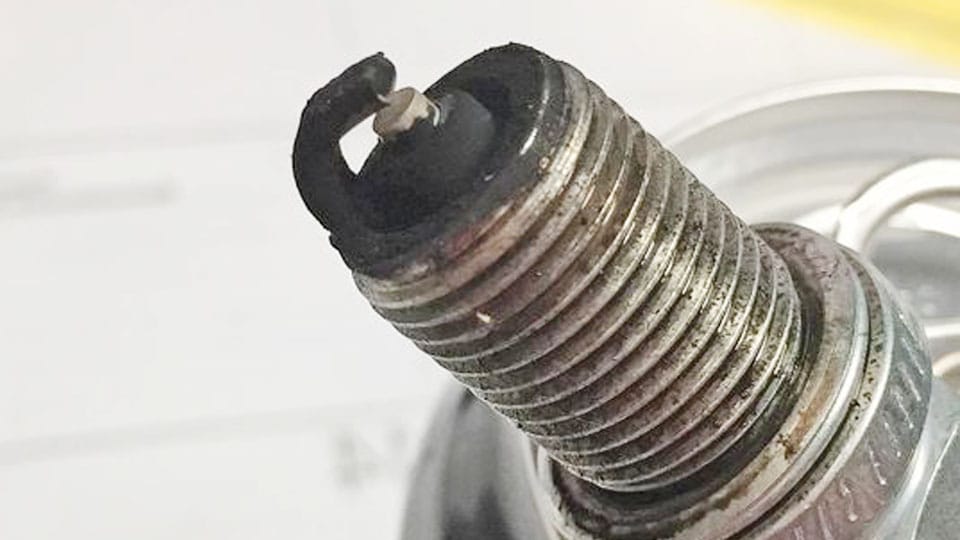
Common spark plug socket sizes include 5/8 inch, 13/16 inch, and 14 mm, but the right choice depends on the plug’s hex and the engine’s packaging. Spark plug sockets fit the hex flats on the plug body, not the thread diameter, and a socket that is too thick or too short can round the plug or fail to seat fully. This guide starts with identification first, then shows how clearance, depth, and retention style affect the final choice.
Quick answer
Match the socket to the plug hex, then check whether the well is recessed or cramped. In most passenger cars, 5/8 inch is a common starting point; older American engines often use 13/16 inch; many newer engines use 14 mm. Use thin-wall sockets for tight plug tubes and deep-well sockets when the plug sits far down in the head.
| Engine family | Typical plug hex | Socket size to try | Thin-wall or deep-well need | If the socket slips, check this next |
|---|---|---|---|---|
| Modern passenger cars | 5/8 inch, often listed around 15.9 mm | 5/8 inch | Deep-well is often needed; thin-wall helps if the plug tube is narrow | Confirm the hex, then check whether the socket wall is too thick for the tube |
| Older American cars and trucks | 13/16 inch, about 20.6 mm | 13/16 inch | Deep-well often needed; thin-wall if accessories crowd the bay | Verify the plug is truly 13/16 inch and not a smaller hex with a deep recess |
| Newer Asian cars | 14 mm | 14 mm | Thin-wall is often needed; deep-well if the plug is recessed | Measure the hex or compare the removed plug before assuming 5/8 inch will fit |
| Ford and BMW/Mini applications, some engines | Application-specific; often 14 mm on certain engines | 14 mm | Thin-wall if access is cramped; deep-well if the plug is sunk into the head | Check the owner’s manual and the removed plug instead of relying on the badge alone |
| Small engines like lawnmowers | 3/4 inch, 19 mm | 3/4 inch | Deep-well depends on the engine design | Confirm you are working on a small-engine plug, not a car plug with a similar reach |
| Loose plug in hand, size unknown | Match by hex | Match the socket to the measured flats | Choose deep-well if the plug body is long; thin-wall if the well is tight | Measure across the hex, then confirm the plug specification in the owner’s manual |
What size socket do you need for spark plugs?
Start with the plug hex, not the thread size. A spark plug socket grips the hex flats on the plug body, while the thread diameter belongs to the portion that screws into the cylinder head. The same engine family can also need a deep-well or thin-wall socket if the plug sits far down in a recessed tube.
When 5/8 inch is the default choice
Use 5/8 inch when the plug hex is 5/8 inch across the flats. It is one of the most common spark plug socket sizes for modern passenger cars, and it is roughly 15.9 mm, not a separate 14 mm fit. If the socket feels tight, the well may be narrow rather than the size being wrong.
When 13/16 inch is the better match
Use 13/16 inch when the plug hex is larger, which is common on older American cars and trucks. The size is roughly 20.6 mm, and the exact fit should still be checked against the removed plug or service literature rather than a retail label alone. A socket that is close in feel can still slip under load.
When 14 mm is the better match
Use 14 mm only when the plug hex is actually 14 mm across the flats. Many newer engines use this size, but not every model in a brand family does. That is why the owner’s manual and the removed plug matter more than the vehicle badge. A 14 mm socket is not interchangeable with 5/8 inch.
Say a removed plug measures 13/16 inch across the hex and the engine has a deep plug tunnel. A 5/8-inch socket may feel close enough to start, then slip under load and mark the flats. The correct 13/16-inch deep-well socket avoids that problem and reaches the plug without extra extension gymnastics.
Quick comparison
| Product | Badge | Best for | Price | ||
|---|---|---|---|---|---|
 | Salior 5/8" Magnetic Spark Plug Socket,6-Point 3/8" DriveSalior | Our pick | 5/8-inch · magnetic · thin-wall | $6.49 Price as of 6 Nov 2026 | View |
 | 13/16-inch Magnetic Spark Plug Socket 3/8-inch Drive 6-PointA ABIGAIL | Also great | 13/16-inch · magnetic · thin-wall | $9.99 Price as of 6 Nov 2026 | View |
 | QWORK 14mm&16mm Magnetic Swivel Spark Plug SocketQWORK | Pair with it | 14mm/16mm · swivel · magnetic | $8.45 Price as of 6 Nov 2026 | View |
 | TecoTek 7 Piece 3/8-Inch Drive Magnetic Swivel Spark PlugTecoTek | Also great | 7-piece · 3/8-inch drive · magnetic | $28.47 Price as of 6 Nov 2026 | View |
For most modern passenger cars, start with 5/8 inch or 14 mm, then confirm the exact hex in the owner’s manual or on the removed plug. If the well is tight, choose thin-wall; if the plug sits deep, choose deep-well, and if you are working from a loose plug, match the hex before buying anything else.
How we chose
The size-first approach here uses four checks: common hex size, engine-family fit, clearance in the plug well, and retention style. That matters because socket size, plug hex size, and thread size are often mixed together on shopping pages.
Also keep the recommendations tied to the most common actual use cases: modern passenger cars, older American cars and trucks, and newer Asian cars. Where fit becomes uncertain, the article points you back to the owner’s manual or the plug itself.
Finally, the guidance separates depth from diameter. A socket can be the right size and still fail if it is too short, too thick-walled, or unable to hold a recessed plug securely.
5/8-inch spark plug socket: best for modern cars
A 5/8-inch spark plug socket is the best starting point for many modern passenger cars because it matches one of the most common hex sizes on current plugs. The Salior socket shown here uses a magnetic hold and thin-wall, deep-well construction, which makes it a practical choice when the plug well is recessed and narrow.
This size suits DIY owners who need a compact socket for newer vehicles and want a single tool that works with common 3/8-inch-drive ratchets. It is especially useful when the plug sits deep in the cylinder head and a standard socket feels bulky or hard to align.
The drawback is simple: 5/8 inch is common, not universal. If your engine uses 13/16 inch, 14 mm, or another hex, this socket will not solve the fit problem, and a magnetic tip cannot make the wrong size grab correctly.
13/16-inch spark plug socket: best for older American engines
A 13/16-inch spark plug socket is the safer match for larger plug hexes, which are common on older American cars and trucks. Based on the listed specs, this A ABIGAIL socket also uses a magnetic hold and thin-wall form, which helps when the plug sits deep and the well is narrow.
This is the better choice if the removed plug already measured 13/16 inch or if the owner’s manual calls for that size. It is also a sensible option when you expect deeper access, since spark plugs often sit far down in the cylinder head and a short socket can make the extension stack awkward.
The drawback is size specificity. A 13/16-inch socket can be the right answer on one engine and the wrong one on the next, so confirm the hex instead of relying on a rough equivalence.
14mm thin-wall spark plug socket: best for tight wells
A 14 mm spark plug socket is the correct choice when the plug hex is actually 14 mm across the flats, which is common on some newer engines. This QWORK set is useful because it includes both 14 mm and 16 mm options, plus swivel and magnetic features for awkward access.
It fits readers who are unsure whether the engine needs 14 mm or 16 mm and want one compact set that covers both possibilities. The rotating head can help in crowded bays where the ratchet handle cannot line up cleanly with the plug well.
The drawback is that a multi-size set can hide the exact match if you do not verify first. The wrong insert may still go on a few turns and then slip, so this is best used after you confirm the plug hex or compare the removed plug to the socket opening.
Suppose a newer sedan uses 14 mm plugs and the wells are narrow. A standard-wall socket may fit the hex but still rub the tube walls before it seats fully, which makes removal awkward and reinstallation even riskier. A thin-wall 14 mm socket gives you the clearance you need without forcing the tool against the plug tube.
Mixed-size spark plug socket set: best for one-box coverage
A mixed-size set makes sense if you service more than one vehicle and do not want to guess between 9/16 inch, 5/8 inch, 13/16 inch, and 14 mm. TecoTek’s set covers those common sizes and adds both 6-point and 12-point options, along with swivel and magnetic retention.
This is the best fit for someone who wants one purchase to cover a small garage, a family fleet, or a mix of older and newer engines. The thin-wall and swivel features also help when plug access changes from one vehicle to the next.
The drawback is that sets often include sizes you will never use, and more parts can mean more confusion in the tool drawer. If you only service one engine, a single matched socket is usually simpler and cheaper.
What should you buy?
Buy a 5/8-inch socket first if you service a modern passenger car and want the most common starting point. That size covers many standard plugs, and the magnetic or rubber-retained deep-well versions are usually the easiest for DIY work.
If you only service one engine, match the socket to the plug hex you already know. A single 13/16-inch or 14 mm socket is better than a broad guess, especially when the plug wells are recessed or the engine bay leaves little working room.
If you work across mixed vehicles, a small set is smarter than buying one size at a time. A set with 5/8 inch, 13/16 inch, 9/16 inch, and 14 mm covers most of the common cases discussed here, but you still need to check depth and wall thickness before installation day.
Should the socket have a rubber insert or a magnet? Either can help. A rubber insert grips the plug well enough for many removals, while a magnet is often better when the plug has to come out of a deep tube and you want to avoid dropping it onto the head or frame rail.
A torque wrench matters for installation. Spark plugs can be damaged by under-tightening or over-tightening, and the wrong socket size can make torque feel wrong even before the plug is seated. Use the owner’s manual to confirm both the plug type and the tightening spec, then tighten only after the threads start by hand.
How do I find the exact spark plug socket size for my engine?
The fastest way is to check the owner’s manual, then confirm the hex on the removed plug if you already have one out. If the manual is missing, measure across the flats of the plug hex and compare that reading to the socket opening, because the thread size is not the number you are trying to match.
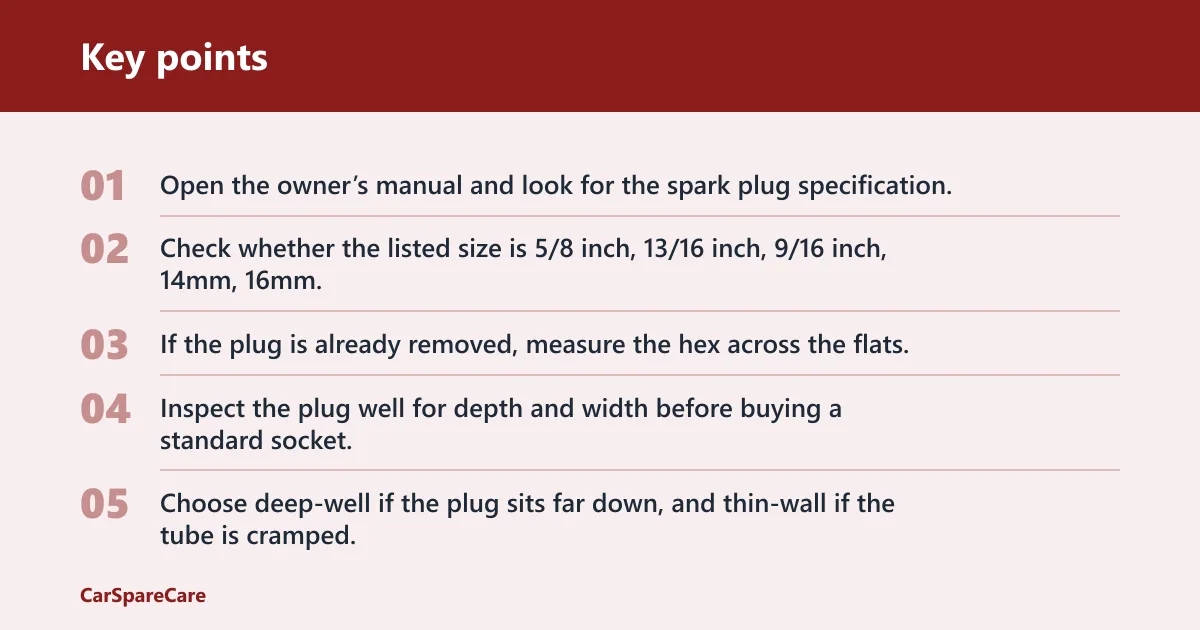
- Open the owner’s manual and look for the spark plug specification.
- Check whether the listed size is 5/8 inch, 13/16 inch, 9/16 inch, 14mm, 16mm, or 20mm/21mm wording.
- If the plug is already removed, measure the hex across the flats.
- Inspect the plug well for depth and width before buying a standard socket.
- Choose deep-well if the plug sits far down, and thin-wall if the tube is cramped.
- Use a torque wrench on installation so the new plug seats to spec.
A common first-timer mistake is assuming every 14 mm plug socket fits the same, when a compact four-cylinder may need a thinner wall to clear the plug well. A 14 mm spark plug in one Ford engine does not mean every Ford uses 14 mm, and a 5/8-inch socket will not rescue a 13/16-inch plug that is already half rounded. Verification takes less time than repairing stripped flats.
What happens if I use the wrong spark plug socket size?
The wrong socket can slip, round the plug hex, crack the porcelain insulator, or leave you unable to reach the plug cleanly. Even when the socket seems close, a poor fit can waste time, distort torque feel, and make removal harder than the original job should have been.
If the socket feels loose, check the hex size first, then check wall thickness and depth. A socket that matches the size on paper can still fail if its walls are too thick for the plug tube or if the plug sits too deep for the socket to seat fully.
Frequently asked questions
Is 5/8 inch the most common spark plug socket size?
Yes, 5/8 inch is one of the most common spark plug socket sizes for modern passenger cars. It is roughly 15.9 mm, which is why 5/8 inch and 14 mm should not be treated as interchangeable. It is common, but not universal, so the owner’s manual or the removed plug should still confirm the fit.
What spark plug socket size do newer Asian cars use?
Many newer Asian cars use 14 mm spark plug hexes, but that is not a blanket rule for every model. Some engines may instead use 5/8 inch or another size. Confirm the exact size in the owner’s manual or by measuring the plug hex before you buy.
Do Ford engines use a 14 mm spark plug socket?
Some Ford applications do use 14 mm spark plug hexes, but not every Ford engine does. That is why size should be confirmed by engine family and manual, not by the badge alone. If access is tight, a thin-wall 14 mm socket may also be needed.
What size socket fits older American V8 spark plugs?
Older American V8s often use 13/16 inch spark plug sockets. That size is common on larger plugs, and competitor wording may describe it as about 20.6 mm. Still, you should verify the plug hex, because engine swaps, replacement heads, and mixed parts can change the requirement.
Do I need a deep well spark plug socket?
Most spark plug jobs benefit from a deep-well socket because plugs often sit deep in the cylinder head. A standard-length socket may not reach far enough to seat fully on the hex. If the plug is recessed, deep-well is the safer choice, especially with a long extension.
Should spark plug sockets have a rubber insert or magnet?
Either feature can help hold the plug during removal and installation. A rubber insert is common, while a magnet can be easier when the plug is deep in the well. The better choice depends on access, but both are useful if you want to avoid dropping the plug into the engine bay.
Sources
Common size conventions in this guide reflect spark plug and socket maker specifications and vehicle service literature that distinguish plug hex size from thread diameter. For fit guidance and tightening specs, check the relevant owner’s manual or service information for the exact engine and plug part number before purchasing a socket.

Hi, I’m Melvin, an automobile engineer with extensive experience in automobile equipment. I currently work for a local automobile firm, where I specialize in the car parts industry. I’ve had the opportunity to collaborate with seasoned inspectors, gaining invaluable hands-on experience that goes beyond just theory.
My passion for automotive care started at a young age, which led me to create CarSpareCare. Through CarSpareCare, I share the knowledge and skills I’ve acquired over the years to help others navigate the world of car maintenance and repairs.
My goal is to provide practical tutorials, essential safety advice, and the latest industry insights so that anyone—whether a beginner or an expert—can confidently tackle their automotive projects.