Replace a spare wheel tyre if it is cracked, damaged, below the legal tread limit of 1.6 mm across the central three-quarters of the tread, or old enough that the rubber may have degraded in storage; many tyre makers and safety bodies advise extra caution from about 6–10 years, even if tread remains (UK legal minimum tread depth: 1.6 mm; age guidance varies by manufacturer and tyre condition). Check space-saver pressure, wheel condition, and the vehicle handbook before use. A bad spare can leave you stranded or make a simple puncture unsafe. This guide explains full-size and compact spares, plus when to replace the wheel or tyre.
What is a spare wheel?


A spare wheel is an extra wheel and tyre kept for emergency use after a puncture, blowout, or other tyre damage. Some cars carry a full-size spare that matches the road wheels, while others use a compact space-saver that is smaller and meant only for temporary use.
Some spares sit under the boot floor or in the boot itself. That storage position keeps the wheel out of sight, but it also means you need to check it before an emergency exposes any age, pressure, or corrosion problem.
Full-size spare versus compact spare
A full-size spare is easier to treat like a normal road wheel, but it still needs inspection. A compact spare tyre has a shorter tread life than a regular-size tyre, and the replacement compact spare must be the same size and design as the original. If you are replacing the compact unit, match the wheel and tyre assembly exactly to the vehicle’s temporary spare specification.
That matters because a space-saver wheel is smaller and lighter than a regular wheel. It is made for limited use, not as a permanent substitute for a damaged road tyre.
Where spare wheels are usually stored
Spare tyres are often stored underneath the floor panel in the boot. That location protects them, but it also hides cracks, pressure loss, and corrosion until you lift the floor and check. If your car has no hidden spare, it may carry a repair kit or use run-flat tyres instead.
Does my car have a spare wheel?
Check the boot floor, the handbook, and any tyre pressure label or emergency-equipment storage area. If you find a full-size wheel, a compact space-saver, or a tyre repair kit, that tells you what the car was supplied with. If nothing is there, the car may rely on run-flat tyres or roadside assistance instead.
Do all cars have a spare wheel?
No. Some cars have a spare wheel, some carry a tyre repair kit, and some rely on run-flat tyres. Newer cars often omit a spare because makers want more boot space, lower weight, or a different emergency setup. You need to check what your car actually carries.
Cars with repair kits instead
A tyre repair kit usually contains sealant and an inflator pack. It is meant as a temporary measure, and whether the tyre can later be repaired or must be replaced depends on the damage type, where the puncture is, and the vehicle or kit maker’s guidance. It does not suit every puncture, especially if the damage is large or on the sidewall.
Cars with run-flat tyres
Run-flat tyres have reinforced sidewalls. They let you drive on for a short period at reduced speed after a puncture, which can remove the need for a spare on some cars. Some run-flat-equipped cars still include a repair kit, so do not assume the boot is empty just because the tyres are run-flats. Always follow the vehicle handbook and the tyre maker’s instructions for speed, distance, and repairability.
Why some new cars omit a spare
There is a trade-off. A spare wheel takes boot space and adds weight. A repair kit is lighter and simpler to package. That does not make the kit a full replacement for a spare wheel. It just means the car uses a different emergency plan.
Is a spare wheel a legal requirement?
Usually, no. In many places, including the UK, there is no general legal requirement to carry a spare wheel, as long as the car remains roadworthy and any alternative system is suitable for the vehicle. What matters is that the car has a safe, lawful way to deal with a puncture and that any fitted tyre meets the legal tread and condition rules. Check local rules if you drive outside your home country.
Spare wheel checklist
Use this check before you need the spare on the roadside. It is easier to spot a problem in the driveway than in the rain, after a puncture, with traffic passing close by. A good pass/fail rule is simple: if the spare fails tread, age, pressure, or condition checks, do not use it and call assistance or arrange a tyre replacement.
| Spare type | Visible checks | Replacement trigger | Next action |
|---|---|---|---|
| Full-size spare | Tread depth, sidewall cracks, cuts, bulges, corrosion, pressure, valve cap, wheel damage | Below 1.6 mm tread, visible cracking, bulge, major corrosion, bent wheel, or pressure loss that returns after inflation | Replace or have a tyre specialist inspect before relying on it |
| Compact space-saver | Tread wear indicator bars, sidewall cracks, correct pressure, matching spare wheel design, tyre age | Indicator bars are visible, the tyre is damaged, or the spare no longer matches the original compact design | Replace with the same size and design, mounted on the same compact spare tire wheel |
| Kit-only car | Sealant expiry date, canister condition, inflator hose, power lead, adapter, instructions | Missing equipment, expired sealant, damaged hose, empty canister, or a puncture the kit cannot seal | Replace the kit parts and arrange professional tyre inspection |
Age check: date code and DOT marking
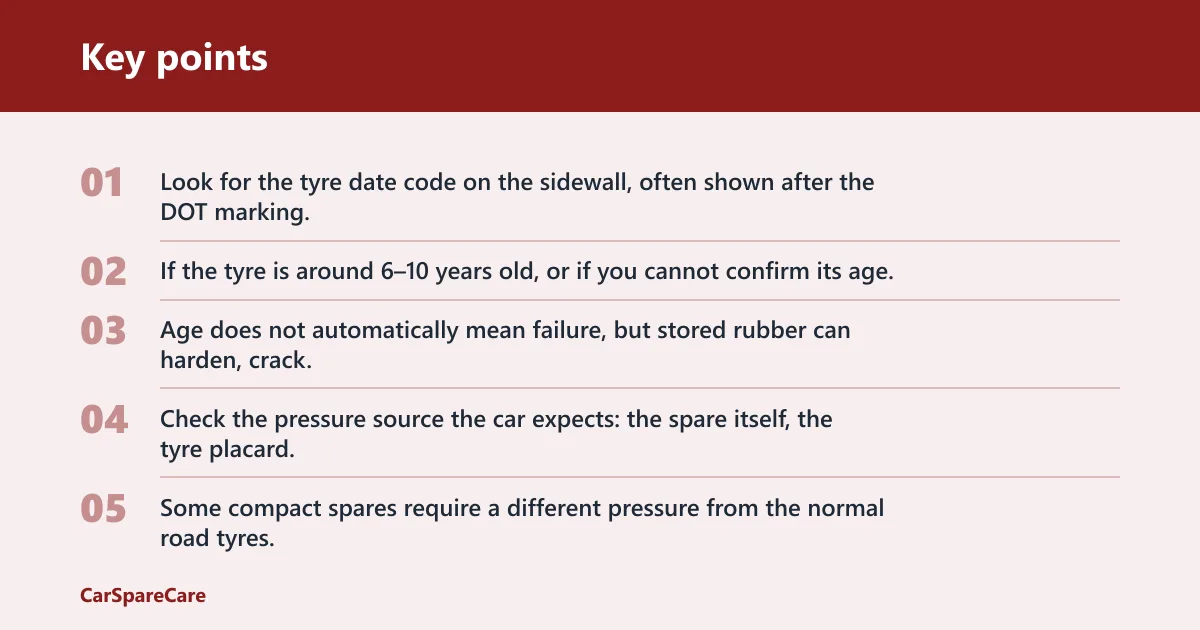
Look for the tyre date code on the sidewall, often shown after the DOT marking. If the tyre is around 6–10 years old, or if you cannot confirm its age, treat it as suspect and inspect it closely before use. Age does not automatically mean failure, but stored rubber can harden, crack, or lose reliability even when the tread looks usable.
Pressure source label
Check the pressure source the car expects: the spare itself, the tyre placard, or the owner’s handbook. Some compact spares require a different pressure from the normal road tyres, so do not assume the main tyre pressures apply. Inflate only to the listed spare or temporary-use figure.
Speed symbol on space-savers
Check the space-saver sidewall for any speed restriction marking or temporary-use information, and then follow the handbook’s lower limit if the two differ. Many temporary spares are intended for reduced-speed driving only, so the speed symbol and vehicle instructions matter just as much as tread depth.
When should you replace a spare wheel?
Replace a spare wheel tyre when the tyre is worn, damaged, or no longer safe to fit. For a compact spare, visible tread wear indicator bars are a clear replacement trigger. For any spare, sidewall cracks, cuts, bulges, or a wheel that no longer holds air mean it should not be trusted in an emergency.
Tread wear and visible indicators
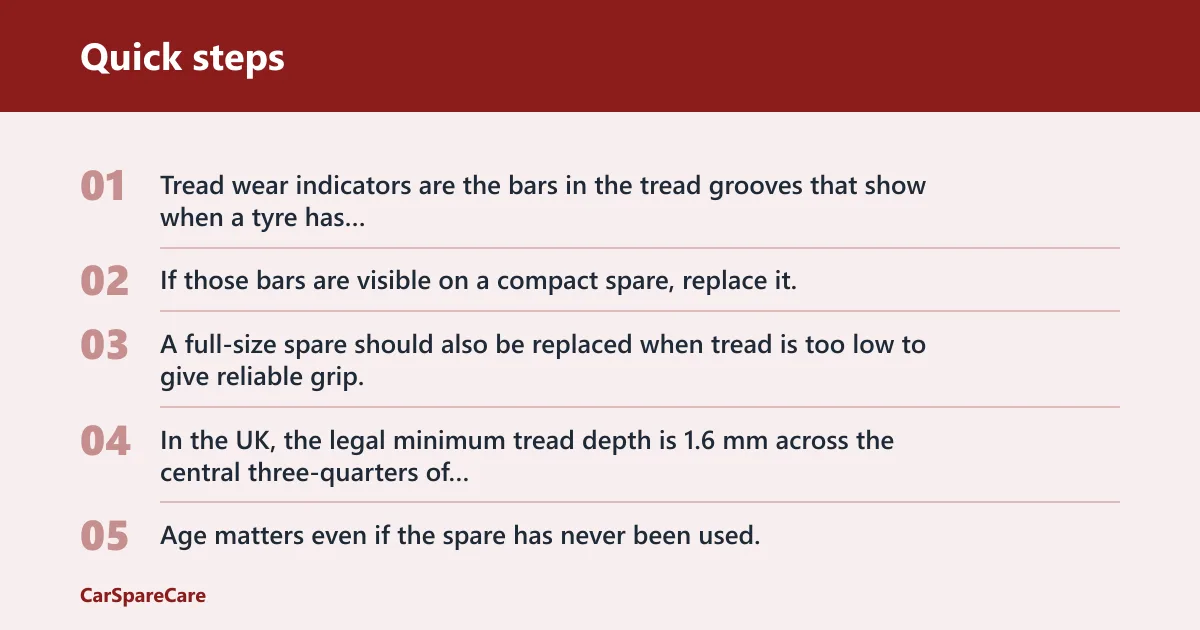
Tread wear indicators are the bars in the tread grooves that show when a tyre has reached its wear limit. If those bars are visible on a compact spare, replace it. A full-size spare should also be replaced when tread is too low to give reliable grip. In the UK, the legal minimum tread depth is 1.6 mm across the central three-quarters of the tread around the entire circumference, not just in one spot.
Age and storage damage
Age matters even if the spare has never been used. Rubber degrades in storage, so a tyre that looks fine from a distance can still be unsafe. Many tyre manufacturers and safety groups advise extra caution once a tyre is around 6–10 years old, even if tread remains, because age-related cracking and hardening can reduce reliability.
Suppose your boot-mounted spare is dry, unused, and still has good tread, but the sidewall shows shallow cracking around the lettering. That is enough reason to replace it or have a tyre specialist inspect it, because storage ageing can weaken the tyre long before the tread disappears.
Pressure loss and corrosion
A spare tyre’s pressure should be checked regularly. If it repeatedly loses pressure, the valve, bead, or wheel may be at fault. Corrosion on the wheel rim can also prevent proper sealing, especially on a spare that has sat unused for years.
Mismatched fitment or missing equipment
A spare is only useful if it fits the car and the wheel-changing gear is present. If the spare does not match the required design, or the jack, locking wheel nut, wheel wedges, or gloves are missing, the emergency setup is incomplete. Fix that before you need it.
Why is a spare wheel smaller than the others?
A compact spare is smaller so it takes less boot space, weighs less, and costs less to package into the car. The trade-off is that it is only for temporary use, usually with lower speed and distance limits than a normal tyre. Its smaller size is a design compromise, not a sign that the car needs “less” safety.
How do you know a compact spare is unsafe?
A compact spare becomes unsafe when its tread wear bars are visible, the tyre shows cracking or bulges, the wheel is damaged, or the pressure is wrong. It is also unsafe if it no longer matches the original compact spare design, because that design sets its use limits and fitment.
Visible tread wear bars
The clearest sign is the wear indicator bars in the tread grooves. If they are flush with the tread, the compact spare has reached its limit. Do not save it for “just one more emergency.” Replace it first.
Cracks, bulges, or wheel corrosion
Check the sidewall and bead area carefully. Cracks, cuts, or bulges can fail under load. Corrosion on the wheel itself matters too, because a damaged rim may not hold air properly or may seat badly when fitted to the car.
Incorrect pressure
Pressure loss is common on unused spares. Low pressure reduces stability and can make the temporary tyre more vulnerable to damage. Inflate it to the pressure listed for the spare or temporary wheel setup, then recheck it regularly.
Design limits no longer match
The replacement compact spare must be the same size and design as the original. If someone fitted a different compact wheel, or the tyre no longer matches the supplied spare wheel design, it should not be treated as a proper spare. That mismatch can affect fitment and safe use.
How should you use a spare wheel safely?
Use a spare wheel only within its intended limits. Check the spare before fitting it, follow the car’s temporary-use speed and distance rules, and get the damaged tyre inspected as soon as possible. A spare buys time. It does not remove the need for a proper repair or replacement.
Speed and distance limits
A space-saver wheel is meant only for temporary use. Many manufacturers set limits around 50 mph/80 km/h and about 50 miles/80 km or similar, but the exact figure depends on the vehicle and spare type, so check the handbook and the sidewall marking before driving. Keep the journey short and the speed low, then move on to a full repair or replacement.
Before you fit the spare
- Check the spare for tread, cracks, bulges, and corrosion.
- Confirm the pressure is correct.
- Make sure the wheel matches the car’s temporary-use specification.
- Inspect the damaged tyre for sidewall cuts or other major damage.
- Fit the spare only if the setup is safe and complete.
When not to use it
Do not use the spare and call assistance if the tyre has a sidewall split, the wheel is bent, the spare will not hold air, the pressure or speed information is missing, or the car’s temporary-use instructions cannot be confirmed. In those cases, forcing the spare into service can make the breakdown worse.
When to visit a tyre specialist
Visit a tyre specialist if the puncture damaged the sidewall, if the wheel and tyre types do not match, or if you are considering a switch between run-flats, standard tyres, or a different spare setup. A specialist can also tell you whether a punctured tyre can be repaired or must be replaced.
Wheel-changing equipment and repair kits
Changing a wheel is physically demanding and requires the right tools. You should have a tyre jack, locking wheel nut tool if fitted, wheel wedges, and gloves. Without them, even a simple puncture can become a roadside problem.
Jack, locking wheel nut, wedges, and gloves
The jack lifts the car. The locking wheel nut tool removes security nuts. Wheel wedges help stop the car from rolling, and gloves protect your hands from grime and sharp edges. Keep these items with the spare, not buried somewhere else in the boot.
What repair kits can and cannot fix
A repair kit helps with some punctures, but not all. Because it uses sealant and an inflator pack, it is best treated as a short-term measure. Depending on the damage and the manufacturer’s guidance, a tyre treated with sealant may be repairable later or may need replacement. It will not fix every tyre damage pattern, especially if the puncture is large or on the sidewall.
A common first-timer mistake is to assume the sealant has “fixed” the tyre for good. It has not. The tyre still needs inspection, and in many cases replacement, before it can be trusted for everyday driving.
Frequently asked questions
When should a spare tire be replaced?
Replace a spare tire when the tread is worn out, the sidewall is cracked or cut, the wheel is damaged, or the pressure will not hold. For a compact spare, visible tread wear indicator bars are the clearest replacement sign. Age alone can also make an unused spare unsafe.
Should you carry a spare wheel?
If your car has space for one, carrying a spare wheel can make a puncture easier to deal with than relying on a kit alone. But some cars are designed without one and use repair kits or run-flat tyres instead. The right answer depends on the car’s original equipment and your driving needs.
How do you fit a spare wheel?
Park safely, apply the handbrake, use wheel wedges, loosen the wheel nuts, jack the car at the correct lift point, fit the spare, and tighten the nuts in the proper pattern. Then check the pressure and drive only within the temporary-use limits if it is a space-saver.
Why don’t new cars have spare wheels?
Many new cars leave out the spare wheel to save weight, free up boot space, or pair the car with run-flat tyres or a repair kit. That choice does not mean a spare is unnecessary in every case. It means the manufacturer has chosen a different emergency setup.
What size spare wheel do I need?
You need the spare size specified for your car, not a random wheel that happens to fit over the hub. For a compact spare, the replacement must be the same size and design as the original. If you are unsure, check the handbook or ask a tyre specialist before buying one.
Where to buy a spare wheel?
Buy a spare wheel from a tyre specialist, a main dealer, or a reputable parts supplier that can match the exact design and fitment for your car. Make sure you know whether you need a full-size spare, a compact space-saver, or the correct wheel to match an existing temporary setup.

Hi, I’m Melvin, an automobile engineer with extensive experience in automobile equipment. I currently work for a local automobile firm, where I specialize in the car parts industry. I’ve had the opportunity to collaborate with seasoned inspectors, gaining invaluable hands-on experience that goes beyond just theory.
My passion for automotive care started at a young age, which led me to create CarSpareCare. Through CarSpareCare, I share the knowledge and skills I’ve acquired over the years to help others navigate the world of car maintenance and repairs.
My goal is to provide practical tutorials, essential safety advice, and the latest industry insights so that anyone—whether a beginner or an expert—can confidently tackle their automotive projects.