
Wash, decontaminate, and dry the paint first. Then apply a thin, even layer of sealant with a clean applicator, let it cure for the product’s stated time, and buff off residue before water or dust reaches the finish. Skip prep or rush cure time, and the sealant can streak, bond poorly, or leave high spots that are harder to remove later. This guide gives the prep order, application steps, cure timing, and fixes for the most common first-time mistakes. Industry guidance and product labels commonly place sealant durability anywhere from about 3 months to 12 months, with real-world results affected by climate, parking, and wash habits (Consumer Reports; product manufacturer application guides).
What paint sealant does
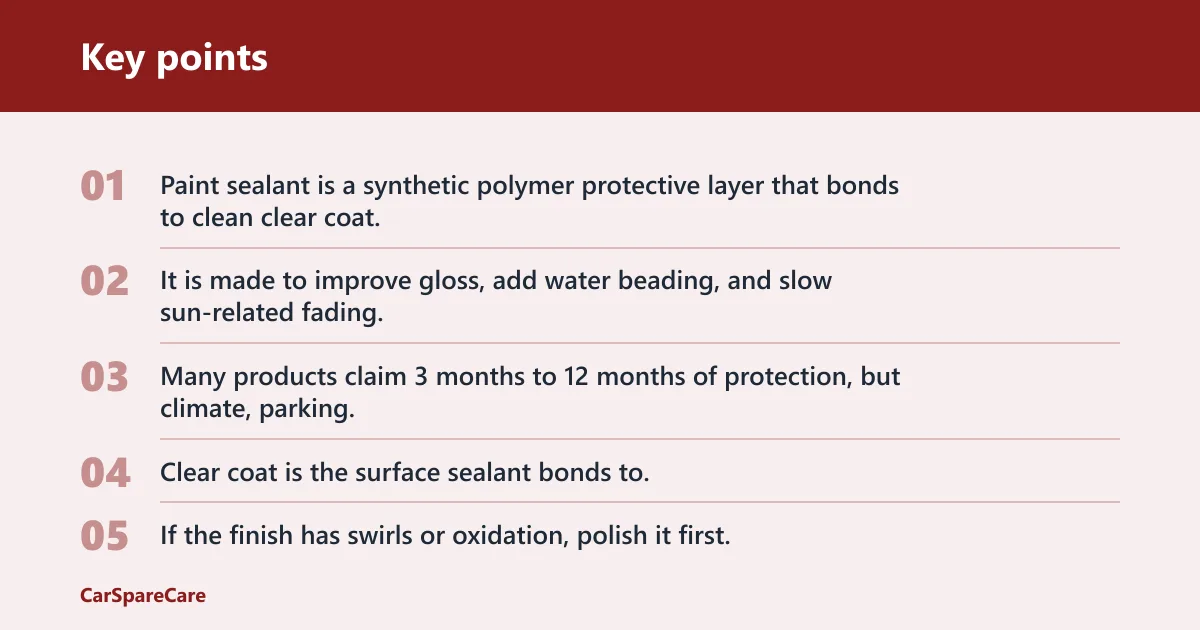


Paint sealant is a synthetic polymer protective layer that bonds to clean clear coat. It is made to improve gloss, add water beading, and slow sun-related fading. Many products claim 3 months to 12 months of protection, but climate, parking, and wash method change how long it actually lasts (consumer product labeling and detailing manufacturer guidance).
Clear coat is the surface sealant bonds to, so it needs to be clean and decontaminated before application. If the finish has swirls or oxidation, polish it first. A polished surface usually gives better bonding and clearer gloss than a tired, rough panel.
Sealants are not natural waxes. Their chemistry is usually based on synthetic polymers, while some products are marketed as silica-infused or SiO2-adjacent with stronger beading and longer-life claims. Those hydrophobic effects help water bead and sheet, but they do not make the paint impervious to mineral spotting, bird droppings, or UV exposure, especially once the surface is dirty or the layer has aged (AAA; EPA consumer care guidance; manufacturer technical sheets).
What you’ll need
- Wash soap and a rinse setup
- Clay bar and clay lubricant
- Microfiber towels for drying and buff-off
- At least two clean microfiber towels if you use a spray sealant
- Foam applicator pad for hand application
- Sealant product in the format you chose: spray, liquid, paste, WOWA, or Wipe On Wipe Off
- Optional dual-action polisher and finishing pad for larger panels
- Separate towels for trim and wheel-adjacent edges if the product tends to stain
Do you need to clay bar first?
Yes, if the paint feels rough after washing or if you can feel bonded contamination. Clay barring removes particles that washing leaves behind, and those particles can block adhesion on a bond-critical product like sealant. If the surface already feels slick and clean, you may still proceed, but roughness is a clear sign to clay first.
Polish first if swirls or oxidation are visible. Sealant will not hide damaged clear coat well, and a thin polymer layer can lock in the look of that damage. If a black hood looks dull under direct light and feels gritty after washing, clay removes the grit, but polish corrects the finish before sealing.
Prep
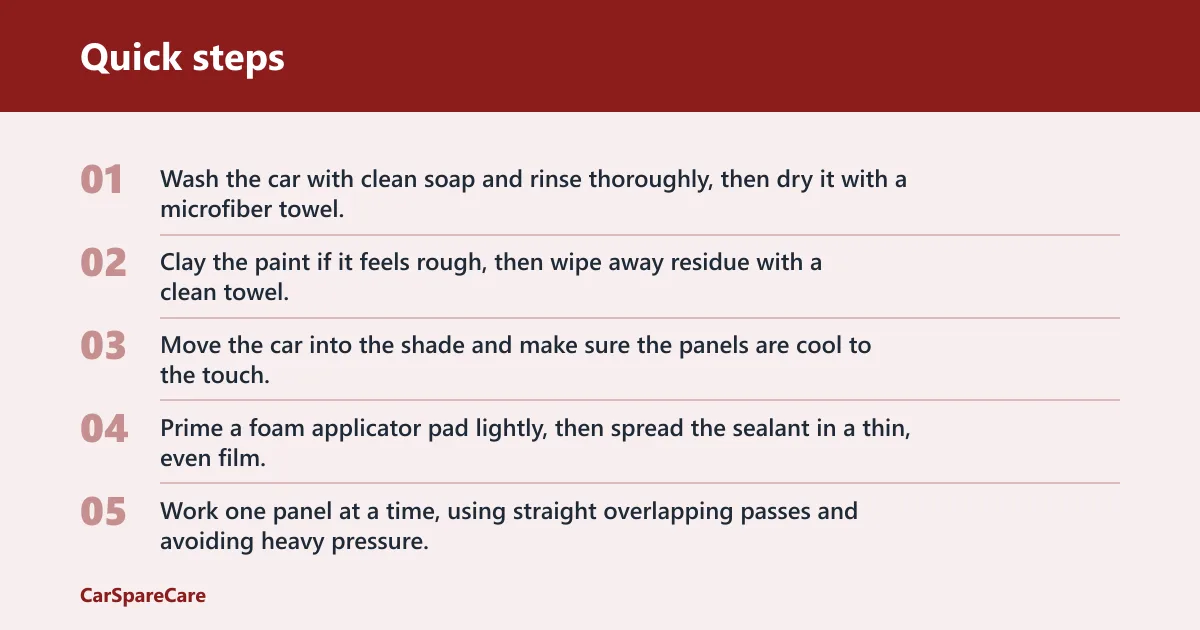
- Wash the car with clean soap and rinse thoroughly, then dry it with a microfiber towel.
- Clay the paint if it feels rough, then wipe away residue with a clean towel.
- Move the car into the shade and make sure the panels are cool to the touch.
Apply
- Prime a foam applicator pad lightly, then spread the sealant in a thin, even film.
- Work one panel at a time, using straight overlapping passes and avoiding heavy pressure.
Buff
- Let the sealant haze or set for the label time, then buff off with a clean microfiber towel.
- Inspect trim, edges, emblems, and panel gaps for residue, then remove any leftover film before it dries hard.
Cure
Follow the label first. Most sealants need curing time before washing, and the finish should stay dry during that period so the coating can harden properly. If the product says not to wash for about 12 to 24 hours, respect that window even if the car looks dry to the touch. Product guidance from major brands commonly warns that moisture, dew, or washing too soon can interrupt bonding and leave a weaker finish (manufacturer technical sheets; detailing product instructions).
Do not top with another product unless the label allows it. A fresh sealant layer can be disturbed by quick detailers, drying aids, or a second coat applied too soon. Picture a sedan parked outside overnight after application; morning dew on an uncured film can weaken the finish before it fully sets.
Aftercare
Once fully cured, wash gently with pH-appropriate soap, use clean towels, and avoid harsh scrubbing on the first maintenance wash. Hydrophobic behavior can fade before the product is fully “gone,” so judge performance by beading, gloss, and label durability rather than by one wash alone (manufacturer care guides; detailing association recommendations).
Which sealant format should you choose?
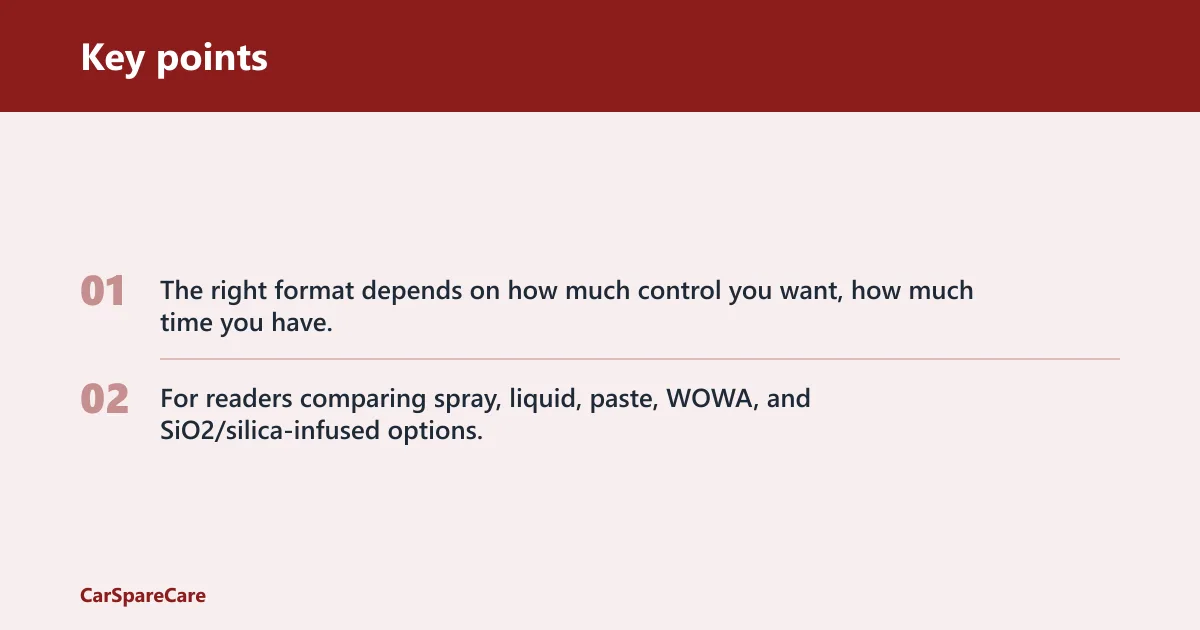
The right format depends on how much control you want, how much time you have, and how sensitive the product is to residue, humidity, and overapplication. For readers comparing spray, liquid, paste, WOWA, and SiO2/silica-infused options, the practical differences are usually about application speed, buffing effort, and how easy it is to overdo the coat.
| Format | Best use case | Ease | Cure sensitivity | Common failure mode |
|---|---|---|---|---|
| Spray | Quick maintenance, regular top-ups, and simple coverage on well-prepped paint | Very easy | Moderate; can streak if overapplied or used on hot panels | Haze or smearing from using too much product |
| Liquid | General-purpose sealing with more control than a spray but less effort than a paste | Easy to moderate | Moderate; uneven film can cure inconsistently | Patchy removal or residue in panel edges |
| Paste | Traditional hand application, especially when you want slower working time | Moderate | Lower flash risk, but thickness still matters | Heavy application that becomes difficult to buff off |
| WOWA | Controlled hand application when the product is designed to be wiped on and wiped off cleanly | Moderate to easy | High; timing and panel size matter more | Streaks from buffing too late or on too large a section |
| SiO2 / silica-infused | Longer-life claims, stronger water behavior, and users who want a more durable feel than basic polymer spray | Easy to moderate | Moderate to high; often less forgiving of humidity, residue, or cross-contamination | Water spotting or grabby wipe-off if the layer is laid down too thick |
Should you apply sealant by hand or with a dual-action polisher?
Use hand application for small areas, tight panels, and a first-time job. A foam applicator gives you better control over product load and is safer when you are learning the finish behavior of a new sealant. Use a dual-action polisher for larger panels if the product allows machine application and you want more even coverage with less arm fatigue.
Do not overload the pad either way. A dual-action polisher can spread product faster, but too much sealant still leaves streaks and makes buff-off harder. If the car has large flat doors, a DA can save time; if it has a small coupe roof or many edges, hand application is easier to control.
How long should sealant cure before washing?
Follow the label first. Most sealants need curing time before washing, and the finish should stay dry during that period so the coating can harden properly. If the product says not to wash for about 12 to 24 hours, respect that window even if the car looks dry to the touch (manufacturer directions commonly specify 12 to 24 hours or longer depending on formulation and ambient conditions).
Do not top with another product unless the label allows it. A fresh sealant layer can be disturbed by quick detailers, drying aids, or a second coat applied too soon. Picture a sedan parked outside overnight after application; morning dew on an uncured film can weaken the finish before it fully sets.
Common mistakes
Most first-time failures come from a short list of avoidable errors. Fix the surface, thin the coat, and keep towels clean.
- Applying too much product: thick coats are harder to remove and can streak.
- Sealing dirty or unclayed paint: contamination blocks bonding and weakens beading.
- Working on hot panels or in direct sun: the product flashes too fast and leaves haze.
- Using contaminated towels or pads: old residue drags across the finish and creates smears.
- Letting residue dry on trim: black plastic and textured edges can trap white film.
What to check first when sealant looks wrong
If something goes wrong, diagnose the issue in this order before stripping the product or reapplying more. Most problems are caused by prep, product load, or cure interruption rather than by a bad bottle.
- Weak beading: inspect for contamination, missed clay work, or a coat that has not finished curing.
- Residue smears: check towel cleanliness, product thickness, and whether buffing started after the film had already set.
- Trim stains: look for dried sealant on textured plastic, edge gaps, emblems, or rubber seals.
- Cure seems interrupted: confirm the car stayed dry long enough and that no dew, rain, wash water, or add-on products touched it too soon.
Paint sealant troubleshooting matrix
Use this when the finish looks wrong after application. Start with the most likely cause and move down the list only if the first fix does not clear the problem.
| Symptom | Likely cause | Immediate fix | Prevention |
|---|---|---|---|
| Streaking | Too much product or buffing after the film has already set | Wipe the panel again with a clean microfiber towel, then inspect under angled light | Use a thinner coat and buff panel by panel |
| Greasy residue | Overapplication or incompatible towels holding old dressing | Remove residue with a fresh towel and a light second wipe | Reserve one clean towel for final buffing only |
| Weak beading | Poor prep, contamination, or sealant that has not fully cured | Wait for the full cure time, then rewash gently and recheck | Clay contaminated paint before sealing and keep the car dry during cure |
| White residue on trim | Sealant dried on textured plastic or edge gaps | Wipe trim with a clean microfiber towel; if needed, use a trim-safe cleaner | Mask delicate trim or wipe edges immediately after application |
| Sealant not curing properly | Applied too thick, used on a hot panel, or exposed to moisture too soon | Remove the unstable layer, then reapply a thinner coat in the shade | Follow the label cure time and avoid washing or dew exposure during cure |
Frequently asked questions
What is a paint sealant for cars?
Paint sealant is a synthetic polymer layer applied to clean clear coat to help it resist water, UV exposure, and road grime. Many products claim 3 months to 12 months of protection. It works best on clean, decontaminated, and often polished paint.
How do you seal car paint?
Wash the car, clay it if needed, dry it fully, and apply a thin coat with a foam applicator or the product’s approved method. Buff off residue with a microfiber towel, then keep the car dry until the sealant reaches its stated cure time.
Can I apply paint sealant over wax?
For more reliable bonding, avoid applying sealant over wax. Wax can block contact with the clear coat, which weakens the sealant layer. Remove wax first with a proper wash or paint prep product, then seal clean paint.
How often should I reapply car paint sealant?
Reapply when water beading drops off, gloss looks muted, or the label’s durability window has passed. Real-world life varies with climate, parking, and wash method, so a product that claims 3 months to 12 months may need earlier refreshes on daily-driven cars.
What towels and applicators do I need for sealant?
Use a clean microfiber towel for buff-off and a foam applicator pad for hand application. If you choose a spray sealant, keep at least two microfiber towels ready so one can apply and the other can finish the residue removal without smearing.
Is spray sealant different from wipe-on sealant?
Yes. Spray sealant is quicker for maintenance and is often simpler to spread on clean paint, while Wipe On Wipe Off and WOWA styles rely on controlled hand application and careful buffing. Spray products are easier for quick coverage; hand-applied styles usually give more precise control.
Does paint sealant protect against UV, bird droppings, and water spots?
It helps, but it does not make the paint immune. Many sealants stress UV protection, and their hydrophobic behavior helps water bead and sheet off faster. That can reduce residue retention, yet bird droppings and mineral spots still need prompt cleaning to avoid staining.

Hi, I’m Melvin, an automobile engineer with extensive experience in automobile equipment. I currently work for a local automobile firm, where I specialize in the car parts industry. I’ve had the opportunity to collaborate with seasoned inspectors, gaining invaluable hands-on experience that goes beyond just theory.
My passion for automotive care started at a young age, which led me to create CarSpareCare. Through CarSpareCare, I share the knowledge and skills I’ve acquired over the years to help others navigate the world of car maintenance and repairs.
My goal is to provide practical tutorials, essential safety advice, and the latest industry insights so that anyone—whether a beginner or an expert—can confidently tackle their automotive projects.

