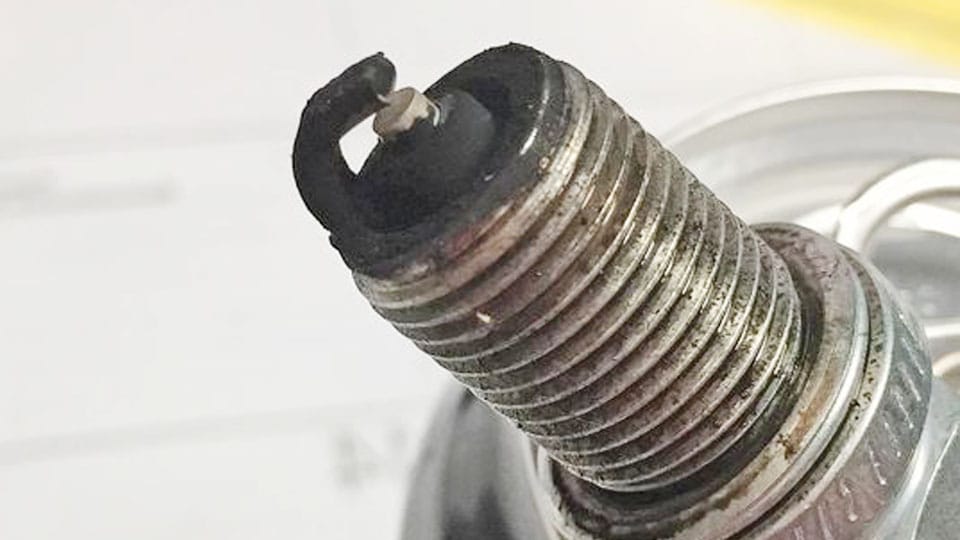
For a permanent in-head repair on an M14x1.25 import application, a common first pick is a Time-Sert kit such as p/n 4412E-111. If you need multiple insert lengths or prefer the V-COIL approach that uses an STI HexTap, the V-COIL M14 x 1.25 system is the other main route. If only the first few spark plug threads in an aluminum head are damaged and the plug still seats squarely, an in-head repair may work; deeper damage usually calls for a solid insert, and misalignment can mean head removal. Done wrong, stripped threads can leak compression, overheat the plug, or leave metal chips in the cylinder.
Aluminum head thread damage: what changes the repair


Aluminum cylinder head threads can fail more easily because the material is softer and heat cycling can keep changing clamp load over time. Cross-threading, over torqueing, corrosion, and blow-out can damage the hole, and over torqueing is commonly reported as a major issue in aluminum engine blocks. The repair choice depends on how much thread remains, whether the seat still seals, and whether debris can be controlled.
Damage patterns that still respond to repair
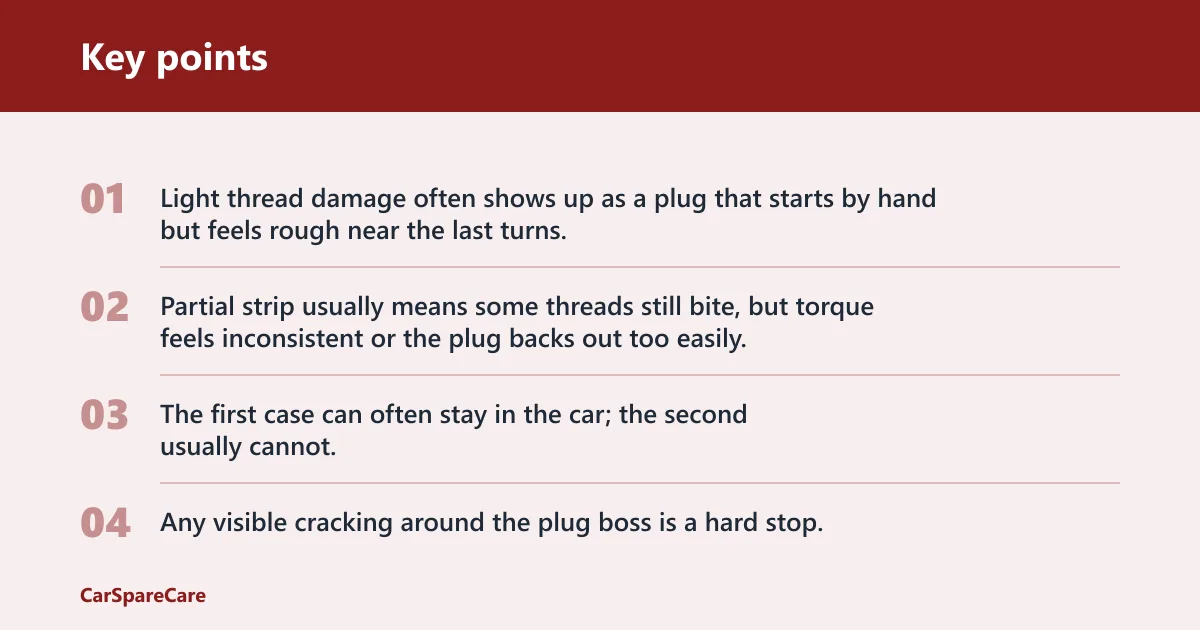
Light thread damage often shows up as a plug that starts by hand but feels rough near the last turns. Partial strip usually means some threads still bite, but torque feels inconsistent or the plug backs out too easily. Those cases may accept a chaser or insert repair if the seat is intact and the bore is straight.
Suppose the plug took torque once and now the first few threads are shiny and rolled over, but the plug still draws down evenly. That is a very different problem from a plug that will not tighten at all and wobbles in the hole. The first case can often stay in the car; the second usually cannot.
Signs the head may need removal
Remove the head, or at least stop and reassess, if the plug hole is badly misaligned, the boss is cracked, or the insert has already failed more than once. Repeated repair on thin aluminum often means the surrounding material is no longer strong enough to hold a new thread reliably. Any visible cracking around the plug boss is a hard stop.
A damaged seat is another stop sign. If the sealing face is pitted, recut geometry matters, and a repair that restores threads without restoring the seat can still leak.
Can you repair spark plug threads in place?
Yes, sometimes. In-car repair is realistic when the remaining threads still guide the plug straight, the cylinder can be protected from chips, and the seat surface is not badly damaged. If the hole is deep, angled, cracked, or packed with debris, removing the head is safer than gambling on a partial fix.
When chip control makes head removal safer
Aluminum chips are not magnetic, so cleanup has to be planned before any cutting starts. A shop vacuum, grease on the tap flutes, and careful chip capture at the opening help, but they do not remove the risk. If you cannot keep chips out of the cylinder, the repair should move off the engine.
Compressed air can move debris farther into the cylinder if used carelessly, so it should not be relied on as the only cleanup method. The safest in-car choice is the one that lets you control chips and keep the piston position favorable for collection.
How piston position affects the risk
Bring the piston to a position that limits how far debris can fall into the cylinder, then keep the hole clean as you work. Exact piston position depends on the engine, but the goal is simple: create the best barrier possible under the plug opening. Follow the vehicle manual for access and any special cylinder-service instructions.
Keep items out of airbag zones and the driver’s view, and follow the vehicle manual for any related service precautions. Never work under a vehicle held only by a jack, and check local laws where access equipment or support stands are involved.
-
Inspect the threads by hand.
Start the spark plug with fingers only. If it will not turn several threads smoothly, stop before you add damage. -
Check the seat geometry.
Confirm whether the plug uses a tapered seat or a washer seat. The sealing geometry must match the repair method. -
Decide on head removal.
If the plug boss is cracked, the hole is badly angled, or chip control is poor, remove the head instead of forcing an in-car fix.
Spark plug thread repair kit parts to match first
Choose the kit by thread size, reach, seat style, insert type, and the tools included. A common metric spark plug thread size is M14x1.25, and that matters before anything else. A kit that fits the wrong thread pitch or plug reach can make the damage worse.
Thread size and reach
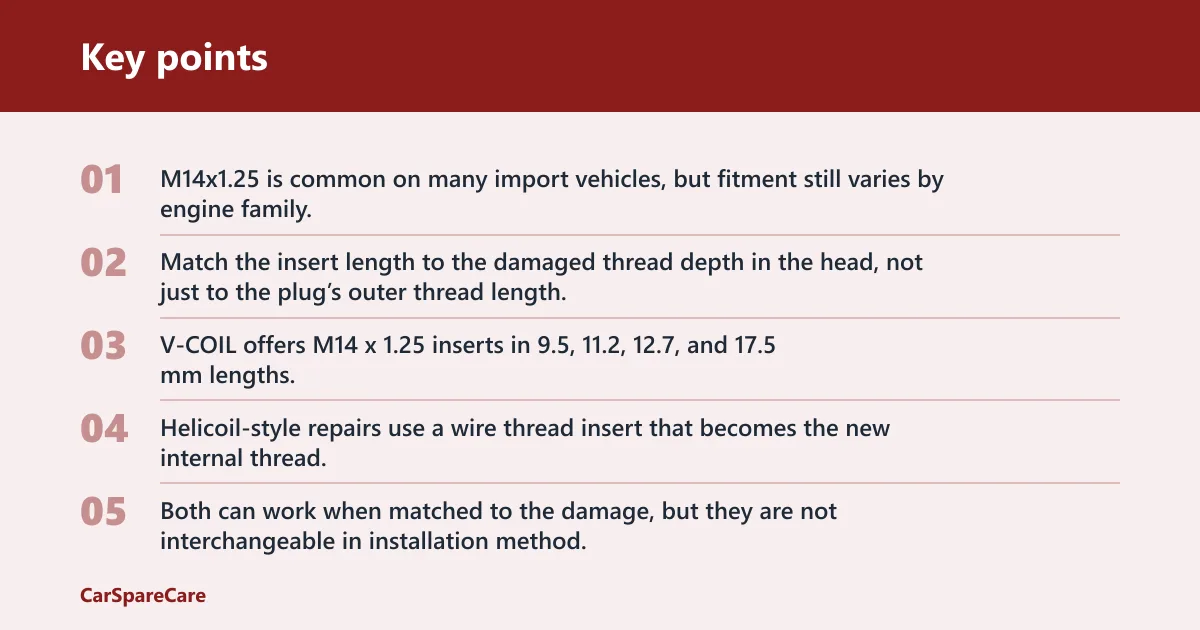
M14x1.25 is common on many import vehicles, but fitment still varies by engine family. Match the insert length to the damaged thread depth in the head, not just to the plug’s outer thread length. V-COIL offers M14 x 1.25 inserts in 9.5, 11.2, 12.7, and 17.5 mm lengths.
That length choice matters because a short insert may not carry load across the full damaged area, while an overly long insert can interfere with plug seating or combustion chamber clearance. Check the engine’s plug reach before buying.
Insert type and length
Helicoil-style repairs use a wire thread insert that becomes the new internal thread. Time-Sert uses a solid sleeve insert and is often treated as the more permanent repair path for spark plug holes in aluminum heads. Both can work when matched to the damage, but they are not interchangeable in installation method.
For a deeper repair, the insert length should match the usable thread depth in the head. If the damage stops high in the bore, a shorter insert may be enough. If the lower threads are gone, a longer insert is often the better fit.
Tap, step-tap, and seat cutter
A proper spark plug thread repair kit should include the correct tap or step-tap, an insert system, seat-cutter or re-cutting tool when needed, and instructions. The Time-Sert kit p/n 4412E-111 is listed for import vehicles, uses M14x1.25 threads, includes five inserts, a Long Reach Drive Wrench, and a step-tap. V-COIL says its M14x1.25 spark plug system uses an STI HexTap, and that no drilling out is needed for spark plug threads.
Do not assume every kit needs the same prep. Some systems require drilling and tapping the hole before insert installation; others are built around a step-tap or a special STI tap path. Use the included instructions for the exact kit in your hand.
Thread repair scenarios and the right fix
The repair method should follow the damage, not the other way around. Mild cross-threading can sometimes be corrected in place. Partial strip usually needs an insert. Fully stripped holes, damaged seats, repeated failure, and unknown thread depth move you toward a more complete repair or head removal.
Mild cross-threading
If the plug still starts straight and only the first few threads are marred, a careful thread repair may save the hole. A chaser or light clean-up can work only when the plug still centers squarely and torque stays normal. If it binds early, stop.
Partial strip
Partial strip means some thread engagement remains, but the plug no longer torques with confidence. This is a common case for a wire insert or solid insert, depending on whether the seat is still good and whether the hole needs a permanent repair. In an aluminum head, lean toward the stronger fix if the engine sees regular heat cycling.
Fully stripped hole
A fully stripped hole usually cannot hold a spark plug safely without an insert. If the bore is still aligned and the seat is sound, a solid insert is often the safer long-term option. If the hole is damaged off-center or the boss is thin, removal may be the better route.
Damaged seat
If the seat leaks, thread repair alone is not enough. A tapered-seat plug must seal on its taper, while a washer-seat plug seals on its crush washer and the proper seating surface. The repair has to preserve that geometry.
Repeated failure
Repeated insert pullout is a warning that the aluminum around the hole is too thin or the installation method was wrong. At that point, another insert may only delay a bigger failure. Stop and inspect the boss for cracking or distortion before trying again.
Unknown thread depth
If you cannot measure the remaining thread depth reliably, do not guess. Unknown depth makes it hard to choose between 9.5 mm, 11.2 mm, 12.7 mm, and 17.5 mm inserts, and a wrong choice can leave the plug short on engagement or too deep in the chamber. Measure first or remove the head.
Spark plug thread repair decision table
| Repair scenario | Recommended insert type | Head can stay on? | Tool set required | Estimated difficulty | Red-flag symptoms to stop and escalate |
|---|---|---|---|---|---|
| Mild cross-threading | Clean-up only, or the lightest matching insert if threads no longer guide the plug | Yes, if chips can be controlled | Correct plug socket, thread chaser or kit tap, cleaning tools, instructions | Low | Plug will not start by hand; visible angle error; rough binding within the first turn |
| Partial strip | Wire insert or solid insert matched to M14x1.25 and thread depth | Often yes | Repair kit, tap or step-tap, insert driver, cleanup supplies | Medium | Torque feels uneven; plug rocks in the bore; seat is damaged |
| Fully stripped hole | Time-Sert-style solid insert for a stronger permanent repair | Sometimes, if alignment and chip control are good | Solid insert kit, step-tap, seat cutter if required, cleanup tools | Medium to high | No thread engagement at all; cracked boss; debris cannot be contained |
| Damaged seat | Insert plus seat re-cutting tool that matches the plug seat type | Often no if access is poor | Insert kit, seat cutter or re-cutting tool, inspection light | High | Tapered-seat or washer-seat geometry cannot be restored cleanly; compression leak remains after install |
| Repeated failure | Solid insert only if the boss still has enough material; otherwise head removal | Usually no | Full insert kit, measurement tools, possible machine work | High | Insert pulls out again; cracks around the bore; plug never torques consistently |
| Unknown thread depth | Do not choose yet; measure or remove the head first | No until depth is known | Depth gauge or caliper, inspection light, possibly head removal tools | Medium | Depth cannot be verified; plug thread length or seat style is uncertain |
Helicoil vs Time-Sert for aluminum heads
Helicoil-style inserts and Time-Sert-style solid inserts both restore a damaged spark plug thread, but they are built differently. Wire inserts are lighter and common, while solid inserts are often chosen for a more permanent repair in a hot aluminum head. The better choice depends on damage depth, heat cycling, and whether the seat also needs work.
Wire insert repair
A Helicoil-style wire insert creates a new internal thread with a coiled insert. It can work well in a straight, well-prepared hole, and it is common in spark plug repair kits. Its limitation is that the repair depends on the quality of the tapped aluminum and the condition of the surrounding material.
Solid insert repair
Time-Sert uses a solid sleeve insert and is often treated as the stronger permanent fix. That setup is aimed at a controlled repair where the original hole is damaged but the boss is still salvageable.
A solid insert is often the better answer when the engine sees repeated heat cycles and the original hole has already failed once. The harder sleeve gives the plug a more stable thread surface than a wire coil in many cases.
Which one suits repeated heat cycles?
For an aluminum head that has already stripped once, a solid insert usually has the edge when the surrounding metal is still healthy enough to support it. A wire insert can still be valid for lighter damage, but repeated failures push the decision toward the more substantial system. If the boss is thin or cracked, neither insert is a substitute for a sound head.
How do you know if the seat also needs recutting?
You need to check the seat whenever the plug still won’t seal after the threads are restored, or when the old plug showed compression leakage around the bore. Tapered-seat plugs and washer-seat plugs seal differently, so the repair must match the plug type. A thread fix alone cannot correct a damaged sealing face.
Tapered-seat plugs
Tapered-seat plugs seal on a tapered metal surface, so the repair has to preserve that taper. Do not re-cut a tapered-seat plug hole as if it were a washer-seat hole. That mismatch can leave the plug sealing poorly even if the threads are perfect.
Washer-seat plugs
Washer-seat plugs rely on the crush washer and a proper sealing face. If the surface is nicked, recessed, or uneven after thread repair, the plug may torque normally but still leak. In that case, a seat cutter or re-cutting tool may be needed if the kit supports it.
Leak signs after installation
After repair, watch for hiss, soot, odor, or torque that changes after the first heat cycle. Those signs point to a seating problem, not just a thread issue. If the plug still leaks, stop and inspect the seat rather than tightening it further.
-
Choose the matching kit.
Confirm M14x1.25, the plug seat type, and the insert length before you buy or start. If the engine family or plug reach is unclear, verify the application in the manual or the kit listing. -
Prepare the cylinder carefully.
Protect the cylinder from chips using a method that fits the engine and access. If you cannot keep debris controlled, remove the head. -
Cut and install slowly.
Follow the kit instructions for the tap, step-tap, or STI HexTap. Advance only as needed, then clean the hole before installing the insert. -
Verify the seal.
Install the plug by hand first, then torque it to the vehicle specification from the manual. If the seat style is wrong or the plug still leaks, stop and correct the sealing surface.
A common first-timer mistake is choosing the insert by plug diameter alone and ignoring seat style. The threads may fit, but the seal can still fail if a tapered-seat hole is treated like a washer-seat hole.
Another common mistake is forcing the plug after a repair that felt “close enough.” If it no longer starts by hand after insert installation, something is wrong with alignment, depth, or seat geometry.
Frequently asked questions
How do you repair stripped spark plug threads in an aluminum head?
Match the repair to the damage. Light cross-threading may clean up in place, but partial or full stripping usually needs an insert. Choose M14x1.25 if that is the engine’s thread size, keep chips controlled, and use a kit that matches the seat type and thread depth.
Can you repair spark plug threads without removing the head?
Sometimes, yes. In-car repair works only when the hole is straight enough, the seat is not badly damaged, and you can keep chips out of the cylinder. If the boss is cracked, the damage is deep, or chip control is poor, head removal is the safer choice.
What tool do you use to repair stripped spark plug threads?
Use the kit’s tap or step-tap, the correct insert driver, and a seat cutter only if the seat needs re-cutting.
Do you need to drill out damaged spark plug threads first?
It depends on the kit. Some systems require drilling before tapping, while V-COIL says its spark plug thread system does not need drilling out for M14 x 1.25 threads. Follow the instructions for the exact kit, because the wrong prep can ruin the hole.
How much does spark plug thread repair cost?
Cost varies with the kit tier, whether you need a seat cutter, and whether the head has to come off. A basic repair kit costs less than a solid insert system plus machine work, but a failed DIY attempt can turn a simple job into a cylinder head repair.
What’s the difference between Helicoil and Time-Sert for spark plug threads?
Helicoil uses a wire insert, while Time-Sert uses a solid sleeve insert. Wire inserts can suit lighter damage, but solid inserts are often preferred for a more permanent repair in aluminum heads that see repeated heat cycling. Choose based on thread depth, seat condition, and failure history.

Hi, I’m Melvin, an automobile engineer with extensive experience in automobile equipment. I currently work for a local automobile firm, where I specialize in the car parts industry. I’ve had the opportunity to collaborate with seasoned inspectors, gaining invaluable hands-on experience that goes beyond just theory.
My passion for automotive care started at a young age, which led me to create CarSpareCare. Through CarSpareCare, I share the knowledge and skills I’ve acquired over the years to help others navigate the world of car maintenance and repairs.
My goal is to provide practical tutorials, essential safety advice, and the latest industry insights so that anyone—whether a beginner or an expert—can confidently tackle their automotive projects.