

The best microfiber towels for car paint care are a 3-towel system: a plush wash mitt or wash towel, a high-GSM drying towel, and a short-nap finishing towel for wax or sealant removal. Poor towel choice can leave marring, streaks, lint, and wasted detailing product. This guide shows how to pick safe microfiber by pile, GSM, edge type, and task.
Quick picks
Start with one towel for drying, one for paint finishing, and one for glass. That setup covers wash day, wax removal, and quick detailing without forcing a single towel to do every job badly.
- Best overall for paint-safe basics: a plush 500 GSM edgeless towel for wax, polish, and final wipe work.
- Best for drying large panels: a large, high-absorbency drying towel in the 350 to 600 GSM range.
- Best for glass and mirrors: a waffle weave towel, typically around 400 GSM, because it helps cut streaks.
- Best budget starter pack: a multipack of all-purpose 320 GSM towels for non-critical jobs and paint-adjacent tasks.
What microfiber towels are best for car paint care?
The best microfiber towels for car paint care match the job, not the price tag. For paint, that usually means a plush finishing towel, a low-lint drying towel, and a separate waffle weave towel for glass. The safest choice depends on contamination risk, panel size, and whether the towel will touch fresh wax or bare clear coat.
Why the right towel depends on the job
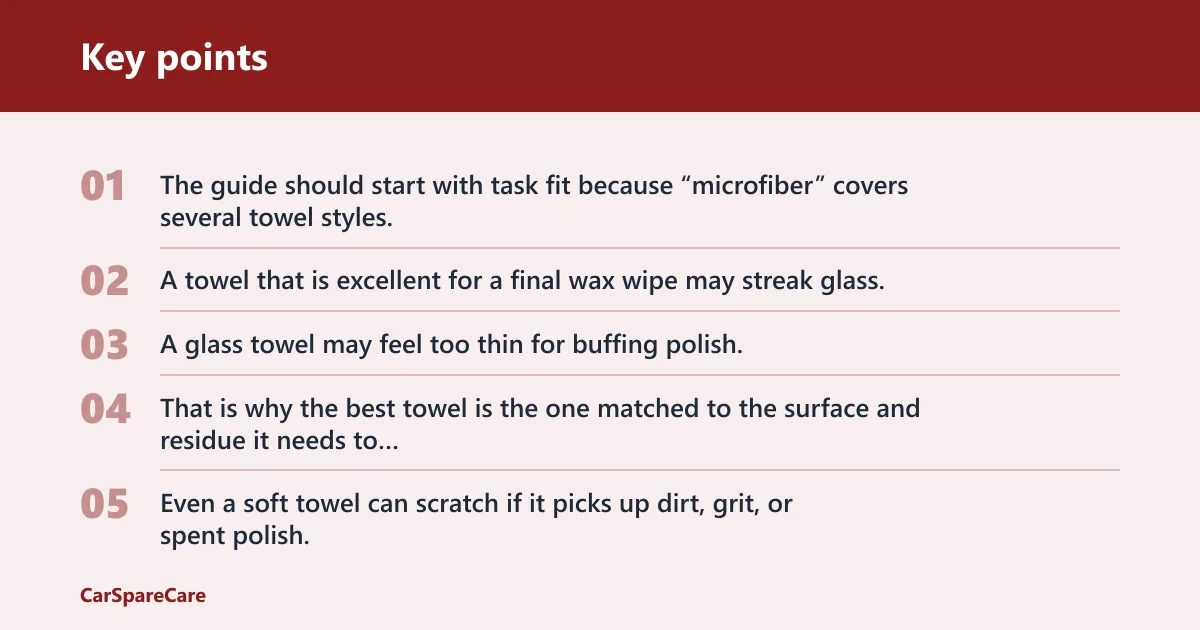
The guide should start with task fit because “microfiber” covers several towel styles. A towel that is excellent for a final wax wipe may streak glass. A glass towel may feel too thin for buffing polish. That is why the best towel is the one matched to the surface and residue it needs to remove.
Why contamination matters more than marketing claims
Even a soft towel can scratch if it picks up dirt, grit, or spent polish. That failure mode matters more than broad claims about softness. Use separate towels for paint, wheels, glass, and interior work, and do not put a towel back on paint after it has touched a dirty panel, badge edge, or trim seam.
Say your freshly washed trunk has a few water spots and you reach for a plush microfiber towel that was previously used to wipe interior glass. The finish can pick up marring because the issue is contamination, not just towel pile.
Quick comparison
| Product | Badge | Best for | Price | ||
|---|---|---|---|---|---|
 | The Rag Company Eagle Edgeless 500 Detailing TowelThe Rag Company | Our pick | 16×16 in · 500 GSM · Blue | $25.95 Price as of 6 Nov 2026 | View |
 | Amazon Basics Microfiber Cleaning ClothsAmazon Basics | Budget pick | 16 x 12 in · Pack of 24 · Blue/White/Yellow | $10.38 Price as of 6 Nov 2026 | View |
 | Meguiar’s Supreme Shine Microfiber TowelsMeguiar’s | Also great | 16×24 in · 9 Total · Plush | $27.99 Price as of 6 Nov 2026 | View |
Use this table to match towel type to the job. The key is to buy for risk first, then size and pile second. A towel that is “better” on paper can still be the wrong pick if it is too plush for glass or too small for drying a full sedan.
How we chose
We compared towels by paint safety, task fit, GSM and blend ratio, edge design, and value per usable towel. Those criteria matter more than brand language, especially when you are choosing between a cheap multipack and a more specialized finishing towel.
The guide also favors towels that fit a beginner’s minimum kit: one drying towel, one finishing towel, and one glass towel. If a towel type tends to fail by streaking, linting, or trapping dirt, that drawback matters even if the towel looks plush.
The Rag Company Eagle Edgeless 500: best for finishing paint
This is the best fit for paint finishing, wax removal, and polishing residue based on the manufacturer’s specs and published product details. The 500 GSM pile and 70/30 blend put it in the plush category, while the edgeless, tagless design helps reduce paint risk on clear coat.
It stands out for final wipe work where you want cushioning between your hand and the paint. That makes it suitable for buffing sealant haze, drying small areas carefully, and quick detailer wipe-downs on clean panels.
The drawback is practical: a plush towel can hold too much product or moisture if you overload it. On glass, or on a saturated panel, that extra pile can leave streaks and force more follow-up passes.
Amazon Basics microfiber cloths: best for budget cleanup
This pack is the budget choice for general-purpose detailing jobs, especially if you need a large count for lower-risk tasks. The 16 x 12 in size and lint-free, non-abrasive positioning make it useful for interiors, door jambs, and other jobs where you want many towels in rotation.
It stands out on value per cloth, which makes it easier to separate towels by job and retire a few to dirtier work. That matters more than chasing a single premium towel when you are building a starter set.
The drawback is that an all-purpose cloth is not the first pick for delicate final paint finishing. It can be fine for general wiping, but it is not the same tool as a dedicated plush paint towel or a drying towel with more absorbency.
Meguiar’s Supreme Shine towels: best for wax removal

This is the best fit for wax, polish, and compound removal when you want a larger finishing towel. The 16×24 in format gives you more clean surface per pass, and the plush dual-sided build suits residue removal on paint, glass, and chrome.
It stands out for swirl-aware finishing work where a softer, larger towel can reduce re-wiping. The safety edging is also a plus when you are moving over clear coat and trim edges.
The drawback is that a larger plush towel can feel bulky on tight body lines or mirror caps. It can also be more towel than you need for a small quick detailer wipe.
What GSM is best for microfiber towels on paint?
For paint, a useful GSM range is usually in the mid to high zone, but higher is not always better. The guide’s 220–600 range covers everything from thinner utility towels to very plush finishing towels. For clear coat, many buyers should look around 350 to 600 GSM, depending on the task.
What GSM means in practice
GSM means grams per square meter. Lower GSM towels tend to be thinner and lighter, which can help on glass and quick tasks. Higher GSM towels tend to be plusher and more absorbent, which helps for paint finishing and drying, but too much pile can hold moisture and leave streaks if the towel becomes saturated.
Lower GSM vs higher GSM use cases
A lower GSM towel is often better for glass, mirrors, and light interior work because it is easier to keep streak-free. A higher GSM towel is usually better for paint, wax, and polish because the pile cushions the surface and can capture residue more cleanly. The key is matching absorbency to the residue load.
Suppose you use a very plush towel on side glass that still carries detail spray. The towel may smear instead of clear because the pile is holding too much liquid for a clean final pass.
How do I choose a microfiber towel for drying a car?
Choose a drying towel that is large, highly absorbent, low-lint, and safe on clear coat. For most cars, that means a towel in a larger format than a hand cloth, with enough pile to pull water off the panel without needing heavy pressure. Drying is one place where size matters as much as softness.
Ideal GSM, weave, and size
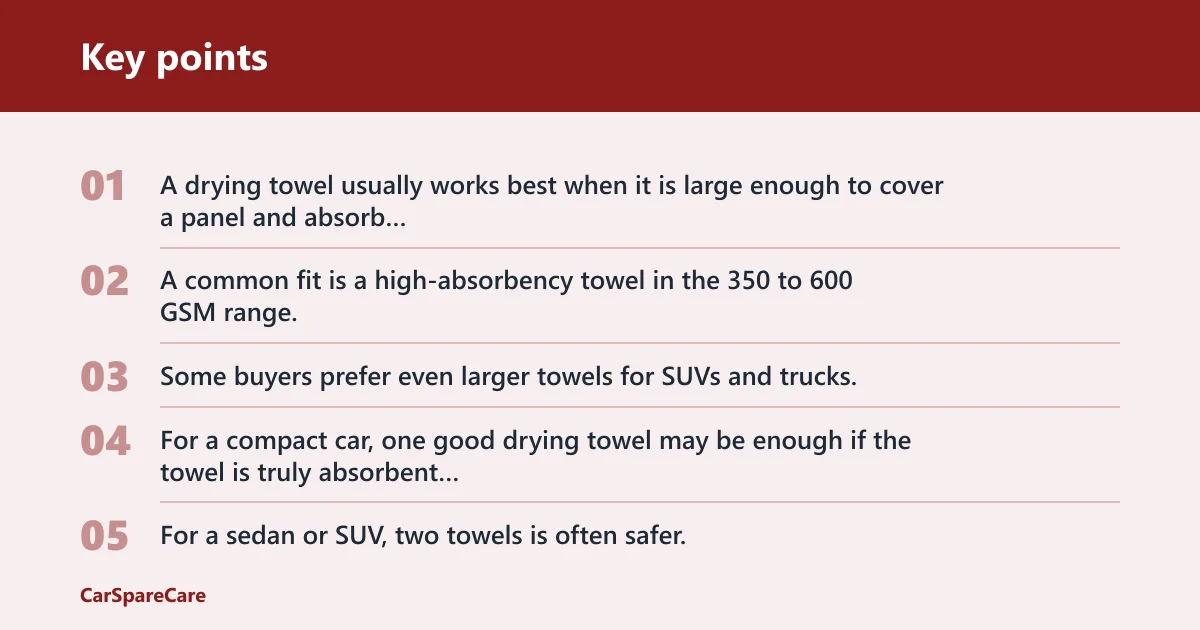
A drying towel usually works best when it is large enough to cover a panel and absorb enough water to reduce passes. A common fit is a high-absorbency towel in the 350 to 600 GSM range, often in a larger format. Some buyers prefer even larger towels for SUVs and trucks.
How much towel you need per car
For a compact car, one good drying towel may be enough if the towel is truly absorbent and you wring it or swap it before saturation. For a sedan or SUV, two towels is often safer. More towel surface means less risk of dragging a wet, overloaded towel across the paint.
When a drying towel is the wrong choice
Do not use a drying towel for tight wax removal around badges or for glass if it leaves lint. A saturated plush towel can also streak if you keep using it past its absorbency limit. Once it feels heavy and stops pulling water cleanly, swap it out.
What microfiber towel should I use for wax removal?
For wax removal, use a plush paint towel with a high pile and a gentle edge finish. That combination helps lift wax residue without forcing pressure into the clear coat. A 500 to 600 GSM towel is the common target, with soft construction and enough surface area to turn to a clean side often.
Why high pile matters here
High pile helps trap residue and reduce direct contact pressure on paint. That matters when you are removing cured or semi-cured wax and want fewer return passes. The towel should glide over the residue instead of dragging it across the panel.
Best use for buffing and final wipe
Use a plush towel for the last buff after wax or sealant has hazed. Keep it separate from wash towels. A clean finishing towel can also handle quick detailer wipe-downs, provided the panel is already free of grit and the towel is not saturated.
When to avoid a plush towel
A plush towel is not the first choice for glass or for heavy wet drying. It can leave streaks if it is too loaded with product. It is also a poor choice if the towel has already been used on a dusty lower panel and then moved to fresh paint.
What microfiber towel should I use for polishing car paint?
For polishing car paint, use a plush finishing towel with a soft edge and enough nap to catch residue without dragging. The goal is swirl reduction, not brute force. A towel in the 500 to 600 GSM range is often a better fit for final polish wipe-off than a thin utility cloth.
Buffing the residue without marring the finish
Polish residue is one of the easiest places to mar paint if the towel is too rough, too dirty, or too tight in the hand. A plush, paint-safe towel gives more cushion and less direct friction. That is why soft edge design matters as much as pile height.
Short-nap finishing versus deep pile
Short-nap finishing towels can work well for polish removal when the residue is light and the panel is already clean. Deep pile towels are better when you want extra cushion or when the product leaves more residue. The right choice depends on the product’s wipe-off behavior, not just the towel’s price.
Should microfiber towels have edgeless or stitched edges?
For paint work, edgeless or laser-cut edges are usually safer than thick stitched borders. The edge is one of the most common contact points for marring because it can drag, fold, or catch on trim. On clear coat, the simplest rule is to minimize hard seams anywhere near the surface.
Laser-cut edges and edgeless construction
Laser-cut edges reduce bulk at the border, and edgeless construction removes a common scratch point. The premium paint towel in the sourced examples uses laser-cut edges, which is the right idea for final paint contact. That does not make the towel invincible, but it lowers the edge-related risk.
When stitched edges are acceptable
Stitched edges can be fine for interior work, wheels, or general cleanup where paint risk is low. They are less ideal for final wipe paint work, especially on dark finishes where small defects show easily. If you want one towel for many jobs, reserve the edged cloth for dirty work and keep the edgeless towel for paint.
Wash microfiber towels separately from cotton, and separate them by task before they go into the machine. Use a first wash prep, avoid fabric softener, and air-dry when possible. Good wash habits preserve absorbency, reduce lint, and keep a towel from becoming the very thing that mars paint.
First wash prep
New towels often carry loose fibers or finishing residues from manufacturing. A first wash helps clear that out before the towel touches paint. Wash them alone, sort by color or job if possible, and keep them away from towels used for wheels or oily cleanup.
- Shake out loose lint before washing.
- Separate paint towels from wheel, glass, and interior towels.
- Wash with a microfiber-safe detergent or a mild liquid detergent.
- Skip fabric softener and dryer sheets.
- Use low heat or air-dry to protect the fibers.
Towel separation and replacement cues
Keep one pile for paint, one for glass, and one for dirty work. Replace a towel when it starts linting, loses absorbency, feels rough after washing, or shows embedded debris that will not rinse out. A towel that has hardened edges or crushed pile should leave paint duty.
Microfiber towel decision table
This table turns the specs into a purchase decision. Use it to match job, GSM, weave, size, and quantity, then check the “do not use” column before you buy.
| Job | Ideal GSM | Weave / pile | Size | Buy quantity | Do not use | Cost per towel per job calculator |
|---|---|---|---|---|---|---|
| Drying wash water | 350 to 600 | High-absorbency plush or dedicated drying weave | 16 x 27 in or similar large towel; 40 x 40 cm for compact jobs | 1 to 2 towels per vehicle | Glass towel, low-pile utility cloth, dirty wheel towel | Pack price ÷ pack count ÷ estimated reuse count |
| Wax removal | 500 to 600 | Plush paint towel | 16 x 16 in or 40 x 40 cm | 2 towels minimum | Waffle weave, saturated drying towel, wheel towel | Pack price ÷ pack count ÷ estimated reuse count |
| Polish buffing | 500 to 600 | Plush or short-nap finishing towel | 16 x 16 in or 16 x 24 in | 2 to 4 towels | Dirty all-purpose cloth, glass towel, coarse-edged towel | Pack price ÷ pack count ÷ estimated reuse count |
| Quick detailer wipe-down | 350 to 500 | Soft finishing towel | 16 x 16 in or 16 x 24 in | 2 towels | Saturated plush towel, wheel towel, interior rag | Pack price ÷ pack count ÷ estimated reuse count |
| Glass and mirrors | 300 to 400 | Waffle weave | 12 x 12 in or 16 x 12 in | 2 towels | Deep plush paint towel, saturated drying towel | Pack price ÷ pack count ÷ estimated reuse count |
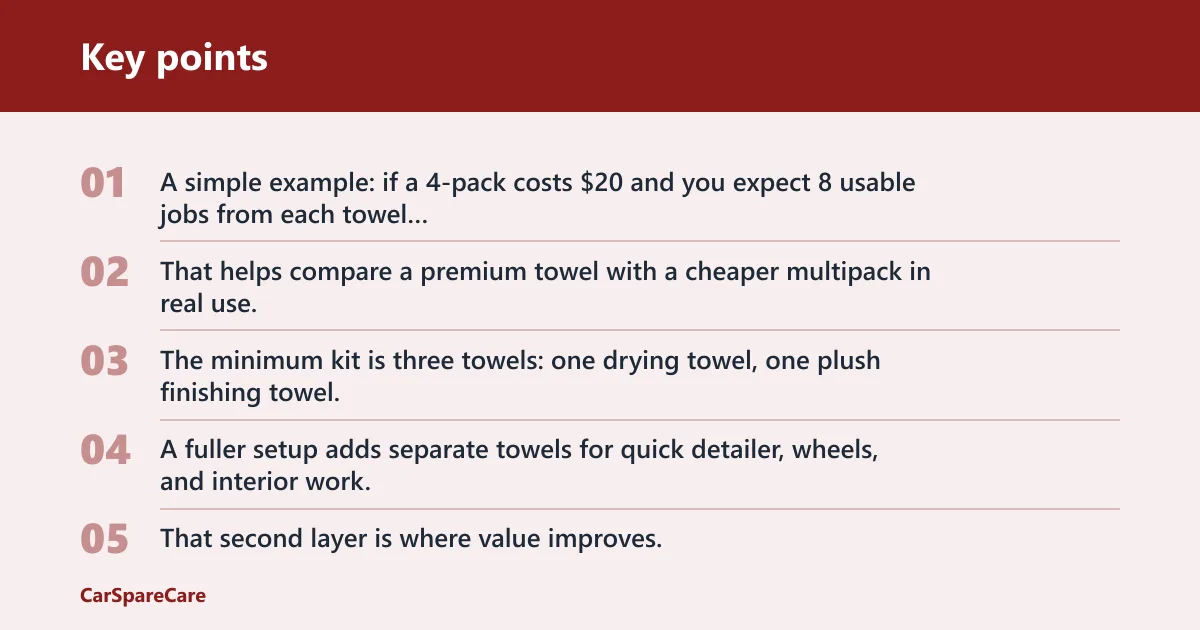
A simple example: if a 4-pack costs $20 and you expect 8 usable jobs from each towel before retirement, the cost per towel per job is $20 ÷ 4 ÷ 8 = $0.625. That helps compare a premium towel with a cheaper multipack in real use, not just by sticker price.
Paint-safe towel kit versus full setup
The minimum kit is three towels: one drying towel, one plush finishing towel, and one glass towel. A fuller setup adds separate towels for quick detailer, wheels, and interior work. That second layer is where value improves, because you stop overusing your best paint towels on dirty chores.
Waffle weave towel: best for glass
A waffle weave towel is the better choice for glass and windows because it is lint-free and helps cut streaks. The 400 GSM waffle-weave towel in the sourced facts is a good example of that task fit. It is not the first choice for plush paint work because it lacks the pile you want for soft paint finishing.
Why it reduces streaks on windows
The weave creates channels that help move moisture and cleaner off the surface. That helps reduce smears on glass and mirrors. A low-lint finish matters here because glass shows residue fast, especially in direct light.
Why it is not the best paint-finishing towel
Glass towels are efficient, but efficiency is not the same as cushioning. They are thinner and less plush than a dedicated paint towel, so they are not the best match for swirl-sensitive finishing work. Use them on windows and save your plush towel for paint.
Which one should you buy?
If you want one safe starter purchase, choose the plush finishing towel first, then add a large drying towel and a waffle weave glass towel. That order covers the highest-risk paint jobs and the most common frustration points: streaks, residue, and towel mismatch.
Best choice on a tight budget: the Amazon Basics pack, because it gives you many cloths for separation by task. Best choice for a two-towel setup: pair a plush paint towel with a glass towel and use a separate drying towel later. Best choice for a full paint-care kit: use a plush finishing towel, a large drying towel, and a waffle weave glass towel together.
What to skip if you only want one pack: do not buy only ultra-plush towels and expect them to handle every task well. A single style is a compromise. The safer move is to build around job risk, then add specialty towels as your routine grows.
A common first-timer mistake is using the same 16 x 16 in towel on wheels, then on the hood. The problem is not the size alone; it is cross-contamination. Once a towel touches brake dust or heavy grime, it should leave paint duty.

Hi, I’m Melvin, an automobile engineer with extensive experience in automobile equipment. I currently work for a local automobile firm, where I specialize in the car parts industry. I’ve had the opportunity to collaborate with seasoned inspectors, gaining invaluable hands-on experience that goes beyond just theory.
My passion for automotive care started at a young age, which led me to create CarSpareCare. Through CarSpareCare, I share the knowledge and skills I’ve acquired over the years to help others navigate the world of car maintenance and repairs.
My goal is to provide practical tutorials, essential safety advice, and the latest industry insights so that anyone—whether a beginner or an expert—can confidently tackle their automotive projects.

