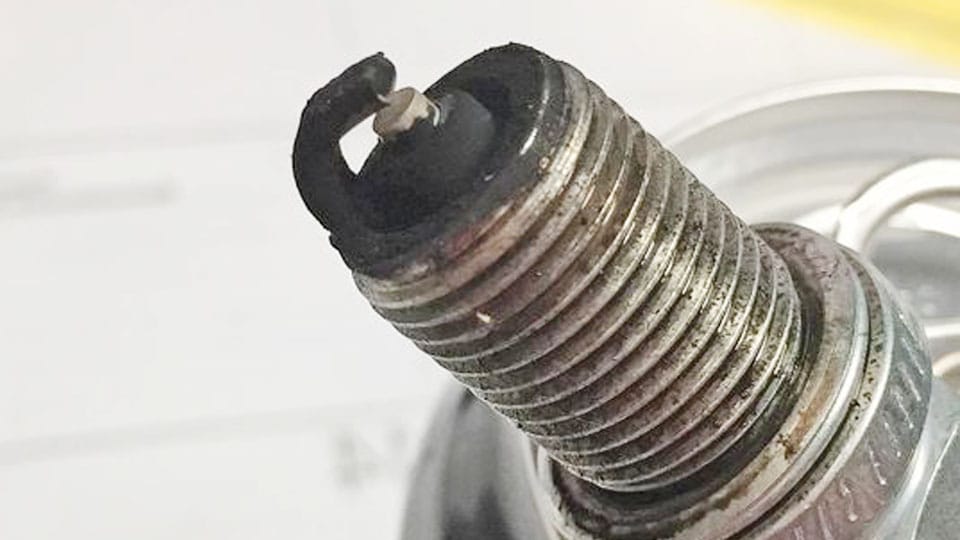
If service history is unknown, inspect spark plugs at about 60,000 miles, then check them every about 30,000 miles or 3 years; replace sooner if the plugs are copper or show wear, fouling, or misfire. Waiting too long can raise fuel use, rough idle, hard starts, and coil stress that turns a cheap tune-up into a larger repair. This guide builds a mileage-and-age schedule, explains severe-use intervals, and shows when inspection beats automatic replacement.
How spark plug wear shows up
Worn plugs usually show up first as an uneven idle, a stumble when you press the throttle, longer cranking, or a fuel economy drop. A flashing or steady check engine light can also appear when the engine control module sees a misfire. Those symptoms can come and go before the plug fully fails.
Rough idle and misfires
Rough idle often means one cylinder is not firing cleanly. Misfires may be mild at first, then become more frequent under load, during cold starts, or at highway speed. A single misfire code does not always mean the plug is the only fault, but plug wear belongs near the top of the list.
Hard starting and hesitation
Hard starting and hesitation are common when the plug gap has widened or the tip is fouled. The problem often shows up more after the car sits overnight, during damp weather, or during the first minute of driving. If the engine needs extra cranking, the plugs should be checked soon.
Fuel economy drop and check engine light
Fuel economy can slip before a major drivability complaint appears. A check engine light tied to misfire codes means the engine is already losing combustion quality. Repeated misfires can damage the catalytic converter, and that repair costs far more than plug replacement.
How often do spark plugs last?
Spark plugs wear by both mileage and time. Copper plugs usually age out first, while platinum and iridium designs often last longer. Engine design matters too, because some vehicles need spark plug replacement between 30,000 and 100,000 miles, and severe use can shorten that window by 20–50%.
Copper, platinum, and iridium lifespan ranges
Copper plugs typically need replacement every 30,000 to 60,000 miles, and many copper plugs may need replacement around 20,000 to 30,000 miles. Platinum plugs usually last 60,000 to 100,000 miles, while iridium plugs often last 100,000 miles or more. Some guides place iridium at 100,000 to 120,000 miles on certain vehicles.
Why engine design changes the interval
Plug life is not the same across engines. A direct-injection turbo engine, a long-life iridium setup, and a simple older engine do not age the same way. Heat load, access, ignition system design, and combustion chamber shape all affect how quickly the plug wears.
When age matters as much as miles
Time matters even if the odometer stays low. Spark plugs also degrade with time, even at low annual mileage, and most mechanics recommend replacement every five to seven years. That matters for a low-mileage car used for short errands, long storage periods, or both.
Spark plug schedule table
The table below turns mileage, age, and service history into a repeatable schedule. Use the owner’s manual first, then adjust for severity and records. If the last replacement date is unknown, treat the car as overdue sooner rather than later.
| Mileage band | Time since last replacement | Action |
|---|---|---|
| 60,000 to 90,000 miles | 0 to 5 years | Inspect at routine service. Verify records, check for rough idle, misfires, fouling, and plug wear before deciding. This band is often where platinum plugs are still serviceable, but copper plugs may already be near the end. |
| 90,000 to 120,000 miles | 5 to 7 years | Replace soon unless the owner’s manual lists a longer interval for that exact engine and the plugs were replaced recently. This is the point where wear risk rises, especially with city driving or any severe-service flag. |
| 120,000+ miles | 7+ years or unknown | Replace now unless service records prove a recent change. At this age and mileage, the cost of waiting is higher because misfires, coil stress, and catalytic converter damage become more likely. |
| Any mileage with severe-service flag | Short trips, towing, turbo use, dust, extreme temperatures, or oil consumption | Shorten the interval by 20–50% and inspect sooner. Severe service burns through plug life faster, so do not wait for the longest published interval. |
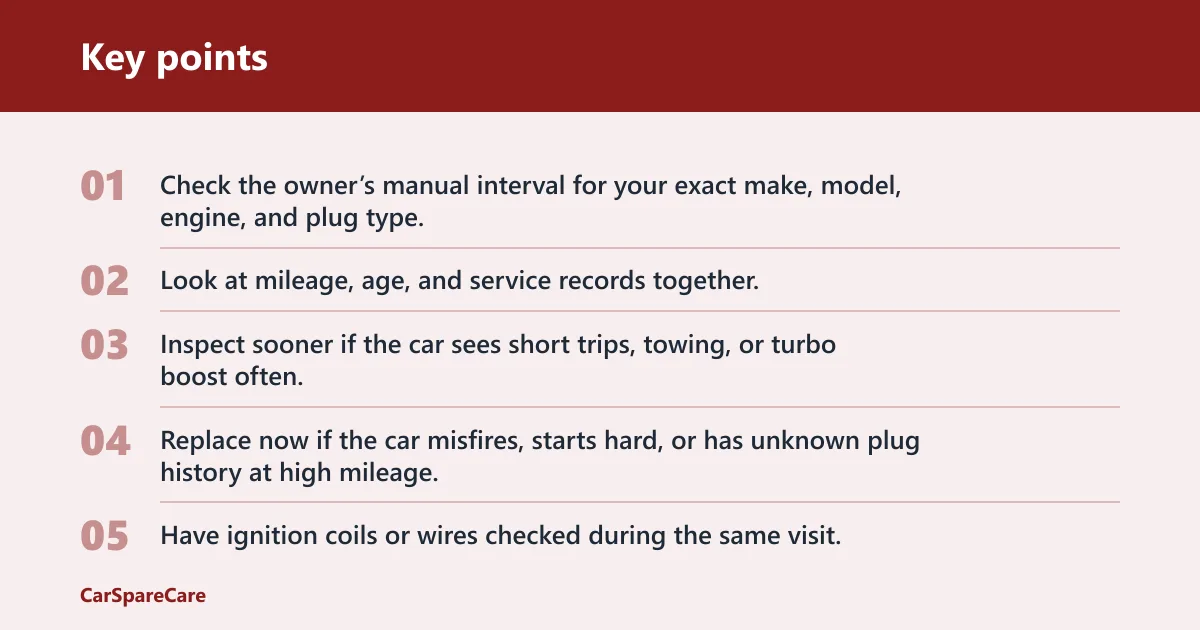
A practical way to use the table is simple: inspect at every routine oil change once a car is past about 60,000 miles, then inspect more often after around 90,000 miles. A common mistake is assuming the plugs can go untouched for another 40,000 miles just because the engine still starts cleanly. That usually pushes the job too late.
- Check the owner’s manual interval for your exact make, model, engine, and plug type.
- Look at mileage, age, and service records together.
- Inspect sooner if the car sees short trips, towing, or turbo boost often.
- Replace now if the car misfires, starts hard, or has unknown plug history at high mileage.
- Have ignition coils or wires checked during the same visit.
Does driving severity shorten plug life?
Yes. Short trips, stop-and-go traffic, towing, dusty conditions, extreme temperatures, turbocharging, and oil consumption all shorten spark plug life. The effect is not minor. Severe driving can cut the normal interval by 20–50%, so a plug that might last 100,000 miles in easy use may need attention much earlier.
Short trips and stop-and-go traffic
Short trips keep the engine from reaching steady operating conditions for long. Stop-and-go traffic adds repeated low-speed load changes and more time spent idling. Both patterns can leave deposits on plugs and shorten useful life.
Towing, dust, and extreme temperatures
Towing raises cylinder pressure and heat, which is hard on the ignition system. Dust can add contamination during service and underhood exposure. Extreme heat or cold can also expose weak plugs sooner, because a borderline ignition system has less margin.
Turbo engines and oil consumption
Turbo engines often place greater thermal stress on plugs. Oil consumption can foul the tip and leave deposits that hurt spark quality. If either condition is present, use the severe-service side of the schedule rather than the longest interval in the manual.
Say your sedan has 88,000 miles, spends most of its time on five-minute school runs, and the plug records are missing. That car belongs in the inspect-soon group, not the wait-until-it-breaks group. The mileage is moderate, but the duty cycle is severe and the history is unknown.
When should you replace spark plugs now?
Replace spark plugs now when the engine is misfiring, rough running keeps returning, the check engine light points to misfires, or service history is missing at high mileage. Also replace now if the plugs are beyond the manual interval, or if age alone has pushed them past five to seven years in regular use.
Misfire codes or repeated rough running
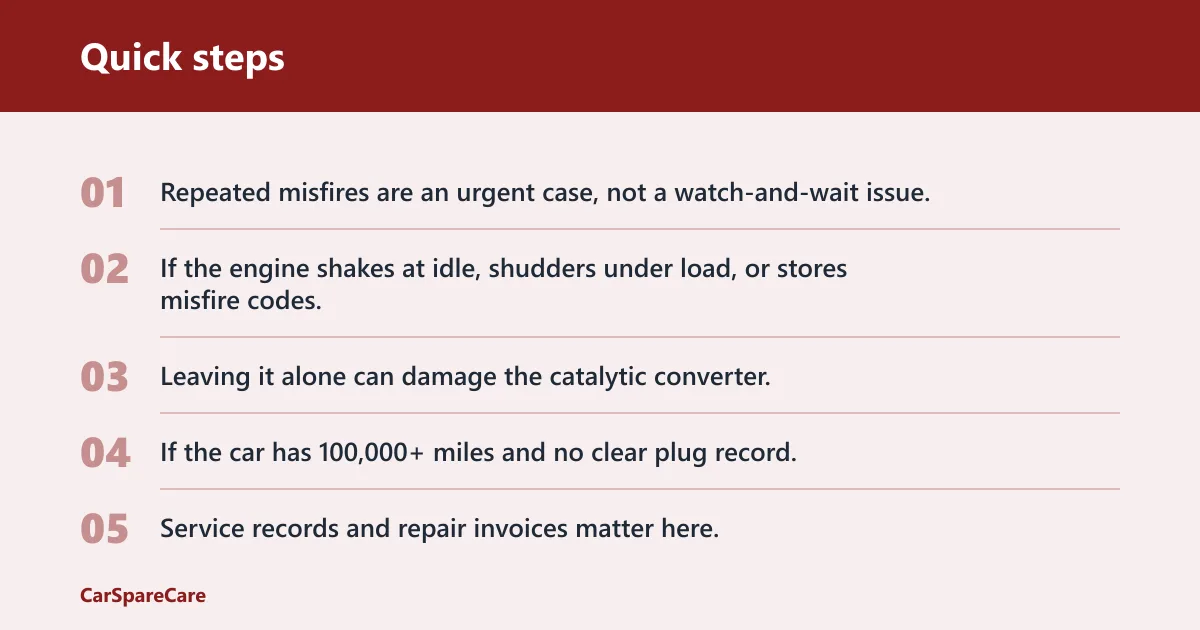
Repeated misfires are an urgent case, not a watch-and-wait issue. If the engine shakes at idle, shudders under load, or stores misfire codes, the plugs should be checked immediately and replaced if worn, fouled, or cracked. Leaving it alone can damage the catalytic converter.
Unknown service history at high mileage
If the car has 100,000+ miles and no clear plug record, it is reasonable to assume the plugs are due unless proof says otherwise. Service records and repair invoices matter here. They can tell you whether the plugs were changed recently, what type was installed, and whether the old interval still applies.
Age-based replacement for low-mileage older cars
Low-mileage older vehicles still need age-based attention. A car with 40,000 miles but eight years on the same plugs can be due on time alone. Time-based wear is common enough that a low-mileage car should not be treated as automatically safe.
Picture a turbo hatchback with 126,000 miles, a steady misfire code, and no proof of recent service. In that case, replacement should not wait for another oil change. The plug issue may be joined by coil or fuel trim faults, but the spark plugs belong on the short list first.
How to find the exact interval
The owner’s manual maintenance schedule is the final authority. It may list exact miles and months or years, and it may separate normal service from severe service. If the manual gives a range, use the shorter end when the vehicle sees hard use or when the plug type is copper.
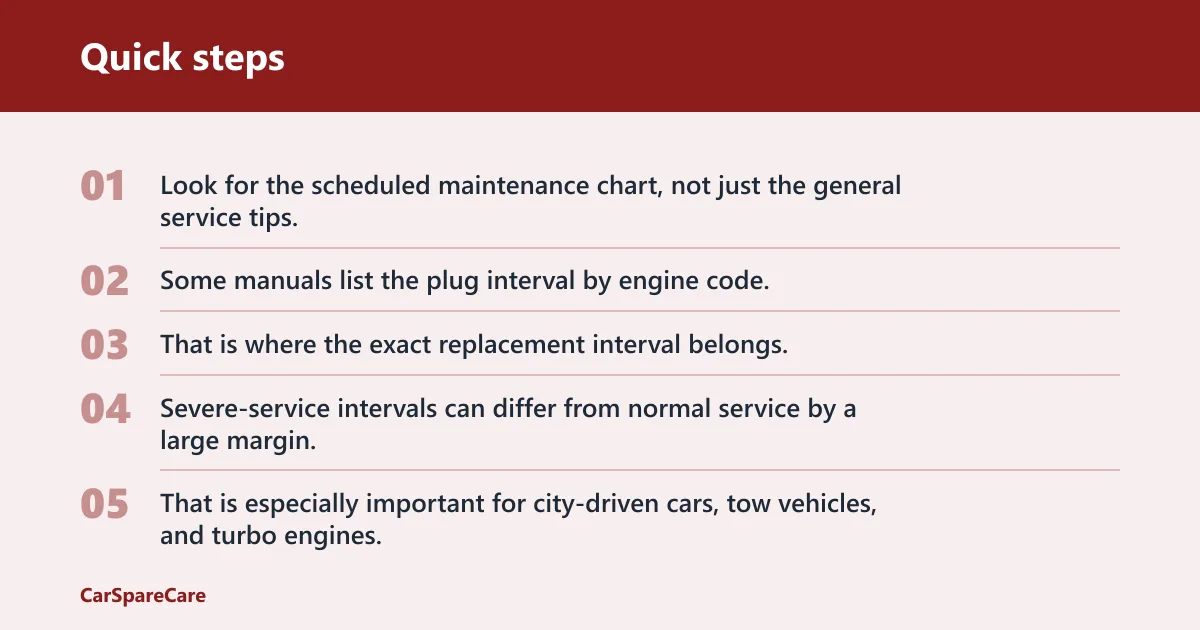
Owner’s manual maintenance schedule
Look for the scheduled maintenance chart, not just the general service tips. Some manuals list the plug interval by engine code, and some separate normal and severe schedules. That is where the exact replacement interval belongs.
Normal versus severe-service line items
Severe-service intervals can differ from normal service by a large margin. That is especially important for city-driven cars, tow vehicles, and turbo engines. If your driving pattern matches the severe list, do not use the normal-service number as your only guide.
Service records and repair invoices
Service records are the fastest way to confirm the last replacement date when ownership history is unknown. Repair invoices can show the plug material and mileage at service. Without those records, the safest assumption is that the plugs may be due sooner than the odometer suggests.
| Plug type | Typical lifespan range | Notes |
|---|---|---|
| Copper | 30,000 to 60,000 miles | Often the shortest-life option. Many copper plugs need earlier replacement in severe use. |
| Platinum | 60,000 to 100,000 miles | Common on many vehicles. Single platinum plugs are often around 60,000 miles, and double platinum plugs are often around 60,000 to 100,000 miles. |
| Iridium | 100,000 miles or more | Often the longest-life option. Some vehicles list 80,000 to 100,000 miles, and some run to 120,000 miles. |
Frequently asked questions
When should I replace spark plugs on a high-mileage car?
Start inspecting at 60,000 miles if the plug history is unknown, then tighten the check to every 30,000 miles or 3 years as the car ages. Replace sooner if the plugs are copper, if the manual interval has passed, or if you see misfire symptoms, fouling, or hard starting.
Do spark plugs wear out by miles or age?
They wear by both. Mileage tracks use, but age matters because plugs degrade with time even at low annual mileage. That is why a car with modest miles but many years on the same plugs can still be due for replacement, especially if the manual lists a time limit.
What mileage is too high for spark plugs?
There is no single cutoff. Some vehicles need replacement between 30,000 and 100,000 miles, and iridium plugs can last longer on some engines. Once a car is past around 90,000 miles, inspection becomes more important, and 120,000+ miles often means replacement is due unless records show a recent change.
Do high-mileage or severe driving conditions shorten spark plug life?
Yes. Short trips, stop-and-go traffic, towing, dusty conditions, extreme temperatures, turbocharging, and oil consumption can shorten life by 20–50%. If those conditions apply, do not wait for the longest published interval. Move the inspection earlier and treat the severe-service schedule as the correct one.
Can worn spark plugs cause a check engine light or misfires?
Yes. Worn plugs can cause misfires, and repeated misfires can trigger the check engine light. The light may come with rough idle, hesitation, or hard starting. Because misfires can also damage the catalytic converter, they should be handled quickly rather than ignored.
How do I find my car’s exact spark plug interval?
Use the owner’s manual maintenance schedule for your exact engine. It may list miles, months, or years, and it may separate normal and severe service. If you have service records or invoices, compare them to the manual before you replace anything. That avoids changing plugs too early or too late.
Should I replace spark plugs early if my car rough idles?
If rough idle is new or repeated, spark plugs should be inspected early, not delayed until the next major mileage mark. Rough idle can come from plugs, coils, or other faults, but worn or fouled plugs are common enough that they should be checked right away, especially on a high-mileage engine.
How often do copper, platinum, and iridium spark plugs last?
Some vehicles go longer or shorter depending on engine design, plug type, and how severe the driving conditions are.

Hi, I’m Melvin, an automobile engineer with extensive experience in automobile equipment. I currently work for a local automobile firm, where I specialize in the car parts industry. I’ve had the opportunity to collaborate with seasoned inspectors, gaining invaluable hands-on experience that goes beyond just theory.
My passion for automotive care started at a young age, which led me to create CarSpareCare. Through CarSpareCare, I share the knowledge and skills I’ve acquired over the years to help others navigate the world of car maintenance and repairs.
My goal is to provide practical tutorials, essential safety advice, and the latest industry insights so that anyone—whether a beginner or an expert—can confidently tackle their automotive projects.