
A flashing check engine light usually means an active engine misfire, and you should stop driving if it is severe, the car shakes, or the light flashes under load. Ignoring it can overheat and damage the catalytic converter, turning a small fault into a much larger repair. This guide explains what conditions trigger a flash, how the pattern points to misfire severity, and when you can limp to diagnosis versus when you should pull over immediately.
Flashing CEL triage decision table


| When it happens | Likely system | Severity | Next action |
|---|---|---|---|
| Idle-only flashing | Ignition or vacuum leak at low load | Moderate to severe if the engine shakes | Avoid driving if the shaking is strong; read codes and inspect plugs, coils, and vacuum leaks before more use |
| Acceleration-only flashing | Ignition coil, spark plug, fuel delivery, or mixture problem under load | High | Back off the throttle at once; if it returns with moderate acceleration, pull over and stop |
| Hill-climb flashing | Load-dependent misfire, often ignition or fuel pressure related | High | Reduce load immediately; avoid uphill pulls and seek diagnosis before more driving |
| Cold-start flashing | Moisture, weak spark, or mixture issue during warm-up | Moderate, but still important | If it clears quickly and does not return, document the conditions and scan the codes soon |
| Flashing with fuel smell | Severe misfire or fuel not burning fully | Severe | Stop driving and shut the engine off if the smell is strong; do not keep loading the engine |
| Flashing that stops after restart | Intermittent misfire or temporary trigger | Still significant | Do not assume it is fixed; scan for codes and freeze frame data before the fault repeats |
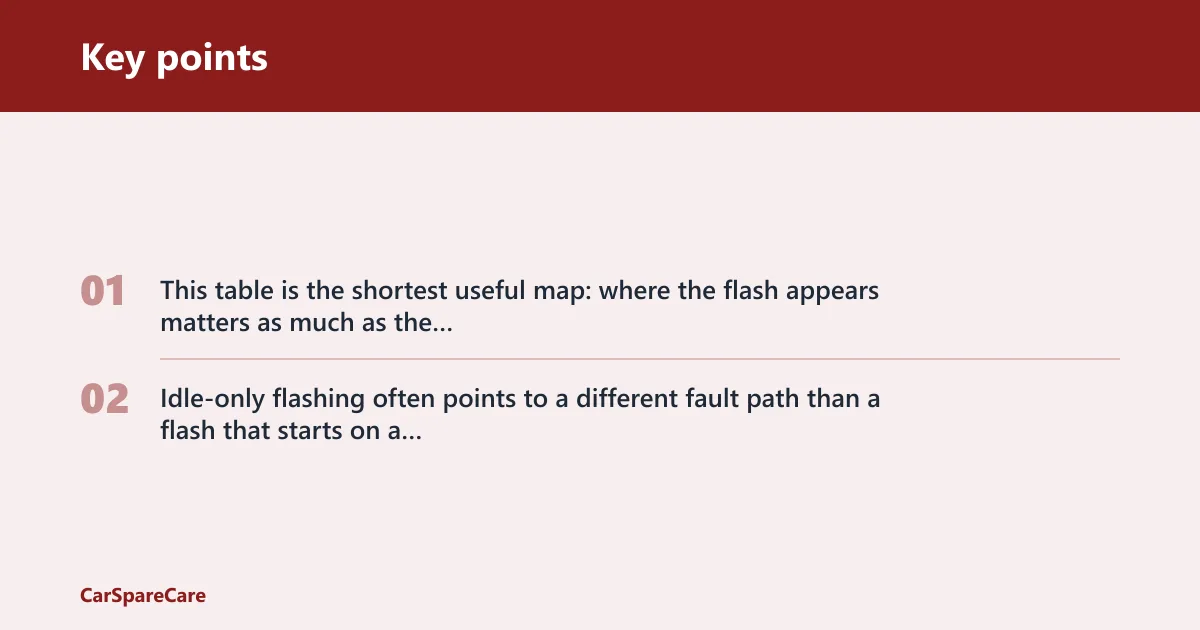
This table is the shortest useful map: where the flash appears matters as much as the flash itself. Idle-only flashing often points to a different fault path than a flash that starts on a steep grade or during a hard pass on the highway.
What does a flashing check engine light mean?
A flashing check engine light is an active warning. On OBD-II vehicles, which have used the standard diagnostic system on U.S. vehicles since 1996, the MIL/check engine light is part of the warning system. A flash usually means misfire rate has crossed a catalyst-damage threshold, so the engine needs less load or a stop right away.
Active warning versus stored fault
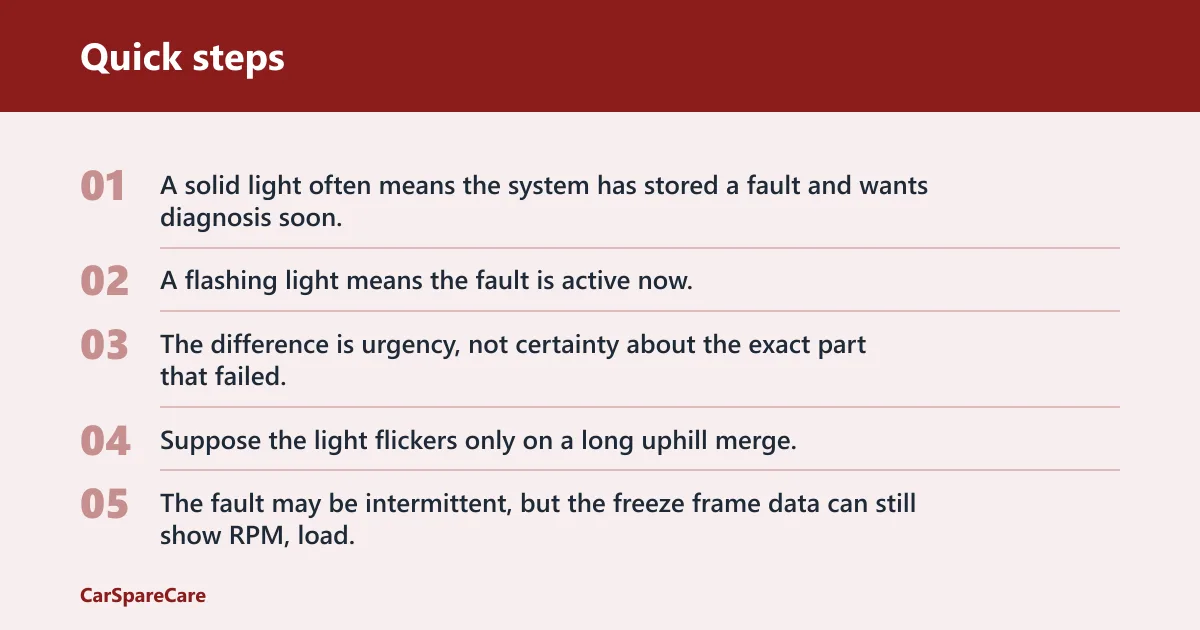
A solid light often means the system has stored a fault and wants diagnosis soon. A flashing light means the fault is active now, or it was active enough to threaten the catalytic converter. The difference is urgency, not certainty about the exact part that failed.
That is why a brief flash still matters. Suppose the light flickers only on a long uphill merge, then goes out once you crest the hill. The fault may be intermittent, but the freeze frame data can still show RPM, load, coolant temperature, and the moment the misfire started.
Why the flash points to misfire
A flashing CEL can indicate an active engine misfire. A misfire is incomplete combustion in one or more cylinders, and it may show up only under certain loads, speeds, or temperatures. That is why the same car can idle normally yet flash the light when you ask for more power.
Think of the flash as a pattern, not a diagnosis by itself. It tells you the engine is not burning fuel cleanly enough in the current operating state, and that state matters for what to do next.
Why does a misfire make the light flash?
When a cylinder misfires, fuel and air do not burn fully in the combustion chamber. That unburned fuel can move into the exhaust, where it burns later and raises exhaust heat. The flashing MIL appears when misfire frequency exceeds a catalyst-damage threshold.
How unburned fuel reaches the exhaust
If spark is weak, fuel delivery is off, or the mixture is wrong, one cylinder may contribute little power on each cycle. The engine control system sees the crankshaft speed changes that follow and flags the misfire pattern. The result is rough running, shaking, or poor acceleration.
The key problem is what happens downstream. Unburned fuel entering the exhaust can overheat the catalytic converter, and a severe flashing CEL can damage a catalytic converter in minutes at highway speed. That is why load reduction matters immediately.
Catalytic converter damage risk
The catalytic converter is expensive to replace, often in the $500 to $2,500 range. If misfire fuel keeps reaching it, the converter can overheat and melt or fail. A flashing light can turn a $50 to $300 repair into a major bill when the converter is damaged too.
The temperature spread is the warning sign. One common reference puts normal converter operation around 800°F to 1,200°F, while a converter-burning misfire can push exhaust temperature to 1,600°F to 2,000°F. That gap is why a short flash under load should never be waved off.
What causes it while driving?
Flashing while driving usually points to a misfire that shows up under load, temperature change, or a specific throttle position. The pattern matters. A fault that appears during acceleration is often different from one that happens only cold, only at idle, or only on a hill.
Load-dependent misfires under acceleration
What causes a check engine light to flash when accelerating? Hard throttle raises cylinder pressure and demands stronger spark and better fuel delivery. Weak ignition coils, worn spark plugs, injector problems, or a lean fuel condition often show up first in that moment because the cylinder needs more margin than it has.
What causes a check engine light to flash while driving? Often, it is a misfire that only appears when engine load rises above a certain point. A common first-timer mistake is to ease off the gas just enough to keep moving and assume the problem is gone. If the light returns the next time you ask for power, the fault is still active.
Hill climbs and high engine load
Steep grades create the same kind of demand as heavy acceleration. That is why a hill-climb flash can point to a coil, plug, injector, or fuel pressure issue that only breaks down when cylinder pressure rises. If the flash appears only on grades, that load pattern is a major clue.
Picture a small sedan holding 45 mph up a long hill with the light flashing only while the throttle is deep. That pattern fits a load-sensitive misfire much more than a general sensor fault, and it deserves a stop-versus-limp decision right away.
Cold-start moisture and temperature effects
Cold-start flashing can point to moisture on ignition parts, a weak spark, or a mixture problem during warm-up. A cold engine needs a different fuel strategy, and if one cylinder is marginal, the first few minutes can expose it. If the flashing stops after a restart but returns the next cold morning, it still matters.
What causes a check engine light to flash on and off? Intermittent misfire is a common answer, especially when temperature or humidity changes the conditions enough to push a weak ignition or fuel-delivery component over the edge. The light may stop because the engine warmed up, not because the problem disappeared.
What should you do right away?
What do I do if the check engine light is flashing? Reduce speed, back off the throttle, and avoid hard acceleration immediately. If the engine shakes hard, smells strongly of fuel, or keeps flashing under light throttle, pull over and stop. If it is mild and the car still runs smoothly, a short limp to diagnosis may be acceptable, but only with minimal load.
Reduce speed and throttle
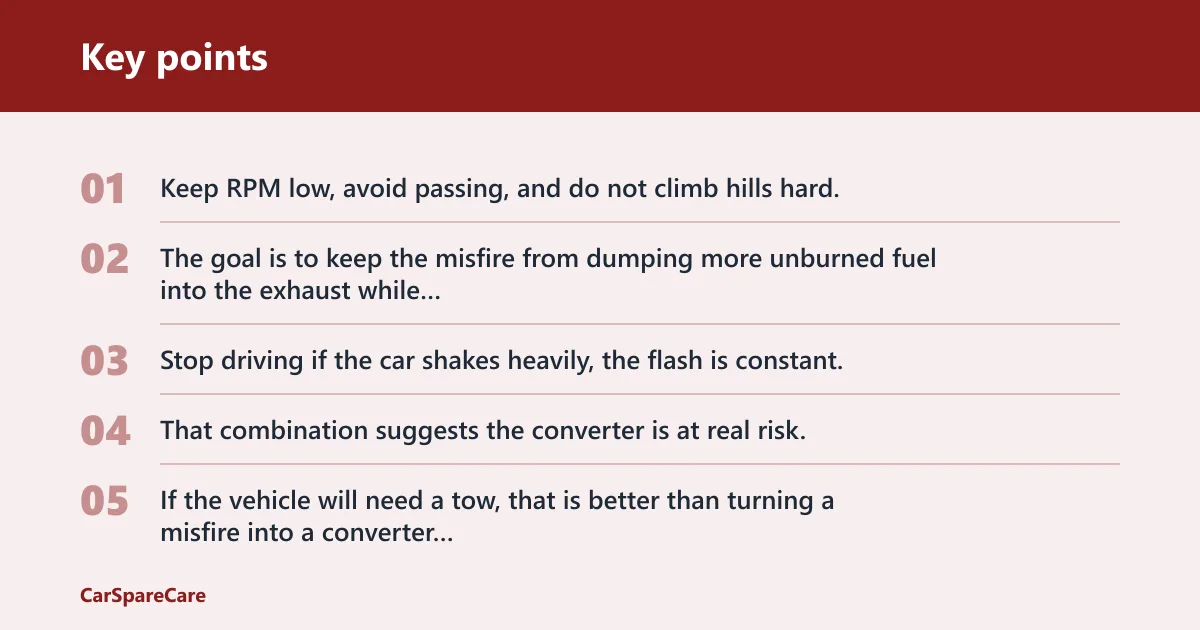
The first move is to reduce engine load. Keep RPM low, avoid passing, and do not climb hills hard. The goal is to keep the misfire from dumping more unburned fuel into the exhaust while you decide whether the car can safely continue.
When to pull over and stop
Stop driving if the car shakes heavily, the flash is constant, the engine sounds rough enough to feel unstable, or a strong fuel smell appears. That combination suggests the converter is at real risk. If the vehicle will need a tow, that is better than turning a misfire into a converter failure.
When a short limp to diagnosis may be acceptable
Can a flashing check engine light stop on its own? Yes, but a brief stop does not erase the fault. If the flash happened once during a specific load condition and the car now runs smoothly, you may be able to drive gently to a nearby scanner or repair shop. Do not use that as a reason for normal driving.
Do not clear codes and continue as if nothing happened. A cleared code removes evidence, but it does not fix a weak coil, a worn plug, or a fuel delivery problem that will set the same fault again.
Common causes of a flashing CEL
The most common causes are still the parts that make combustion happen on time and with the right mixture. Spark plugs, ignition coils, injectors, fuel pressure problems, and air leaks are the first places to look because they can produce misfires that change with load or temperature.
Spark plugs and ignition coils
Bad spark is one of the most common triggers. Worn plugs can fire poorly under pressure, and a weak coil can break down when the cylinder demand rises. Those faults often produce P030x codes, especially if one cylinder misfires more than the others.
Injectors and fuel delivery
A clogged injector, a weak pump, or low fuel pressure can lean out one cylinder or several cylinders. That can cause poor acceleration, rough idle, and a flashing light under load. If the misfire changes with throttle position, fuel delivery is a serious suspect.
Air leaks and mixture problems
Unmetered air from a vacuum leak can make the mixture too lean for stable combustion. Lean misfires often show up at idle first, then worsen under certain load changes. The engine may stumble, surge, or feel flat before the light flashes.
Less common sensor-related triggers
Sensor faults can contribute, but they are less often the direct cause of a flashing light than people assume. A bad reading from airflow, crank, or fuel-control inputs can push the engine into a misfire pattern, but the flash still means combustion is failing in the cylinders.
Use the OBD-II system to read diagnostic trouble codes through the OBD port with a scanner. That is the fastest way to narrow the fault. P0301 through P0308 identify cylinder-specific misfires, which helps you decide whether the problem follows one cylinder, one bank, or a broader fuel or ignition issue.
Read codes and freeze frame data
Freeze frame data is the snapshot that matters most after a flash. It can show RPM, load, coolant temperature, and related conditions at the moment the fault was set. That helps separate idle-only, load-dependent, and cold-start patterns instead of guessing from the light alone.
Say your car flashed only while merging onto a freeway, then stayed off after you backed out of the throttle. If the code is P0302 and the freeze frame shows high load and midrange RPM, that points you toward one cylinder under stress rather than a random warning from the dashboard.
Why P030x codes matter
P0301 through P0308 point to specific cylinders, which is useful when the misfire is not random. A cylinder-specific code often leads to a plug, coil, injector, compression, or wiring check on that cylinder first. A random misfire code points more toward a broader fuel, air, or ignition issue.
What to check before clearing codes
- Note when the flash happened: idle, acceleration, hill climb, or cold start.
- Scan the codes and save freeze frame data before clearing anything.
- Check for rough idle, shaking, poor acceleration, or fuel smell.
- Inspect spark plugs, coils, and visible wiring on the affected cylinder.
- Do not clear the code until the cause is fixed and the symptom is gone.
Frequently asked questions
What causes a check engine light to flash on and off?
Intermittent misfire is the usual cause. The light can flash on when the cylinder fault appears and stop when conditions change, such as after the engine warms up or load drops. That does not make it harmless. It still means the engine needs diagnosis because the same trigger may return.
What causes a check engine light to flash while driving?
A flash while driving usually means the misfire appears under load. Hard acceleration, uphill driving, or a weak ignition or fuel system can trigger it. The car may still move normally at first, but the flashing pattern is a warning that combustion is failing enough to threaten the converter.
What causes a check engine light to flash when accelerating?
Acceleration raises cylinder pressure and exposes weak spark, poor fuel delivery, or a lean mixture. That is why a marginal coil or worn spark plug often flashes only when you press deeper into the throttle. If the flash disappears when you lift off, the load pattern is a strong clue.
What do I do if the check engine light is flashing?
Reduce load immediately, stop hard acceleration, and avoid pushing the engine. If the car shakes hard or smells of fuel, pull over and stop. If the symptom is mild and brief, a short, gentle drive to diagnosis may be acceptable, but only with very light throttle and no extra load.
Is it safe to drive with a flashing check engine light?
Sometimes only a short, low-load limp is reasonable, but it is not a normal driving condition. A flashing light means the engine is misfiring enough to risk catalytic converter damage. If the car runs rough, shakes, or flashes again under light load, stop driving and arrange a tow.
How do I know if the catalytic converter is being damaged?
You may notice a strong sulfur or fuel smell, loss of power, a very hot exhaust area, or a worsening misfire. You cannot confirm converter damage by smell alone, though. If the flash lasted during load and the car kept running rough, treat it as a converter-risk event until scanned and repaired.
Could a flashing check engine light be a misfire?
Yes. A flashing CEL can indicate an active engine misfire, and that is one of the most important meanings of the warning. The exact cause may be spark, fuel, air, or a related control problem, but the flash itself is the system’s way of saying combustion is failing right now.

Hi, I’m Melvin, an automobile engineer with extensive experience in automobile equipment. I currently work for a local automobile firm, where I specialize in the car parts industry. I’ve had the opportunity to collaborate with seasoned inspectors, gaining invaluable hands-on experience that goes beyond just theory.
My passion for automotive care started at a young age, which led me to create CarSpareCare. Through CarSpareCare, I share the knowledge and skills I’ve acquired over the years to help others navigate the world of car maintenance and repairs.
My goal is to provide practical tutorials, essential safety advice, and the latest industry insights so that anyone—whether a beginner or an expert—can confidently tackle their automotive projects.

