Directional tires usually rotate only front to rear on the same side, and only when the front and rear sizes match. Staggered fitments and directional wheels with fixed left/right positions generally cannot be rotated. Ignore that, and you can shorten tread life or create handling and noise problems. This guide shows the safe pattern, the no-go cases, and when to send it to a tire shop.
Directional tire rotation rules
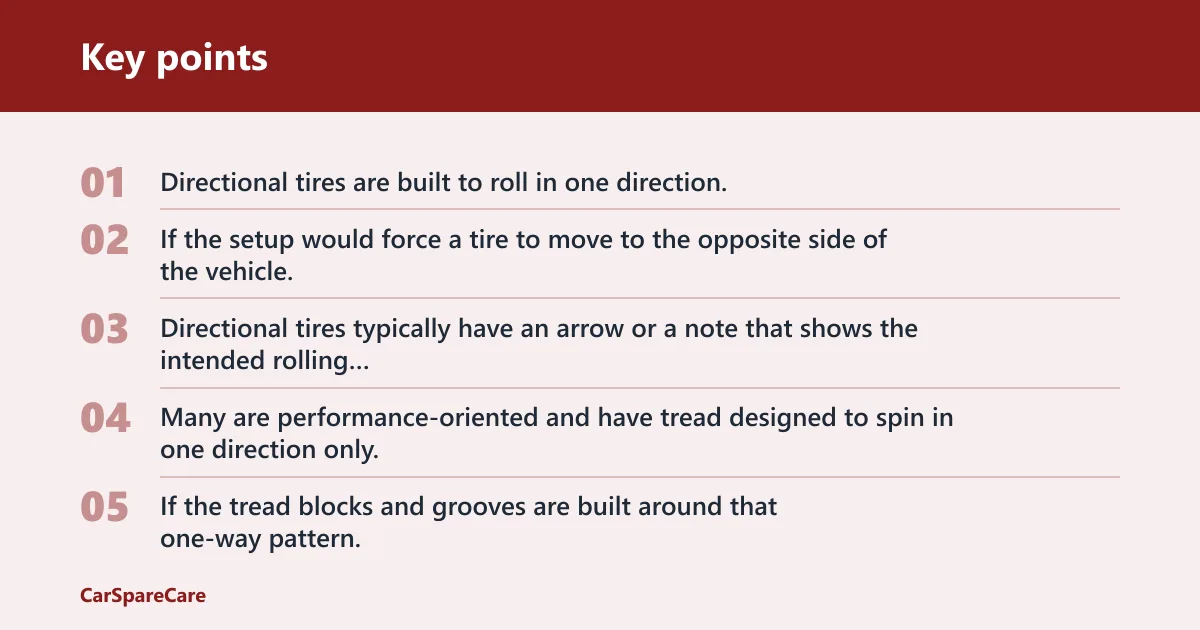


Yes, sometimes. Directional tires are built to roll in one direction, so the usual home rotation is front to rear on the same side. If the setup would force a tire to move to the opposite side of the vehicle, stop there unless the tire is removed from the rim and remounted in the correct direction. (Wikihow)
How to tell if the tire is directional
Look at the sidewall. Directional tires typically have an arrow or a note that shows the intended rolling direction. Many are performance-oriented and have tread designed to spin in one direction only. If the tread blocks and grooves are built around that one-way pattern, side-to-side swaps are off the table.
Do not confuse the tire with the wheel. A wheel can have a fixed left/right design, but the more common issue is the tire tread itself. The key check is simple: if the tire has a one-way arrow or directional marking, treat it as directional unless the manufacturer says otherwise.
When a directional setup cannot change sides
A directional tire should stay on the same side of the vehicle. A left-front directional tire can move to the rear-left position, not the right side. If your planned rotation would cross the centerline of the car, that pattern is wrong for a directional tire unless the tire is dismounted and remounted on the rim.
| Setup type | Can rotate at home | Allowed motion | Needs dismount/remount | Red flags |
|---|---|---|---|---|
| Directional tires | Yes, if same-size and same-side movement is possible | Front to rear on the same side | Yes, for any side-to-side move | Arrow would point the wrong way after rotation |
| Directional wheels | Maybe, but only if the wheel design does not force a fixed side | Depends on tire direction and wheel orientation | Often yes, if the wheel is side-specific | Wheel face or offset is left/right specific |
| Staggered sizes | Often no | Limited; side-to-side only if non-directional and sizes match the axle positions allowed by the maker | Sometimes | Front and rear sizes differ |
| FWD | Yes, on many non-staggered vehicles | Forward cross pattern | Not usually | Directional tires block the cross move |
| RWD | Yes, on many non-staggered vehicles | Rearward cross pattern | Not usually | Directional tires block the cross move |
| AWD | Yes, if the vehicle and tire sizes allow it | X-pattern or crisscross rotation | Usually not, unless the setup blocks the pattern | Diameter mismatch or owner’s manual conflict |
| Full-size spare | Yes, in a 5-tire rotation | Depends on the vehicle’s approved 5-tire pattern | Usually not | Temporary spare is not a full-size spare |
How do you rotate tires properly?
Start with the owner’s manual. Check the approved rotation pattern and interval for your vehicle. Then confirm whether the tires are directional, whether the wheels are directional, and whether the setup is staggered. If the vehicle allows a home rotation, use a level surface, a jack, jack stands, and a lug wrench, then torque the lug nuts to spec after reassembly.
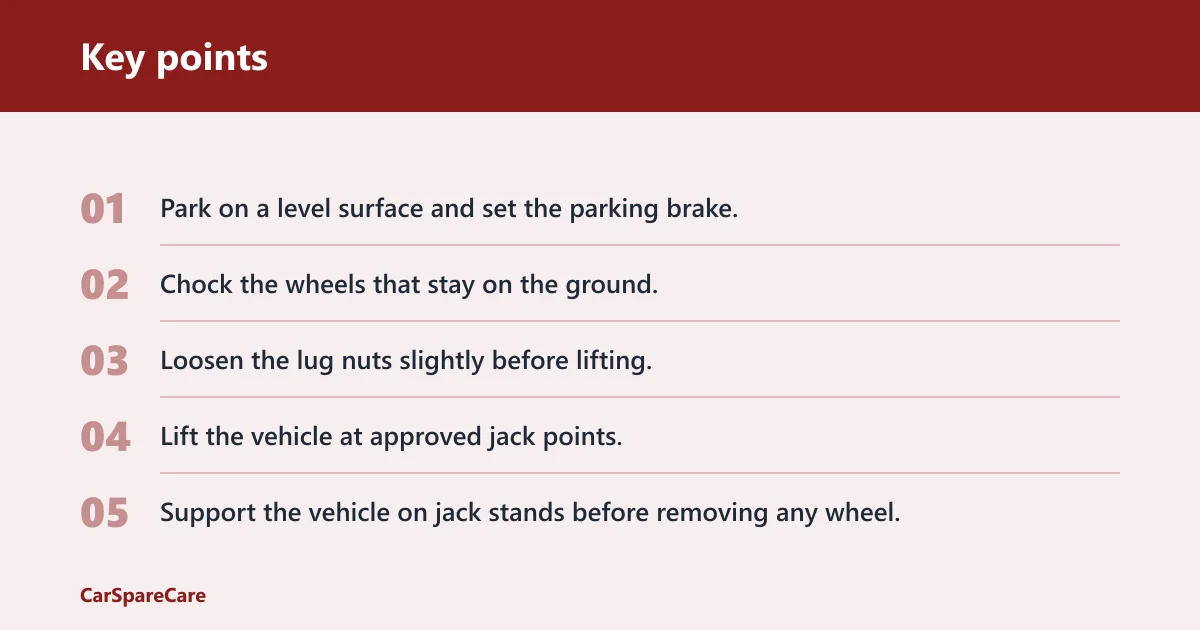
Basic DIY tools and safety checks
- Park on a level surface and set the parking brake.
- Chock the wheels that stay on the ground.
- Loosen the lug nuts slightly before lifting.
- Lift the vehicle at approved jack points.
- Support the vehicle on jack stands before removing any wheel.
- Move each wheel to the approved position only.
- Hand-start the lug nuts, then lower the vehicle.
- Torque the lug nuts to the manufacturer’s specification.
What to inspect while the wheels are off
Check tread depth, shoulder wear, punctures, cracks, bulges, and any feathering or cupping. Measure the tread where wear is most obvious, and compare both shoulders for uneven wear. A rotation is a good time to catch damage before it becomes a handling problem. If you find damage that looks structural, stop and get the tire inspected before the car goes back on the road.
Rotate tires at the mileage interval your manual lists. If the manual gives no interval, many sources place the range at 3,000 to 5,000 miles or 5,000 to 8,000 miles, and some drivers do it at every oil change. The right interval depends on the vehicle, the tire type, and the owner’s manual. (Caranddriver)
If a vehicle has directional tires and the sidewall arrows point toward forward rotation, that indicates the tires should be mounted to match the indicated direction. The correct home move is front-left to rear-left and front-right to rear-right, with no crossing. If the arrows would point backward after the move, the plan stops there.
How do you rotate front-wheel-drive tires?
Front-wheel-drive vehicles commonly use a forward cross pattern. In that pattern, the front tires move straight to the rear on the same side, and the rear tires move to the opposite front corner. That pattern helps even out the faster wear that often shows up on the driven axle.
Forward cross pattern
For a standard non-directional FWD setup, front-left goes to rear-left and front-right goes to rear-right. The rear-left moves to the front-right, and the rear-right moves to the front-left. This is the common FWD rotation pattern and it matches the way the front tires usually work harder.
What changes when the tires are directional
If the tires are directional, you cannot use the cross move unless the tires are dismounted and remounted. For a directional FWD setup, keep each tire on the same side of the vehicle. That means the front tires move straight back and the rear tires move straight forward on the same side, if the maker allows that pattern.
A common first-timer mistake is to treat directional tires like ordinary FWD tires. Suppose a front-left directional tire is moved to the rear-right corner because the pattern looked familiar. That swap puts the tread running the wrong way and defeats the directional design.
How do you rotate rear-wheel-drive tires?
Rear-wheel-drive vehicles commonly use a rearward cross pattern. In that pattern, rear tires move straight to the front on the same side, and front tires move to the opposite rear corner. That pattern is used to balance wear because the rear tires often carry the drivetrain load.
Rearward cross pattern
For a standard non-directional RWD vehicle, rear-left goes to front-left and rear-right goes to front-right. The front-left moves to rear-right, and the front-right moves to rear-left. That is the common rearward cross arrangement for many rear-drive cars and trucks.
How do you rotate all-wheel-drive tires?
AWD vehicles often use an X-pattern rotation, where all four tires may swap diagonally. That pattern helps balance wear across the drivetrain, but it is not universal. The exact rotation depends on the vehicle, the tire sizes, and whether the manual allows diagonal movement.
X-pattern and AWD tire wear balance
On many AWD vehicles with non-directional, same-size tires, diagonal movement is part of the approved pattern. That can help keep wear more even across all four corners. But you should not assume every AWD system accepts the same layout, because AWD drivetrains can be sensitive to tire size differences.
When matching tire size matters
AWD systems often need closely matched rolling diameters. If the tires are unevenly worn, staggered, or mixed in size, the rotation may be restricted or skipped entirely. If the tires are directional, diagonal movement is also blocked unless the tires are removed from the rims and remounted in the correct orientation.
What about staggered tires or a full-size spare?
Staggered tires can limit rotation and may require special handling. In many staggered setups, the front and rear tires are different sizes, so a normal front-to-rear swap is not possible. A full-size spare can be included in a 5-tire rotation, but a temporary spare usually stays out of the routine pattern.
Why staggered sizes limit rotation
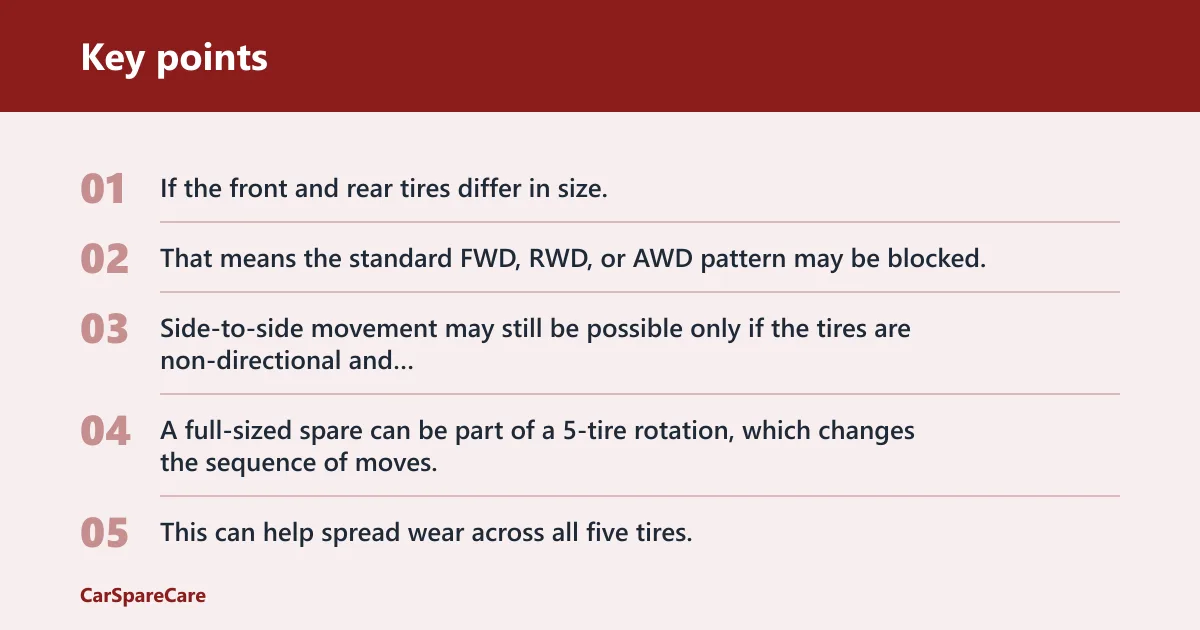
If the front and rear tires differ in size, the tire that fits the front may not fit the rear, and vice versa. That means the standard FWD, RWD, or AWD pattern may be blocked. Side-to-side movement may still be possible only if the tires are non-directional and the wheel design allows it.
How a full-size spare changes the plan
A full-sized spare can be part of a 5-tire rotation, which changes the sequence of moves. This can help spread wear across all five tires, but the pattern must still respect directionality and size match. A temporary spare is different. It is not meant to be treated like a normal tire in a rotation.
When a temporary spare stays out of the rotation
A temporary spare is commonly intended for short-term use only. It should not be folded into a normal rotation plan unless the vehicle manual specifically says otherwise. If the temporary spare is on the car, fix the flat or replace the damaged tire first, then return the vehicle to a standard tire set before rotating.
When should you skip rotation and go to a tire shop?
Skip the home rotation when the setup would require dismounting and remounting, when the tire sizes are staggered in a way that blocks the standard pattern, or when the owner’s manual conflicts with your plan. If the direction arrow would end up wrong, the setup is not safely rotatable on the vehicle as-is.
Cases that need dismounting and remounting
If directional tires must cross sides to follow the vehicle’s normal rotation pattern, the tires have to come off the rims and go back on with the correct direction. That is tire-shop work for most DIY drivers. The same is true when the wheel itself is directional and the wheel orientation matters for fit or appearance.
Signs the setup is not safely rotatable
Watch for these red flags: directional tires that would need to cross sides, staggered sizes that do not support a normal swap, an AWD manual that restricts tire movement, or a temporary spare still mounted on the car. If any of those apply, stop and confirm the correct plan before moving anything.
Owner’s manual and vehicle-specific limits
Vehicle-specific guidance comes first. Some manuals specify a pattern, a mileage interval, or a restriction tied to the drivetrain. If the manual conflicts with a generic pattern, follow the manual. That is the safest way to avoid uneven wear, stability issues, or drivetrain complaints later.
Frequently asked questions
Can you rotate directional tires?
Usually, yes, but only front to rear on the same side when the setup allows it. Directional tires are made to keep the same rolling direction, so they cannot simply cross from left to right without being removed from the rim and remounted the other way.
Can directional tires be rotated?
Yes, if the rotation keeps each tire on the same side of the vehicle and the sizes match the intended positions. A directional tire can move from front-left to rear-left, for example. If the pattern requires a side change, that is a tire-shop job, not a normal driveway rotation.
How do you rotate directional tires on AWD?
Use the vehicle manual first. If the tires are directional, the AWD pattern may be limited to same-side movement only, unless the tires are dismounted and remounted. Do not assume an AWD X-pattern applies when the tread arrows would point the wrong way after the move.
What direction do you rotate tires?
That depends on the setup. FWD commonly uses a forward cross pattern, RWD commonly uses a rearward cross pattern, and AWD often uses an X-pattern. Directional tires are different: they keep the same rolling direction and usually move front to rear on the same side only.

Hi, I’m Melvin, an automobile engineer with extensive experience in automobile equipment. I currently work for a local automobile firm, where I specialize in the car parts industry. I’ve had the opportunity to collaborate with seasoned inspectors, gaining invaluable hands-on experience that goes beyond just theory.
My passion for automotive care started at a young age, which led me to create CarSpareCare. Through CarSpareCare, I share the knowledge and skills I’ve acquired over the years to help others navigate the world of car maintenance and repairs.
My goal is to provide practical tutorials, essential safety advice, and the latest industry insights so that anyone—whether a beginner or an expert—can confidently tackle their automotive projects.