Directional tires roll best in one direction, so rotation is usually limited unless the tire is remounted on the wheel. If the set is non-directional, then the vehicle’s rotation pattern applies. The safest plan is to check size, direction, drivetrain, and the owner’s manual in that order before moving anything.
How directional tires affect rotation
Directional tires are built to roll one way only. The sidewall usually shows an arrow or rotation note that identifies the intended direction. When that mark is present, the tire should normally stay on the same side of the vehicle during rotation unless a tire shop remounts it on the rim.
That constraint is important because a directional tire installed on the wrong side rotates opposite its tread design. That can reduce the intended water-evacuation and noise-control benefits. Directional tread is common in performance, wet-weather, and some winter applications, so the rotation plan is usually more limited than with non-directional tires.
What you’ll need
- Jack
- Lug wrench
- Jack stands
- Wheel chock
- Owner’s manual
- Tire size notes for each wheel position
- Torque wrench, if you have one
Homeowner checklist: confirm the sidewall arrow, match front and rear tire sizes, verify the torque spec in the owner’s manual, and write down the tire positions and mileage for the warranty log before and after the rotation.
📊 Firestone recommends rotation every 7,500 miles or 6 months. Source: Firestonecompleteautocare.
How do you rotate directional tires?
Start by deciding whether the tires are equal-size or staggered, then check whether they are directional or non-directional. After that, follow drivetrain guidance only if the tire sizes and sidewall direction allow it. For directional tires, the usual limit is front-to-rear on the same side unless the tire is remounted.
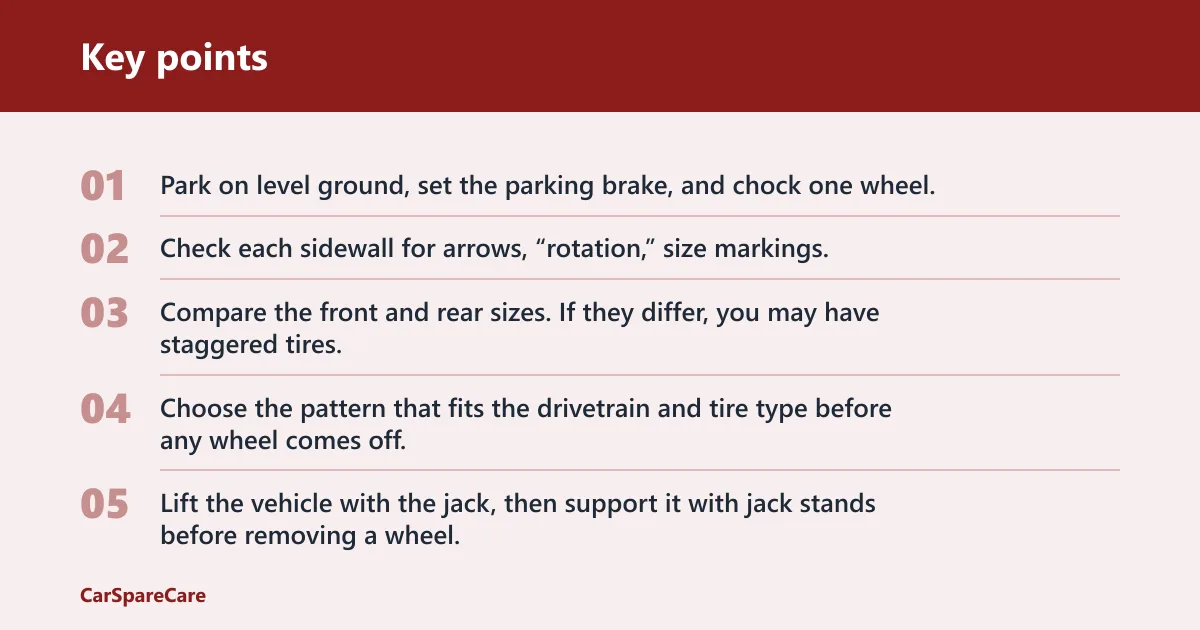
- Park on level ground, set the parking brake, and chock one wheel.
- Check each sidewall for arrows, “rotation,” size markings, and any front or rear fitment note.
- Compare the front and rear sizes. If they differ, you may have staggered tires.
- Choose the pattern that fits the drivetrain and tire type before any wheel comes off.
- Lift the vehicle with the jack, then support it with jack stands before removing a wheel.
- Move each wheel only to a position allowed by the pattern. For directional tires, keep the same side unless a shop remounts the tire on the rim.
- Install the wheels, snug the lug nuts, lower the vehicle, and torque the lugs to spec.
- Record the date, mileage, tire positions, and any unusual wear for warranty tracking.
What rotation pattern fits your drivetrain?
The correct pattern starts with tire fitment, not drivetrain. First confirm whether the tires are equal-size or staggered. Then check whether they are directional or non-directional. After that, use the drivetrain pattern only if the tire and wheel sizes allow it. The owner’s manual overrides any generic rule.
Front-wheel drive
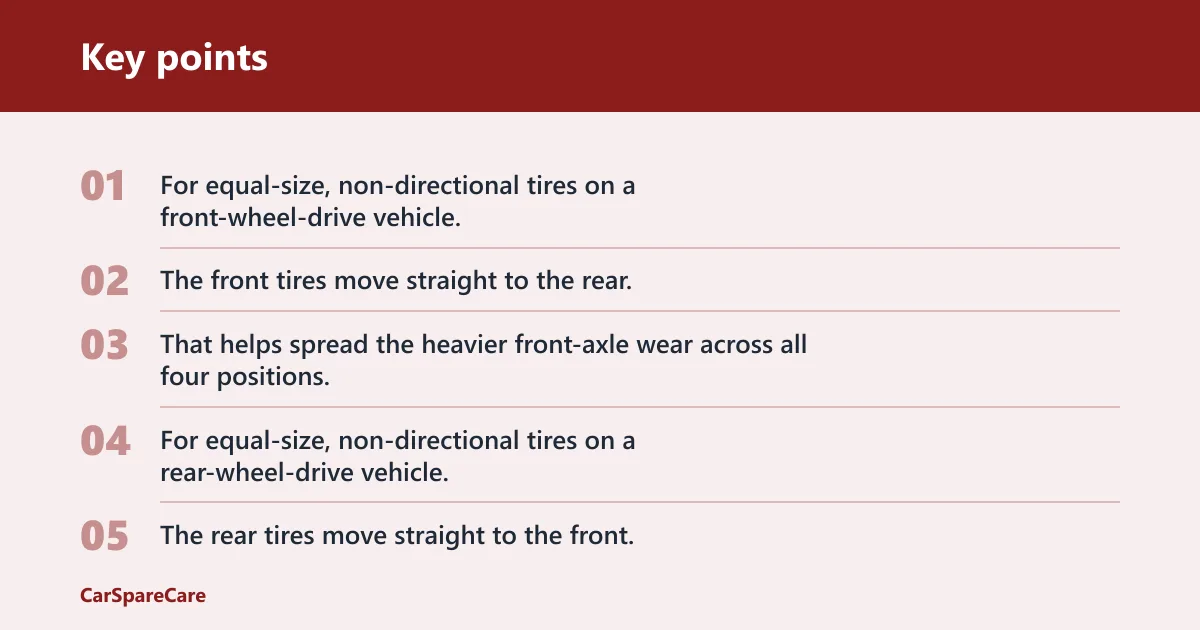
For equal-size, non-directional tires on a front-wheel-drive vehicle, the common pattern is a forward cross. The front tires move straight to the rear, and the rear tires move diagonally to the front. That helps spread the heavier front-axle wear across all four positions.
Rear-wheel drive
For equal-size, non-directional tires on a rear-wheel-drive vehicle, the common pattern is a rearward cross. The rear tires move straight to the front, and the front tires move diagonally to the rear. That pattern is meant to balance wear that often builds differently on the drive axle.
All-wheel drive and four-wheel drive
For AWD and 4WD, a cross-pattern or X-pattern is common when all four tires are the same size, construction, and tread depth range allowed by the manufacturer. If the vehicle has a special factory note, uneven tread depth limits, or size differences, the generic drivetrain pattern may not apply.
When side-to-side only is the limit
Side-to-side rotation can be the only option when front-to-rear movement is blocked by fitment. Staggered setups often cannot rotate front to rear because the tire sizes differ, and some can only move side-to-side if the wheel and tire widths, offsets, and manufacturer guidance allow it. Directional tires generally allow front-to-rear movement on the same side only.
Tire rotation decision table
| tire type | allowed movement | forbidden movement | homeowner check |
|---|---|---|---|
| Non-directional uniform tires | Forward cross, rearward cross, X-pattern, front-to-back, side-to-side, depending on drivetrain | Any move that conflicts with the owner’s manual or tire maker guidance | Confirm equal sizes and compare the manual’s rotation chart |
| Directional tires | Front-to-rear on the same side, if the tire maker allows that pattern | Crossing to the other side without remounting | Look for arrow markings on the sidewall |
| Staggered tires | Often side-to-side only, if sizes and fitment allow it | Front-to-back movement when front and rear sizes differ | Compare front and rear tire sizes before planning a rotation |
| Directional plus staggered tires | Very limited; usually only a shop can expand options by remounting | Normal cross-pattern rotation | Check both size labels and direction arrows before starting |
Can you rotate tires yourself at home?
Yes, if the layout, size, and direction rules still leave a valid pattern. Safe lifting and a clear position record matter just as much as the rotation itself. If the tires are staggered, directional-staggered, or have an owner-manual exception, stop and verify the allowed pattern before loosening any lug nuts.
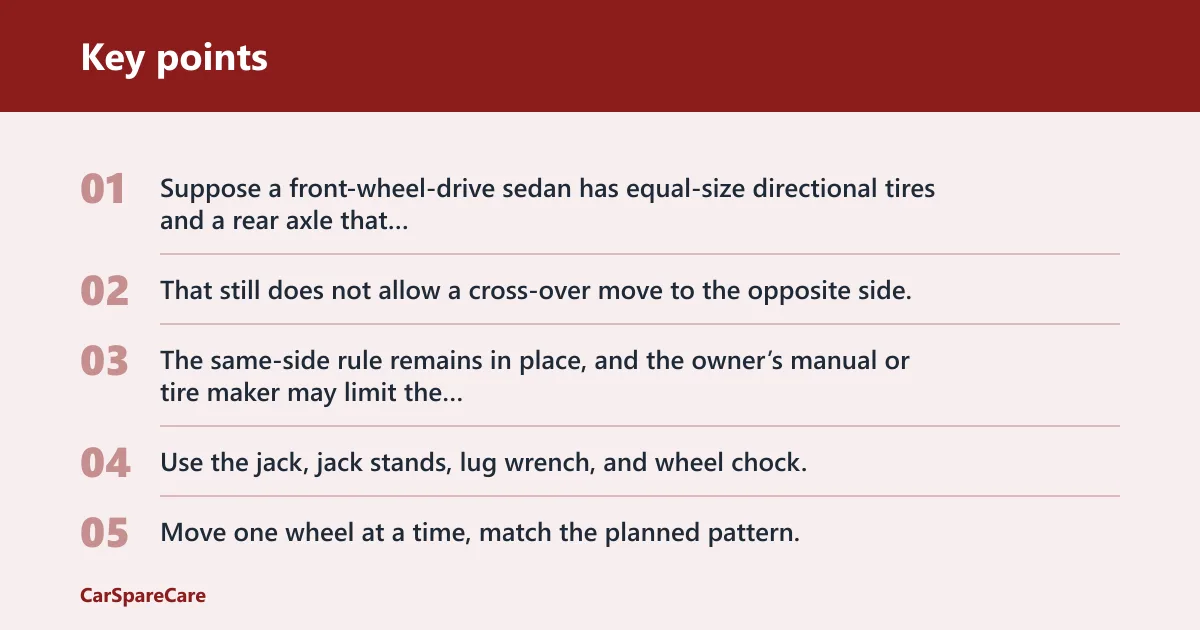
Suppose a front-wheel-drive sedan has equal-size directional tires and a rear axle that shows more wear on the inside edges. That still does not allow a cross-over move to the opposite side. The same-side rule remains in place, and the owner’s manual or tire maker may limit the rotation to front-to-rear only.
What you can do safely
Use the jack, jack stands, lug wrench, and wheel chock. Move one wheel at a time, match the planned pattern, and verify that each tire still points the right way after installation. If one tire has odd wear, note it rather than forcing a pattern that breaks fitment rules.
When to stop and check the manual
Stop if the tire sizes differ front to rear, if the car has run-flat or performance tires with special guidance, or if a sidewall arrow conflicts with the pattern you planned. The owner’s manual and tire maker schedule override generic advice.
When a shop is the better call
A shop is the better call if the tires need remounting to keep direction correct, if vibration suggests a bent wheel or balance issue, or if the car has an unusual AWD system. That is also the safer option when the tread is already cupped or uneven enough to need inspection.
Common mistakes
One common mistake is crossing a directional tire to the wrong side because it “fits” physically. Fit is not enough. The arrow on the sidewall still controls the direction.
Another mistake is treating staggered and directional as the same thing. They are separate limits. A tire can be directional without being staggered, staggered without being directional, or both at once.
Skipping rotation records is another problem. Some tire warranties require rotation intervals, and the mileage note may matter if coverage is questioned later. A simple log with date, odometer reading, and tire positions is enough.
Picture a rear-wheel-drive coupe with rear tires that are wider than the front pair. That setup may stop front-to-back rotation even though the drivetrain would normally suggest a rearward cross pattern. The tire sizes, not the drivetrain alone, decide the final move.
What happens if you don’t rotate your tires?
Uneven wear is the usual result. The front tires on many cars work harder, so they can lose tread faster than the rears. That can lead to traction loss, more road noise, and wear patterns such as cupping that make the ride less smooth.
Rotation helps spread wear more evenly, which can improve safety and handling. It does not fix all tire problems. If the car still shakes after rotation, check balance, alignment, and visible tire damage instead of assuming rotation alone will solve it.
How often should tires be rotated?
A practical interval is usually based on the vehicle manual or tire maker guidance, with many schedules landing around 5,000 to 8,000 miles or about 6 months. Firestone recommends rotation every 7,500 miles or 6 months. The key is to follow the most specific interval that applies to your vehicle and tire type.
Performance tires and wet-weather tires may need closer attention because the tread design and driving style can accelerate wear. AWD and 4WD vehicles also deserve careful timing, since some systems are more sensitive to uneven tread depth across all four tires.
What are directional tires?
Directional tires are tires with tread designed to roll in one direction only. They are usually associated with performance cars and other applications that prioritize water clearing and steady road contact. Because of that design, they stay on the same side during rotation unless the tire is removed and remounted on the wheel.
Are directional tires the same as staggered tires?
No. Directional describes tread direction. Staggered describes different front and rear sizes. A tire can be one, the other, or both. Directional tires limit side changes. Staggered tires limit front-to-back movement. When the two overlap, the rotation plan becomes much narrower.
Frequently asked questions
What is the correct tire rotation pattern for my car?
Use the owner’s manual first. If the car is front-wheel drive, the usual pattern is forward cross. If it is rear-wheel drive, the usual pattern is rearward cross. For AWD or 4WD with uniform tire sizes, X-pattern or cross-pattern guidance is common.
Can you rotate directional tires front to back?
Often yes, if the tire maker allows that move and the tires stay on the same side. Firestone lists front-to-rear as the pattern for directional tires. Do not cross a directional tire to the opposite side unless the tire is remounted to face the correct way.
Do tire rotations help with uneven wear and vibration?
They help with uneven wear by moving load to a different position. They may reduce some vibration tied to wear pattern, but they do not fix balance, alignment, bent wheels, or damaged tires. If vibration stays after rotation, inspect those causes next.
Should tire rotation be done with an oil change?
That is a practical schedule for many owners because both tasks are regular maintenance. The better rule is the mileage and time interval in the owner’s manual. If the oil change falls near 5,000 to 8,000 miles, combining the jobs can make recordkeeping easier.

Hi, I’m Melvin, an automobile engineer with extensive experience in automobile equipment. I currently work for a local automobile firm, where I specialize in the car parts industry. I’ve had the opportunity to collaborate with seasoned inspectors, gaining invaluable hands-on experience that goes beyond just theory.
My passion for automotive care started at a young age, which led me to create CarSpareCare. Through CarSpareCare, I share the knowledge and skills I’ve acquired over the years to help others navigate the world of car maintenance and repairs.
My goal is to provide practical tutorials, essential safety advice, and the latest industry insights so that anyone—whether a beginner or an expert—can confidently tackle their automotive projects.