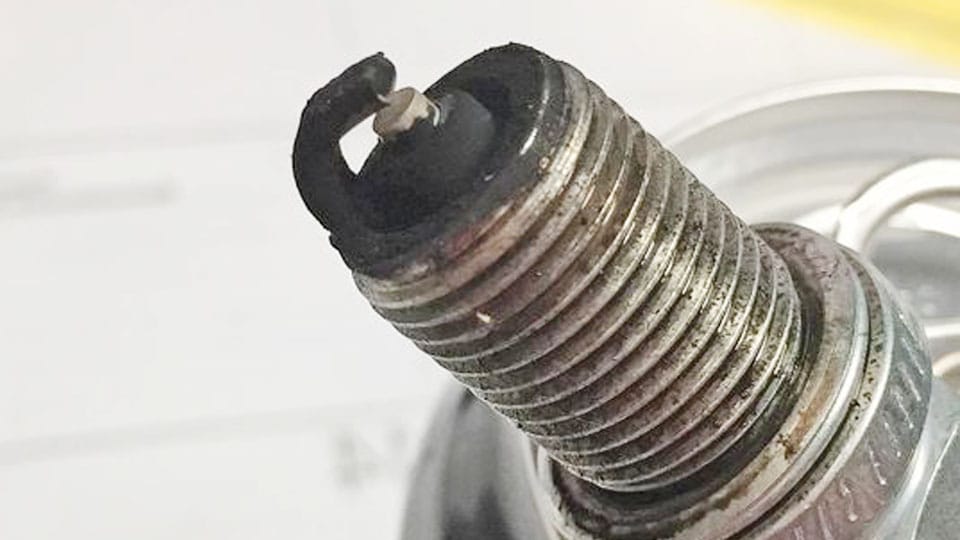
One plug that keeps failing usually points to a cylinder-specific fault: oil, coolant, a leaking injector, a weak coil, compression loss, or a wiring fault, not a bad plug. If you ignore it, the catalytic converter can overheat, cylinder walls can wash down, and you can waste money on repeat parts. This guide shows you how to read the failed plug and decide whether to test ignition, fuel, or engine mechanicals next.
What one failing plug usually means
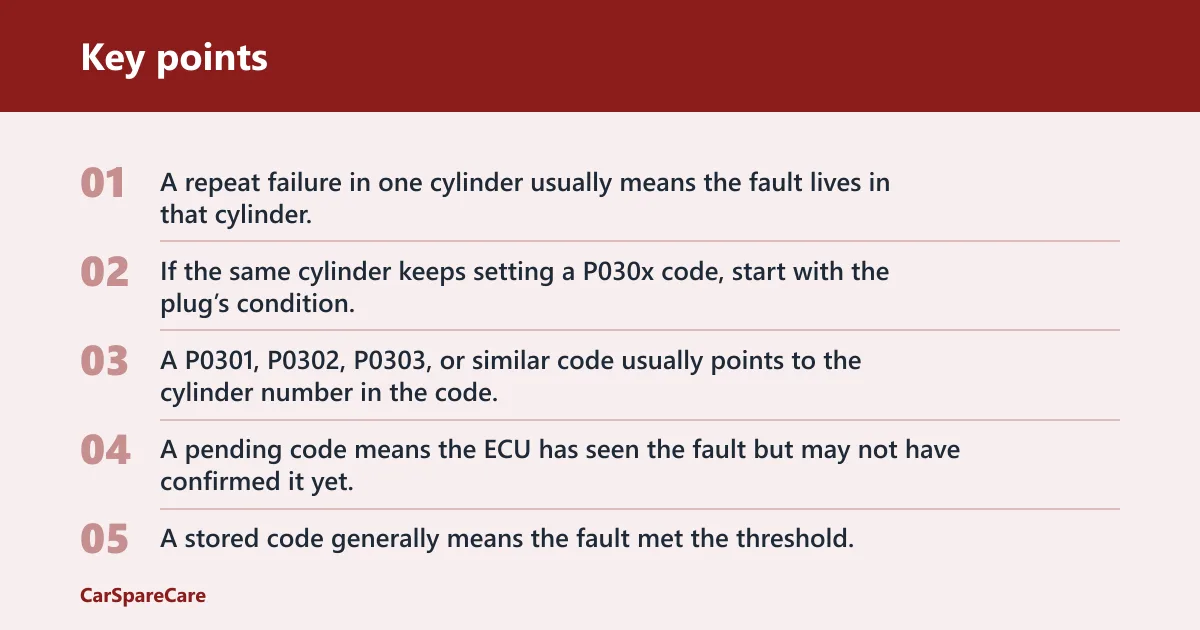


A repeat failure in one cylinder usually means the fault lives in that cylinder, its plug well, or the parts feeding it. If the same cylinder keeps setting a P030x code, start with the plug’s condition, then move in order through ignition, fuel, compression, leaks into the well, and head thread condition.
How a P030x code narrows the search
A P0301, P0302, P0303, or similar code usually points to the cylinder number in the code. A pending code means the ECU has seen the fault but may not have confirmed it yet. A stored code generally means the fault met the threshold. Freeze-frame data can show engine load, coolant temperature, rpm, and fuel trim at the moment the misfire was detected.
One-cylinder failure versus random misfires
One-cylinder repeat failure often means a local issue such as a bad injector, oil in the plug well, or a compression problem. Random misfires across multiple cylinders are more likely to involve fuel pressure, shared ignition power, vacuum leaks, or a wider engine problem. That difference matters because it changes where you test first.
Spark plug diagnosis matrix
This matrix turns plug appearance into the next step. Read the plug first, then test the system most likely to match that evidence. The severity column tells you how quickly to act.
| Plug appearance | Likely root cause | Next test | Do next | Severity |
|---|---|---|---|---|
| Dry black soot | Rich running, weak spark, wrong heat range, short-trip use | Scan data and coil swap | Check misfire counts, fuel trims, and plug gap | Moderate |
| Wet fuel | No spark, injector stuck open, injector leaking, heavy overfueling | Coil swap and injector balance | Compare injector contribution and watch for fuel odor | High |
| Oily wet deposits | Valve stem seal wear, piston ring wear, oil in plug well | Compression test and leakdown test | Check for oil use, blue smoke, and cylinder leakage | High |
| White blistering | Overheating, lean condition, too-hot heat range | Scan data and compression test | Check coolant temp, fuel trims, and plug heat range | High |
| Cracked porcelain | Install damage, detonation, heat shock, impact | Inspect coil boot and thread condition | Replace the plug and check for arcing marks | High |
| Carbon tracking | Boot arcing, insulation leak, oil or moisture in well | Boot, wire, and coil inspection | Replace damaged boot or wire before fitting a new plug | High |
| Steam-cleaned electrodes | Coolant entry from head gasket or related passage | Compression test and leakdown test | Look for sweet-smell exhaust and coolant loss | Critical |
Dry black soot and carbon fouling
Dry black soot usually means the cylinder is running rich or the spark is too weak to burn the mixture cleanly. Wrong gap, a weak coil, or a fouled boot can all leave the plug black without wet fuel on it. Heat range matters too; a plug that runs too cold can collect carbon faster.
Wet fuel, oily deposits, and steam-cleaned electrodes
Wet fuel usually points to a cylinder that is getting fuel but not lighting it. Oily wet deposits point more toward oil control problems, often from valve stem seals or piston rings. Steam-cleaned electrodes look unusually clean or washed, and that pattern strongly suggests coolant entry into that cylinder.
White blistering, cracked porcelain, and carbon tracking
White blistering often means excessive heat or a lean condition. Cracked porcelain can come from impact, over-torque, or thermal stress. Carbon tracking leaves a dark line on the insulator or boot and usually means high-voltage leakage across the outside of the plug rather than through the gap.
What to do next after each plug pattern
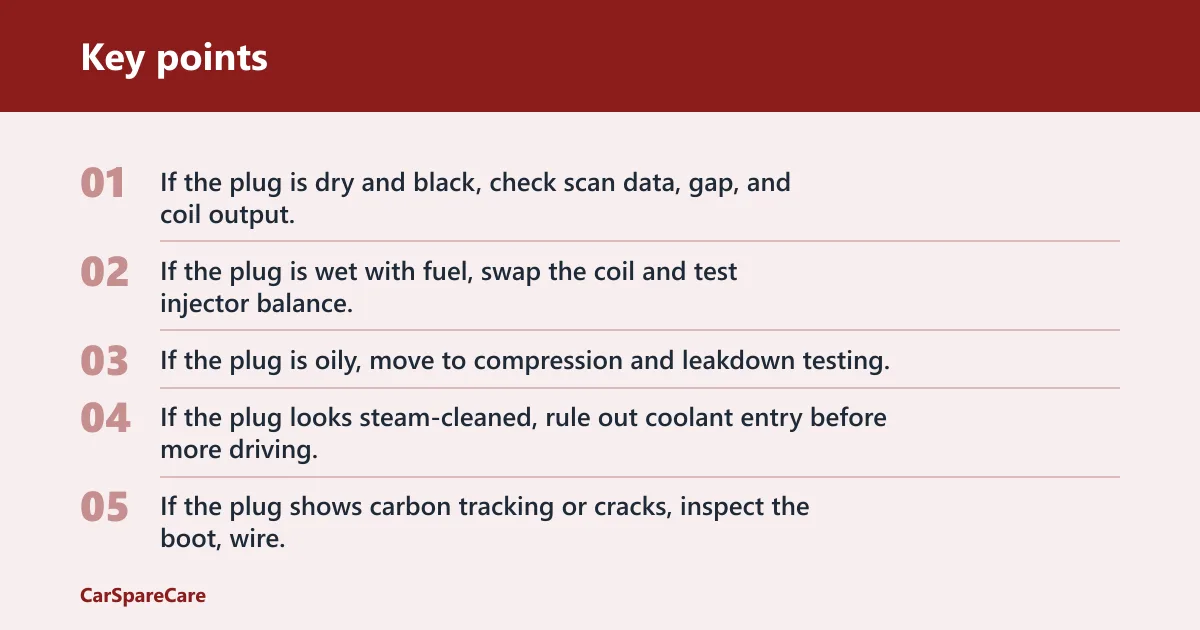
- If the plug is dry and black, check scan data, gap, and coil output.
- If the plug is wet with fuel, swap the coil and test injector balance.
- If the plug is oily, move to compression and leakdown testing.
- If the plug looks steam-cleaned, rule out coolant entry before more driving.
- If the plug shows carbon tracking or cracks, inspect the boot, wire, and porcelain closely.
Could the ignition parts be causing it?
Yes. A weak coil, bad boot, or damaged wire can mimic a bad plug very closely. Coil-on-plug systems fail at the coil or boot on one cylinder, while coil pack systems can fail through a shared coil tower or wire. The clue is often a repeat misfire that follows the ignition part, not the spark plug itself.
Weak coil symptoms and coil-on-plug checks
A weak spark can cause dry fouling, hard starting, and a cylinder that drops out more under load than at idle. On coil-on-plug engines, swap the coil with another cylinder if the design allows it. If the misfire follows the coil, the coil is the suspect. If it stays with the cylinder, keep testing.
Primary and secondary coil failure
Primary failure means the coil is not being charged or switched correctly. Secondary failure means the coil cannot send high voltage to the plug gap. A scan tool, a known-good swap, or a scope pattern can help separate those faults from a plug problem.
Boot, wire, arcing, and heat damage
Check the boot for carbon tracks, splits, swelling, and burnt spots. Measure wire resistance if the engine uses plug wires; high or open resistance can weaken spark delivery. Heat damage is common near exhaust manifolds and valve covers, where a brittle boot may leak voltage before it reaches the plug.
Could fuel delivery be flooding one cylinder?
Yes. A stuck-open or leaking injector can flood one cylinder and foul the plug even when the spark plug brand is changed. Spray pattern problems can also make one cylinder run rich enough to leave a wet, dark, or sooty plug while the others look normal. Scan data and injector testing come before parts swapping.
Stuck-open or leaking injector signs
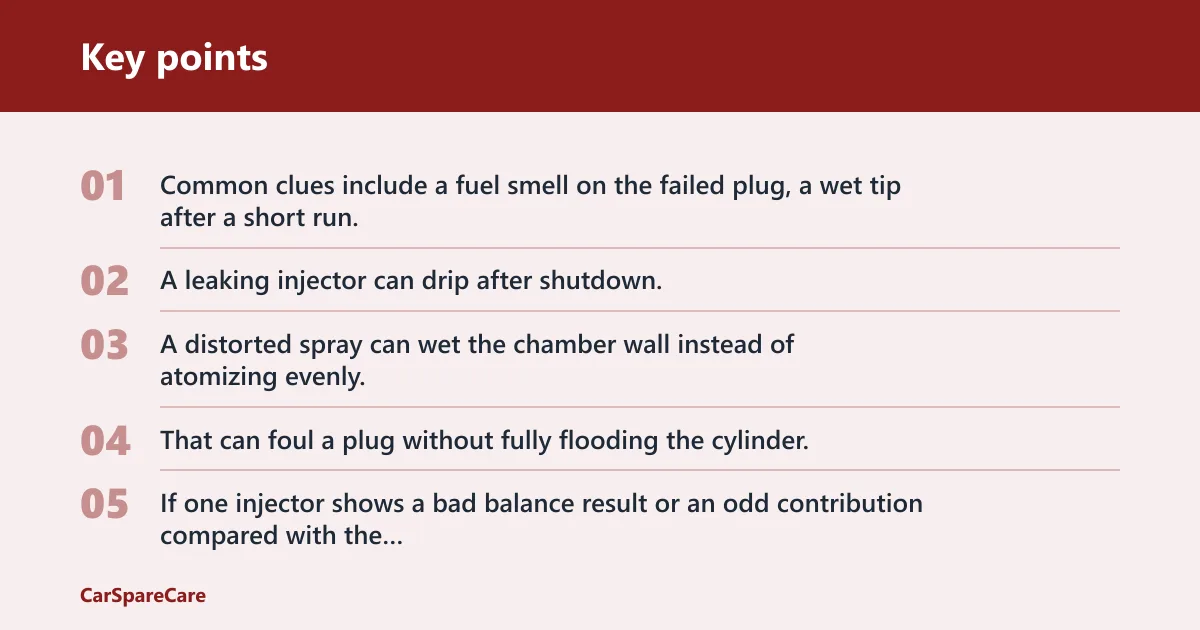
Common clues include a fuel smell on the failed plug, a wet tip after a short run, hard hot restarts, and a single cylinder with a persistent rich misfire. A leaking injector can drip after shutdown, so the cylinder starts over-fueled on the next start.
Spray pattern problems and cylinder-rich conditions
A distorted spray can wet the chamber wall instead of atomizing evenly. That can foul a plug without fully flooding the cylinder. If one injector shows a bad balance result or an odd contribution compared with the others, that cylinder deserves closer fuel-system testing before the plug is replaced again.
What scan data can suggest before parts are swapped
Look at short-term and long-term fuel trims, misfire counts, and freeze-frame data. If the ECU shows a single-cylinder misfire with normal trims, the fault may be local to that cylinder. If fuel trims are extreme across the bank, the issue may be broader than one injector.
Say your 2.0L four-cylinder shows P0302, and cylinder 2 plug comes out wet with fuel while the others are tan. Swapping the coil to cylinder 3 and watching whether the misfire moves is a fast way to separate ignition failure from injector flooding before you buy parts.
Mechanical faults that keep one plug dirty
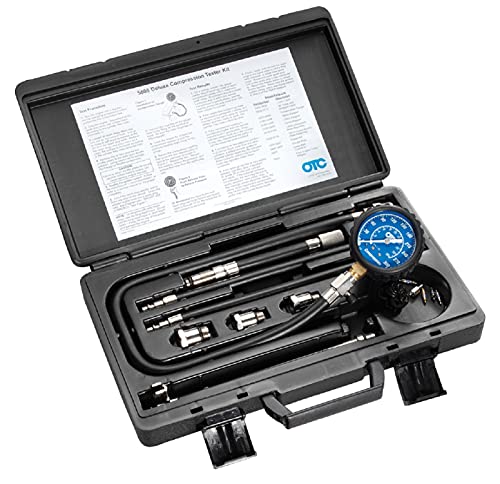
Mechanical faults can keep a plug dirty even when ignition and fuel parts are new. Low compression, poor valve sealing, ring wear, or head gasket leakage can all leave one cylinder unable to burn the mixture properly. That is why repeat failure on one cylinder often needs a compression test and then a leakdown test.
Low compression and cylinder-to-cylinder comparison
Use a compression test to compare all cylinders, not just the bad one. A low cylinder that is far below its neighbors points to a mechanical problem, not a spark plug problem. Uniformly low readings across several cylinders suggest a different issue than one isolated low hole.
Leakdown test follow-up
If compression is low, a leakdown test helps show where the pressure escapes. Air heard at the intake can point toward an intake valve leak, at the exhaust toward an exhaust valve leak, and in the crankcase toward ring leakage. Bubbles in the cooling system suggest a head gasket or related sealing fault.
Valve stem seals, piston rings, and head gasket leaks
Valve stem seal wear often leaves oil fouling after idling or deceleration. Piston ring wear can create ongoing oil use and oily deposits on the plug. A head gasket leak may steam-clean the plug and may also be associated with coolant loss, sweet-smell exhaust, or unexplained overheating.
Oil in the plug well or boot
Oil outside the plug is different from oil on the electrode. Oil inside the plug well usually comes from a valve cover tube seal or spark plug well seal leak. That oil can soak the coil boot, encourage carbon tracking, and weaken spark before the plug even fires.
Valve cover tube seal and spark plug well seal leaks
Look down the plug tube with the coil removed. Wet oil in the well, dirt stuck to the oil, and a swollen boot point to a cover or well seal leak. If the threads and electrode look normal but the outside of the plug is oily, the leak may be above the combustion chamber.
How oil contamination damages the coil boot
Oil softens some boot materials, attracts grit, and can create a path for voltage leakage. Over time, the boot may carbon-track or arc. Once that happens, the boot may continue to leak even after the well is cleaned, so replacement is often needed.
Why the plug itself can keep failing
The plug can be part of the problem, but it is rarely the whole story. Heat range, gap, electrode wear, insulator cracking, and thread condition all matter. If the wrong plug or a damaged installation is in that cylinder, repeat failure can happen even with healthy ignition and fuel systems.
Heat range and gap specification
A plug with the wrong heat range can run too hot or too cold for the engine’s needs. Gap matters too. If the gap is too wide, the coil must work harder; if it is too tight, combustion can be less reliable under load. Most manufacturers list a specific gap for a reason.
Electrode wear and insulator cracking
Worn electrodes need more voltage to fire, which can expose a weak coil or boot problem. Cracked porcelain can let spark escape to ground or create a misfire path outside the gap. Any crack in the insulator makes the plug suspect, even if the tip still looks usable.
Thread damage, cross-threading, and torque loss
Loose plugs can leak compression and hot gas past the seat. Over-tightening can damage aluminum head threads, crack the plug shell, or make later removal risky. Cross-threading can ruin the cylinder head and leave the plug unable to seal correctly, which can mimic a bad plug or cause one.
A common first-timer mistake is replacing the same cylinder’s plug three times without checking the well seal. If oil was sitting around the boot, the new plug can fail again from arcing or contamination even though the plug itself was not the original fault.
Frequently asked questions
What causes one spark plug to keep failing?
One plug that keeps failing usually points to a cylinder-specific fault: a leaking injector, weak coil, oil in the plug well, low compression, coolant entry, or damaged threads. The key is to read the failed plug first, then test the matching system in order instead of replacing parts at random.
What causes spark plugs to go bad?
Spark plugs go bad from normal electrode wear, incorrect gap, heat stress, fouling, contamination, or mechanical damage. A plug can also look bad because another part is causing the cylinder to misfire. That is why the plug’s appearance should guide the next test, not end the diagnosis.
How does a spark plug fail?
A plug fails when it can no longer fire the gap reliably or when deposits, cracks, or damage prevent normal combustion. The failure may be gradual from wear, or sudden from oil, fuel, coolant, arcing, or thread damage. The plug often shows evidence that points to the real cause.
What causes weak spark at spark plugs?
Weak spark often comes from a failing coil, damaged boot or wire, excessive plug gap, poor coil power or ground, or voltage leakage from carbon tracking. A weak spark may still fire at idle but fail under load, which makes the cylinder misfire more often when demand rises.
What causes spark plugs to foul quickly?
Quick fouling usually means the cylinder is running rich, burning oil, or not burning the mixture completely because spark is weak. Coolant entry can also foul a plug fast. If the new plug fouls again in the same cylinder, stop replacing plugs and find the source of the contamination.
Why does the same spark plug keep burning out?
The same plug keeps burning out when that cylinder has a repeat stressor such as overheating, a too-lean condition, the wrong heat range, a bad injector, or poor compression. A plug brand change will not fix a cylinder fault. The repeat failure is the clue, not the solution.

Hi, I’m Melvin, an automobile engineer with extensive experience in automobile equipment. I currently work for a local automobile firm, where I specialize in the car parts industry. I’ve had the opportunity to collaborate with seasoned inspectors, gaining invaluable hands-on experience that goes beyond just theory.
My passion for automotive care started at a young age, which led me to create CarSpareCare. Through CarSpareCare, I share the knowledge and skills I’ve acquired over the years to help others navigate the world of car maintenance and repairs.
My goal is to provide practical tutorials, essential safety advice, and the latest industry insights so that anyone—whether a beginner or an expert—can confidently tackle their automotive projects.