
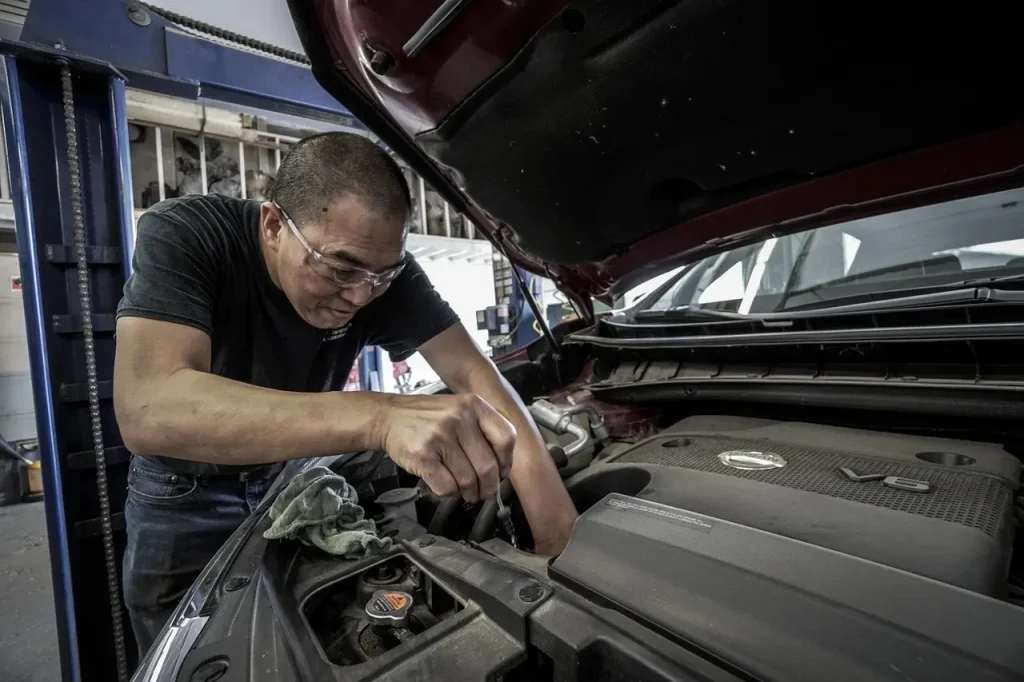
Check cabin airflow first, then refrigerant charge, then compressor or control faults: if the vents are weak at high fan speed, start with the cabin filter or a blocked condenser, while a hot line at the firewall points elsewhere. Ignoring weak AC can leave you with long defrost times, higher cabin temperatures, and a repair bill that climbs fast. Use this order to find the least expensive likely fix before summer heat arrives.
Diagnose airflow vs cooling problems


Start by separating weak airflow from weak cooling. If the fan feels low on every setting, look at the cabin filter, blower motor, and speed control. If airflow is strong but the air is only mildly cool or turns warm, focus on refrigerant charge, condenser airflow, compressor operation, and pressure control.
What you’ll need
- Flashlight
- Gloves
- Cabin air filter access tools, such as a trim tool or screwdriver
- Basic hand tools for covers and fasteners
- Optional scan tool with HVAC data
- Optional manifold gauges for system pressure checks
- UV dye or an electronic leak detector for leak confirmation
AC weak-cooling decision table
| Symptom | Most likely cause | Next check |
|---|---|---|
| Weak airflow at every vent speed | Cabin air filter restriction or blower motor output problem | Remove the filter and compare airflow with it out |
| Cool at speed, warm at idle | Condenser airflow problem, weak condenser fan, or low refrigerant | Inspect the condenser face and fan operation at idle |
| Cold for 10 to 20 minutes, then warm | Pressure switch or sensor fault, compressor cycling issue, or low charge | Watch compressor command and pressure behavior with a scan tool or gauges |
| Clicking but no cold air | Compressor clutch slipping, compressor fault, or low refrigerant protection logic | Check clutch engagement and belt drive at idle |
| One side cold, the other warm on dual-zone systems | Blend door fault or temperature door actuator problem | Change both zones from full cold to full hot and listen for actuator movement |
| Air is cold only after driving at road speed | Condenser airflow is weak at idle | Inspect for blocked fins, debris, and fan control issues |
| Air starts cold, then slowly turns warm on the same trip | Low refrigerant, overcharge, or a restriction at the expansion valve or orifice tube | Have pressures checked before any recharge |
| No compressor sound and no cooling | A/C pressure switch, sensor, relay, or clutch control fault | Check fuses, relay command, and scan data |
| Cooling improves after bumping the fan to high | Cabin side airflow restriction | Inspect the cabin filter and blower speed control |
| Cool air fades when stopped in traffic | Condenser blockage, weak condenser fan, or refrigerant charge issue | Inspect the front of the condenser and fan operation at idle |
| Front-end belt squeal with poor cooling on belt-driven systems | Serpentine belt wear or low belt tension | Inspect the belt for cracks, glazing, and tension |
| Cooling is weak after recent service | Incorrect refrigerant type, overcharge, or leak still present | Verify the correct refrigerant specification and check for leaks |
What should you check first?
Check the cabin side first, because it is cheaper and faster than opening the refrigerant circuit. A dirty cabin air filter can cut airflow enough to feel like weak AC. If airflow is fine, move to the condenser and fan, then the blower motor and its speed control.
Cabin filter and blower airflow
- Set the fan to high and the temperature to full cold.
- Compare the airflow at each vent setting.
- Remove the cabin air filter and inspect it for dirt, leaves, and debris.
- Replace it if the pleats are packed or collapsed.
- If airflow stays weak with the filter out, check the blower motor and speed control module or resistor.
A restricted filter usually causes low cabin airflow, not a true cooling failure. If the fan sounds normal but the air still feels thin, the blower motor or its speed control may be losing output.
Condenser blockage and front-end airflow
- Open the hood and inspect the condenser face from the front grille side.
- Clear leaves, insects, and road debris from the fins.
- Look for bent fins, crushed sections, or impact damage.
- Check that the condenser fan runs when the AC is on and the engine is idling.
Say your car blows cold at 35 mph but turns warm at a stoplight. That pattern often points to condenser airflow, not the cabin filter. A blocked front heat exchanger cannot shed heat well when road speed drops.
How do you check the AC system?
Once airflow checks out, move to the refrigerant circuit and compressor control. Weak cooling after about 10 to 20 minutes, or a system that changes behavior with engine speed, often points to pressure testing and electrical diagnosis before parts are replaced.
Compressor and clutch operation
- With the engine idling and AC on, watch whether the compressor clutch engages on belt-driven systems.
- Listen for repeated clicking, slipping, or harsh cycling.
- On electrically driven compressors, confirm that the scan tool shows an AC request and compressor command.
- If the compressor does not engage, check the relay, fuse, and control signal before replacing hardware.
The compressor moves refrigerant through the system. If it does not engage, or if it slips under load, cooling falls off fast. Electrical compressors can fail without a clutch, so command data matters.
Serpentine belt and drive tension
- Inspect the serpentine belt for cracks, glazing, frayed edges, or contamination.
- Check belt tension and listen for squeal when the AC starts.
- Confirm that the belt drives other accessories normally, since many systems share one belt path.
If the belt is glazed or loose, the compressor may not spin at the needed speed. That can show up as weak cooling, especially at idle or on hot days.
Refrigerant charge, leaks, and pressure behavior
- Check system pressures with the proper manifold gauges or a scan tool that shows pressure sensor data.
- Compare the reading with the vehicle’s specified refrigerant type and charge procedure.
- Look for leak evidence at fittings, hoses, the condenser, and compressor seals.
- Use UV dye or an electronic leak detector to confirm the source before recharging.
Low refrigerant usually suggests there is a leak. Overcharge can also hurt cooling, raise pressures, and create odd cycling. Refrigerant work must use the correct refrigerant type, and leaks should be repaired before any recharge.
Pressure switch, sensor, and metering faults
- Scan for HVAC or powertrain fault codes.
- Watch whether the A/C pressure switch or pressure sensor is inhibiting compressor command.
- If pressures look abnormal, suspect the expansion valve or orifice tube.
- Stop at this point and schedule a shop diagnosis if the readings do not make sense.
An expansion valve or orifice tube meters refrigerant flow. If it sticks or clogs, pressure and temperature patterns go wrong in ways that are hard to confirm without gauges and experience.
Could a simple clean fix it?
Yes, if the problem is airflow restriction rather than a sealed-system fault. Cleaning the condenser and replacing a plugged cabin filter can restore normal output when the compressor and refrigerant charge are otherwise healthy. Do not expect cleaning to fix sensor faults or leaks.
Simple clean or replace steps
- Blow out the condenser face from the back side if access allows, or rinse it gently from the front with low pressure water.
- Replace the cabin air filter if it is dirty or overdue.
- Recheck vent temperature and airflow with the engine idling and again at road speed.
Suppose the cabin filter is packed with dust and the vents improve immediately after replacement. That is a good sign the system was airflow-limited, not refrigerant-limited. If the improvement is small, continue with pressure and control diagnosis.
Common mistakes
Most weak-AC repairs go wrong because the first symptom is misread. A weak fan is not the same as weak cooling, and a recharge is not a fix unless the leak is found and repaired first. Intermittent problems deserve extra attention.
- Recharging without finding a leak: the system will usually lose refrigerant again.
- Confusing low airflow with low cooling: inspect the filter and blower before the refrigerant circuit.
- Ignoring cooling that fades after 10 to 20 minutes: that pattern often points to pressure control or compressor control faults.
- Skipping condenser airflow checks: leaves, insects, and bent fins can mimic a bigger failure.
- Replacing the compressor too early: check belt drive, clutch engagement, relay control, and pressure data first.
- Using the wrong refrigerant: service must match the vehicle specification exactly.
If that didn’t work, try this next
If the basic checks do not restore cooling, move from the cheapest likely fix to the more invasive one. That order helps you avoid buying parts for a problem that is actually electrical, airflow-related, or leak-related.
- Replace the cabin air filter if airflow is low.
- Clean the condenser and confirm fan operation.
- Inspect the serpentine belt on belt-driven systems.
- Check compressor clutch engagement or compressor command data.
- Test refrigerant pressure and look for leaks with UV dye or an electronic detector.
- Book a shop diagnosis for pressure-switch, sensor, expansion-valve, or intermittent faults.
A common first-timer mistake is replacing a compressor because the air is warm, then finding the real fault was a bad pressure sensor or a blocked condenser. Start with the least expensive likely fix.
Frequently asked questions
Car ac stops cooling after some time
That pattern often points to a pressure switch, pressure sensor, compressor control issue, or a refrigerant charge problem. Check whether the compressor is still being commanded on when the air turns warm. If it is not, scan for HVAC codes and compare pressures before replacing parts.
No cold air from car ac
No cold air can come from no compressor engagement, very low refrigerant, or a severe airflow restriction. Check the cabin filter first, then watch the compressor at idle. If the compressor never engages, inspect the relay, fuse, pressure switch, and belt drive before considering deeper repairs.
Should you run car ac in winter?
Yes, periodically. Running the AC for a short time can help keep seals and the compressor lubricated, and it can help clear humid air from the cabin. If the system cycles oddly or only works sometimes, have the fault checked instead of assuming winter use caused it.

Hi, I’m Melvin, an automobile engineer with extensive experience in automobile equipment. I currently work for a local automobile firm, where I specialize in the car parts industry. I’ve had the opportunity to collaborate with seasoned inspectors, gaining invaluable hands-on experience that goes beyond just theory.
My passion for automotive care started at a young age, which led me to create CarSpareCare. Through CarSpareCare, I share the knowledge and skills I’ve acquired over the years to help others navigate the world of car maintenance and repairs.
My goal is to provide practical tutorials, essential safety advice, and the latest industry insights so that anyone—whether a beginner or an expert—can confidently tackle their automotive projects.

