
No. If brake fluid is actively leaking, do not keep driving. Stop, check the fluid level, and tow the car if the pedal feels soft or sinks. Driving with a leak can lead to partial or total brake failure, longer stopping distances, and possible damage if the system runs dry. This guide explains how to tell active leak from seepage or non-brake fluid, when you can inspect first, and which brake parts usually mean high, medium, or low risk.
Brake fluid leak decision matrix

Use this table to sort the most common signs into a drive-or-stop decision. A small stain by itself is not proof, but a soft pedal, red warning light, or fluid at a wheel should move the risk level up fast.
| Symptom | Likely source | Immediate risk level | Whether to drive | Next action |
|---|---|---|---|---|
| Clear to light yellow wet spot near a front wheel, brake dust stained, pedal still firm | Front brake hose, caliper piston seal, or bleeder valve | Medium to high | Do not drive farther than needed to move to a safe spot | Check reservoir level, inspect the wheel for wetness, and arrange tow or repair |
| Wet spot near a rear wheel, fluid on backing plate or inside drum, pedal changes feel | Rear wheel cylinder or rear hose | High | Do not drive | Park it, avoid the parking brake if a drum is soaked, and arrange towing |
| Low reservoir with no visible wheel leak, red brake warning light, or sinking pedal | Master cylinder, hidden line leak, or external leak elsewhere in the system | High | Do not drive | Stop the trip, inspect under the car, and arrange towing or roadside help |
| Small dampness on a line fitting, no drip, no warning light, no pedal change | Brake line or connection seepage | Medium | Only to reposition the car, not for normal driving | Confirm whether the spot grows after pedal pressure, then schedule immediate repair |
| Fluid under the car beneath the brake pedal area, reservoir dropping, pedal soft | Master cylinder or line near the firewall | High | Do not drive | Tow the car; do not assume the leak is minor |
Is it safe to drive with a brake fluid leak?
No, not if the leak is active. Brake fluid carries pedal force to the brakes at each wheel, so losing fluid can cut hydraulic pressure and reduce the vehicle’s stopping ability. A soft brake pedal means you should stop driving and arrange towing or a mechanic.
A tiny seep is different from a drip. A damp fitting that does not grow, and does not change pedal feel, may be a warning sign that needs quick repair rather than an immediate tow. Once the spot spreads, the reservoir drops, or the pedal sinks, the risk changes fast.
Do a safe check before moving the car: look under it for fresh fluid, check the reservoir level, and press the pedal only enough to judge firmness. If the pedal feels soft, sinks, or changes feel during the stop, end the trip there.
Say your front left wheel is wet after parking, and the fluid is clear to light yellow. That points toward a brake hose or caliper leak at the wheel end. Even if the car still stops, fluid can keep escaping and the pad or rotor may already be contaminated.
Active leak versus slow seep
An active leak usually shows fresh wetness, a growing puddle, or a pedal that loses height. That is not a “watch it” situation. A slow seep may leave only a shiny film on a fitting, but it still needs prompt repair because braking loads, cornering, and ABS use can turn a seep into a larger failure.
When towing is the safer call
Towing is the safer call as soon as the pedal feels soft, sinks, or the red brake warning light comes on. Towing is also the right choice if fluid is visible on a wheel, under the car, or inside a drum. Do not count on the leak staying small on the drive.
What happens when brake fluid leaks?
When brake fluid leaks, the system can lose hydraulic pressure. That means the pedal travels farther before the brakes apply force, or it may sink without building normal braking force. Continuing to drive can increase stopping distance and collision risk.
Wheel-end leaks can create another problem: contamination. Fluid can soak pads on disc brakes or shoes on drum brakes. Once friction material is soaked, braking performance can stay poor even after the leak is fixed unless those parts are replaced.
Soft or sinking pedal feel
A soft or sinking brake pedal is a key symptom of hydraulic pressure loss. It can indicate air in the lines or an active leak. If the pedal goes lower than usual, the car should not be driven until the cause is found and corrected.
Suppose you press the pedal at a stop sign and it feels normal at first, then sinks farther when you hold pressure. That change is a warning sign, not a quirk. Stop driving, because a system that cannot hold pressure can fail again on the next stop.
Longer stopping distance and uneven braking
Brake fluid loss can lengthen stopping distance because each wheel may receive less hydraulic force. A leak at one corner can also create uneven braking, especially if one wheel end is contaminated and the others are still dry. That imbalance can make the vehicle pull or stop unpredictably.
Where the leak is coming
Location matters. A leak near a wheel points to wheel-end parts, while fluid under the car near the center or firewall points more toward a line or master-cylinder issue. Appearance helps, but it is not proof on its own.
Brake line and brake hose leaks
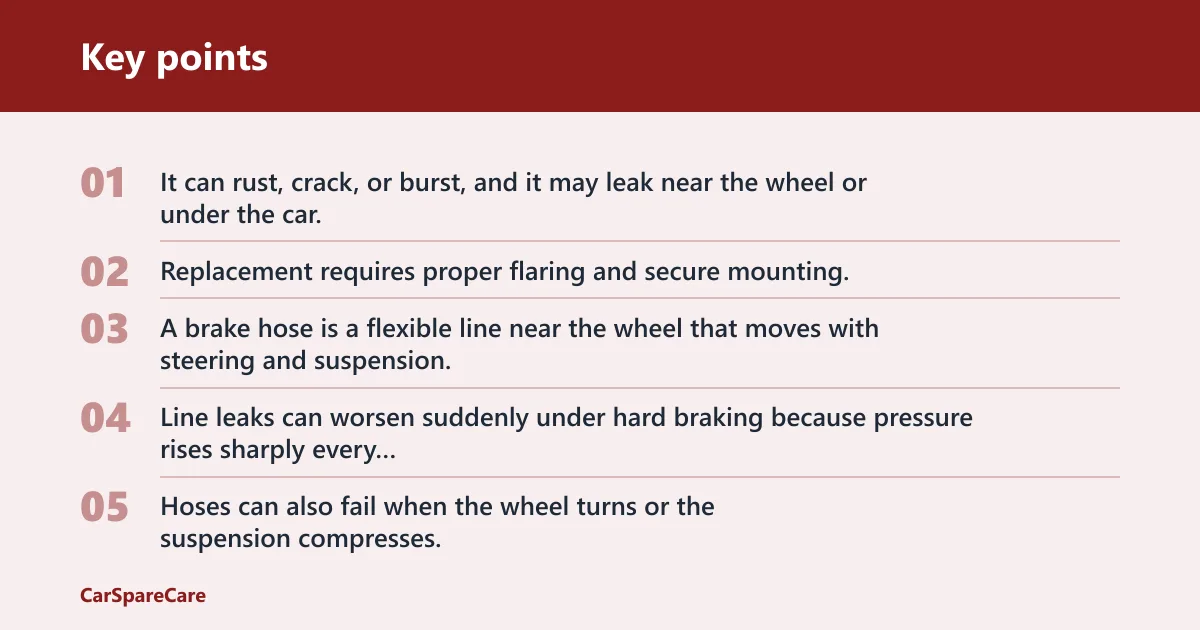
A brake line is a metal hydraulic line. It can rust, crack, or burst, and it may leak near the wheel or under the car. Replacement requires proper flaring and secure mounting. A brake hose is a flexible line near the wheel that moves with steering and suspension; it can crack, swell, or split and usually requires replacement, not patching.
Line leaks can worsen suddenly under hard braking because pressure rises sharply every time you press the pedal. Hoses can also fail when the wheel turns or the suspension compresses, so a hose that only seeps at rest can still burst on the road.
Brake caliper and wheel cylinder leaks
A brake caliper is the wheel-end hydraulic component on disc brakes. It can leak from piston seals or a bleeder valve, and it may contaminate pads and the rotor. Replacement or rebuild may be required. A wheel cylinder is the wheel-end hydraulic component on drum brakes. It can leak internally or externally, and contaminated shoes often need replacement too.
These leaks are serious because they sit right at the braking surface. Fluid on pads or shoes is not a cosmetic issue; it can make the friction parts slippery and reduce braking at that wheel until the parts are replaced.
Master cylinder and low reservoir clues
The master cylinder is the central hydraulic pressure source. A low reservoir may indicate a leak, and the cylinder can fail internally or externally. If the reservoir is low and the pedal is sinking, treat it as a high-risk fault even if you cannot see fluid on the ground.
One clue is where the fluid appears. A leak under the car beneath the brake pedal area can point toward the master cylinder or a nearby line at the firewall. That location is different from a wheel-end leak and should not be treated the same way.
Is it safe to drive with a brake line leak?
No. A brake line leak is unsafe to drive on because the line carries hydraulic pressure to the brakes, and a failed line can lose pressure quickly. If the pedal is soft, the reservoir is dropping, or you see fluid under the car, stop driving and arrange towing.
Brake lines can fail without much warning. Rust, vibration, and road debris can weaken a metal line until it cracks or bursts. The leak may be under the car or near a wheel, and the loss can become much worse the first time you brake hard.
Front wheel, rear wheel, and under-car locations
A front wheel leak often shows up as wetness around the caliper, hose, or inside the wheel area. A rear wheel leak may come from the wheel cylinder or rear hose. A leak under the car can point to a line or the master cylinder. The risk is high in all three cases if the fluid is fresh or the pedal changes feel.
Why repair usually means replacement and bleeding
Brake line repair usually means replacing the damaged section, not patching it. The system also needs brake bleeding after the repair to remove air and restore firm pedal feel. Without bleeding, the pedal can stay soft even after the leak is fixed.
What the warning signs mean
Warning signs matter because they tell you how much pressure the system may have left. A red brake warning light, low reservoir, soft pedal, or fluid near a wheel should be treated as a stop-driving event, not a normal maintenance reminder.
Red brake warning light
The red brake warning light may indicate low fluid or a braking-system fault. Do not ignore it. If it comes on together with a soft pedal or visible fluid, the safest response is to stop and arrange towing.
Fluid on the ground, wheel, or inside a drum
Brake fluid can appear under the car beneath the brake pedal, near a wheel, or inside a drum. Fresh fluid may be clear to light yellow, but age and contamination can darken it. Color is only a clue. The source still needs confirmation before anyone decides it is safe to drive.
Safe checks before moving the car
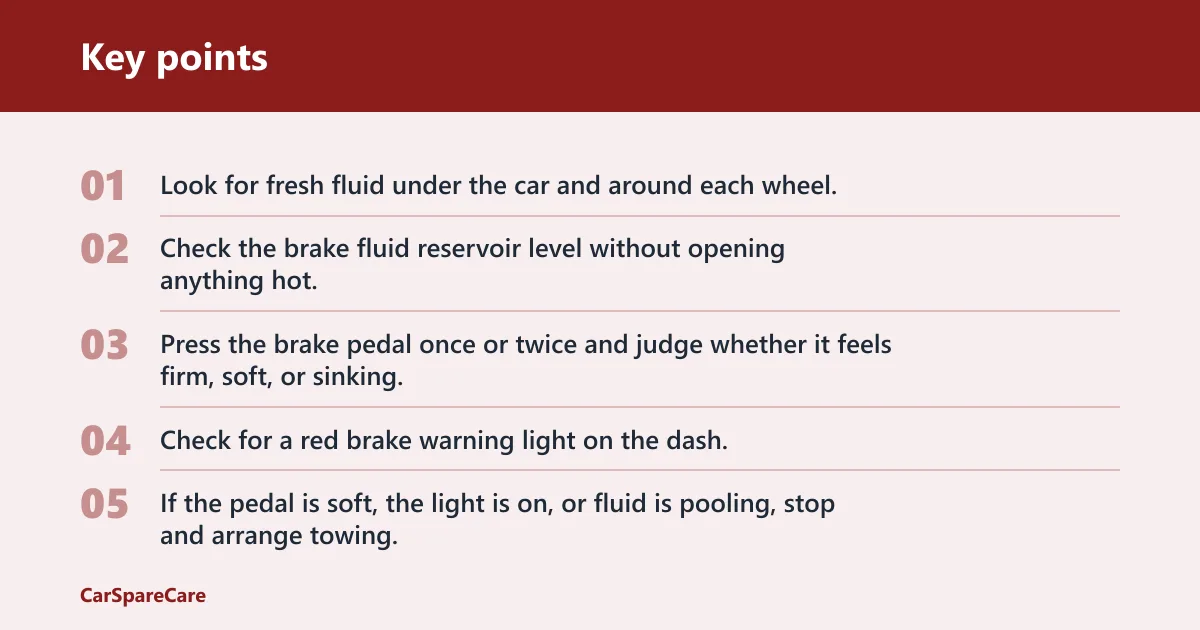
- Look for fresh fluid under the car and around each wheel.
- Check the brake fluid reservoir level without opening anything hot.
- Press the brake pedal once or twice and judge whether it feels firm, soft, or sinking.
- Check for a red brake warning light on the dash.
- If the pedal is soft, the light is on, or fluid is pooling, stop and arrange towing.
Brake fluid leak repair basics
Repair starts with the source, not the stain. A leaking hose, line, caliper, wheel cylinder, or master cylinder usually needs part replacement or rebuild. Patch work is not a safe fix for brake hydraulics.
After a wheel-end leak, inspect the pads, shoes, and rotor or drum surfaces for contamination. Fluid-soaked friction parts often need replacement because the leak can leave them unable to grip properly. Once the repair is complete, the system needs brake bleeding to remove air and restore pedal feel.
Is it expensive to fix a brake fluid leak? The answer depends on the source. A hose or line repair is usually less involved than a caliper, wheel cylinder, or master-cylinder job, and contaminated pads or shoes add labor and parts. The longer the leak runs, the higher the repair bill can climb.
Frequently asked questions
Is it dangerous to drive with a brake fluid leak?
Yes. It is dangerous because braking force depends on hydraulic pressure, and a leak can reduce that pressure fast. Continuing to drive can increase stopping distance and collision risk. The danger rises sharply if the pedal sinks, the reservoir is low, or the warning light is on.
Can you drive with a brake fluid leak?
Only in the narrow sense of moving the car a very short distance to a safe spot, and only if the pedal still feels firm. That is not the same as normal driving. If the pedal is soft, the leak is active, or the light is on, do not keep going.
What happens when your brake fluid leaks?
The system can lose hydraulic pressure, which reduces braking force at the wheels. You may feel a soft or sinking pedal, longer stopping distances, or uneven braking. Wheel-end leaks can also soak pads or shoes, so the repair may involve more than the leaking part.
What should I do if my brake pedal feels soft and I see a leak?
Stop driving immediately. A soft brake pedal means you should stop driving and arrange towing or a mechanic. Check the reservoir only if it is safe to do so, then avoid further driving until the leak source is found and the brakes are repaired and bled.

Hi, I’m Melvin, an automobile engineer with extensive experience in automobile equipment. I currently work for a local automobile firm, where I specialize in the car parts industry. I’ve had the opportunity to collaborate with seasoned inspectors, gaining invaluable hands-on experience that goes beyond just theory.
My passion for automotive care started at a young age, which led me to create CarSpareCare. Through CarSpareCare, I share the knowledge and skills I’ve acquired over the years to help others navigate the world of car maintenance and repairs.
My goal is to provide practical tutorials, essential safety advice, and the latest industry insights so that anyone—whether a beginner or an expert—can confidently tackle their automotive projects.

