A flat 12V car battery often needs about 4 to 24 hours to charge at home; a 2-amp charger can take overnight, while a 10-amp charger commonly needs about 2 to 6 hours for a moderate discharge. Charging too fast can overheat a weak battery, and charging too slowly can leave you with a battery that still won’t start the engine. This guide shows how to estimate charge time from battery capacity, charger amps, depth of discharge, temperature, and battery condition.
This guide is part of our Car battery maintenance guide series.
Quick answer and time ranges
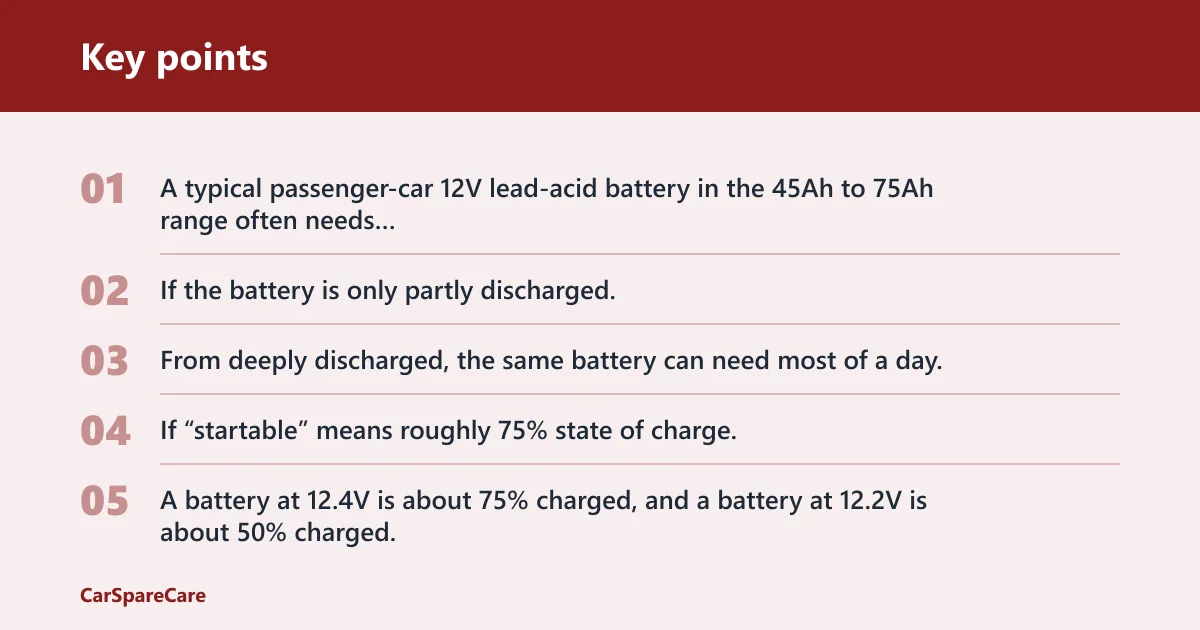



A typical passenger-car 12V lead-acid battery in the 45Ah to 75Ah range often needs several hours to recover enough charge to start the engine, and longer to reach full charge. If the battery is only partly discharged, a 6A to 10A charger may get it to a startable state in a few hours. From deeply discharged, the same battery can need most of a day.
Typical charge time from flat to startable
If “startable” means roughly 75% state of charge, many home chargers are commonly reported to get there in about 3 to 10 hours for a mid-size battery, depending on the starting state, charger amperage, and battery health. A battery at 12.4V is about 75% charged, and a battery at 12.2V is about 50% charged, so the starting voltage matters.
Typical charge time from flat to full
Full charge takes longer than startable charge because the last 20% rises more slowly during the absorption stage. A 12V battery at 12.6V or higher is about 100% charged. For a battery that is already partly discharged, full charge often lands in the 6 to 24 hour range at home, with slower chargers taking the longest.
Why a dead battery is not always dead
A battery that seems dead is often discharged, not ruined. That said, a deeply discharged, old, sulfated, or cold battery can accept charge slowly and may never return to full capacity. The same battery can also charge differently after a jump start because a jump only helps the engine run; it does not fully recharge the battery.
📊 A full charge takes longer because the last 20% is the slowest part. Source: Batterytender.
What changes charging time
Charging time depends on amp-hour capacity, charger amperage, starting state of charge, battery health, and temperature. A larger battery takes longer than a smaller one at the same charger setting. A weaker battery can also spend longer in absorption, where current tapers as the charge nears full.
Battery capacity in amp-hours
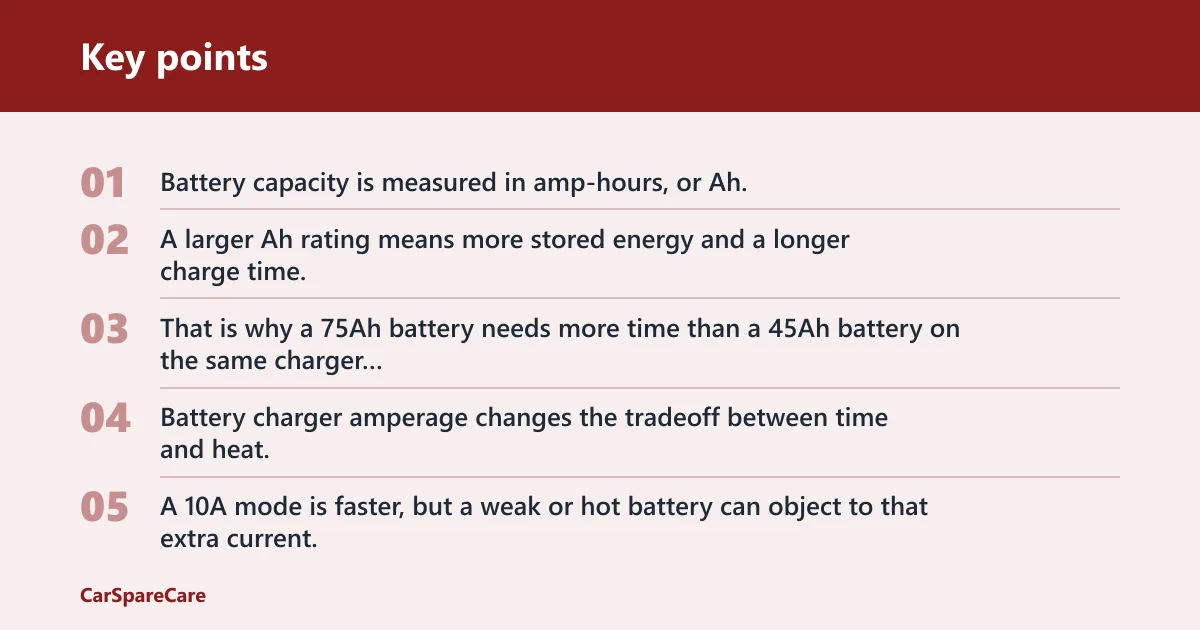
Battery capacity is measured in amp-hours, or Ah. Most sedan batteries hold 45 to 75Ah. A larger Ah rating means more stored energy and a longer charge time. That is why a 75Ah battery needs more time than a 45Ah battery on the same charger setting.
Charger amperage and heat
Battery charger amperage changes the tradeoff between time and heat. A 2A trickle charge is gentle but slow. A 10A mode is faster, but a weak or hot battery can object to that extra current. Higher amps are useful when you need a faster turnaround, but they are not automatically better.
Battery age, sulfation, and depth of discharge
Deep discharge can slow charging and reduce capacity. Older batteries often develop sulfation, which makes them harder to bring back to a full charge. A battery that has been repeatedly run flat may show a normal resting voltage after charging, then fall back quickly under load.
Say your 60Ah battery reads 12.2V after sitting overnight. That is about 50% charged, not fully dead. A 6A charger can often move it back toward a startable state in roughly half the time a 3A charger would need, but the final stretch will still slow down near full.
Charging time matrix
The table below uses a simple estimate: time = amp-hours needed ÷ charger amps, then add about 20% for charging losses. Battery Tender recommends adding about 20% for charging losses. The estimates assume the battery starts at about 25% state of charge, which matches a 12.0V resting reading.
| Battery size | 2A to startable | 4A to startable | 6A to startable | 8A to startable | 10A to startable | 2A to full | 4A to full | 6A to full | 8A to full | 10A to full | Notes |
|---|---|---|---|---|---|---|---|---|---|---|---|
| 45Ah | 13.5 h | 6.8 h | 4.5 h | 3.4 h | 2.7 h | 20.3 h | 10.1 h | 6.8 h | 5.1 h | 4.1 h | Cold weather slows acceptance; old batteries may never reach full; AGM may accept current efficiently but still tapers near the top. |
| 60Ah | 18 h | 9 h | 6 h | 4.5 h | 3.6 h | 27 h | 13.5 h | 9 h | 6.8 h | 5.4 h | Matches the common 60Ah example: 50% discharged needs about 3.75 hours at 8 amps before losses, then about 20% more for losses. |
| 75Ah | 22.5 h | 11.3 h | 7.5 h | 5.6 h | 4.5 h | 33.8 h | 16.9 h | 11.3 h | 8.4 h | 6.8 h | Larger batteries stretch the schedule; cold, aged, or deeply discharged batteries can take longer than the table suggests. |
How to read the table: “Startable” here means about 75% charged, which is usually enough for a healthy engine and starter system. “Full” means about 100%, which is where the charger enters absorption and current tapers off. If the battery is below freezing or heavily sulfated, allow extra time.
How to estimate charge time
You can estimate charge time with a simple calculation. First, work out how many amp-hours you need to put back. Then divide by charger amperage. Finally, add time for losses and taper near full. This gives a practical home estimate instead of a vague range.
Use amp-hours and charger amps
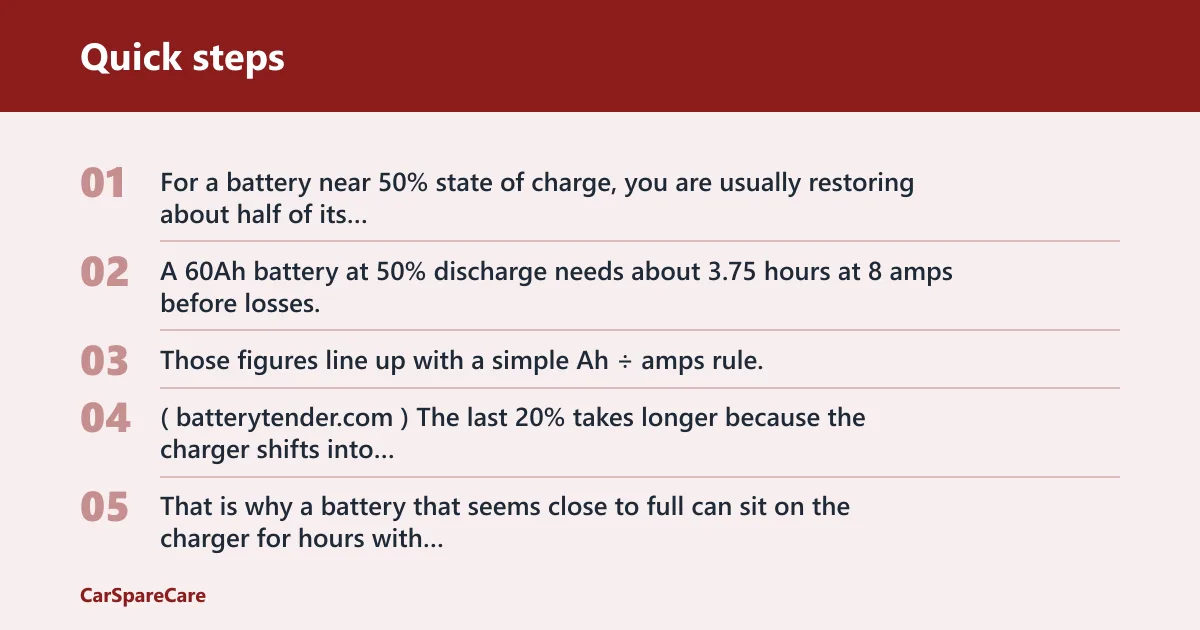
For a battery near 50% state of charge, you are usually restoring about half of its rated Ah to reach full. A 60Ah battery at 50% discharge needs about 3.75 hours at 8 amps before losses, 7.5 hours at 4 amps, and 15 hours at 2 amps before losses. Those figures line up with a simple Ah ÷ amps rule. (Batterytender)
Add extra time for the absorption stage
The last 20% takes longer because the charger shifts into absorption and current tapers. That is why a battery that seems close to full can sit on the charger for hours with little visible change. A smart charger usually handles this automatically and then moves to float maintenance once the battery is full.
Allow for loss and taper near full
A practical home estimate should add about 20% for losses. That allowance helps cover heat, charging inefficiency, and the slow top-off near full charge. If a charger has temperature compensation, it can adjust better in cold weather, but the battery still charges more slowly when the temperature drops below freezing.
Suppose a 75Ah flooded battery is at 12.2V after sitting in a cold garage. The battery is about 50% charged, but the cold may stretch the charge time beyond the table. A 4A setting may be kinder to the battery, while a 10A setting can shorten the wait if the charger and battery support it.
How long does it take at 2 amps or 10 amps?
A 2A charger makes sense when you want a gentle overnight charge or when the battery is small, cold, or older. A 10A charger makes sense when you need a faster top-up on a healthy 45Ah to 75Ah battery. The difference is simple: higher amps shorten the wait, but they raise heat and stress if the battery is weak.
When a 2A charger makes sense
Use 2A when time is not urgent and battery condition is uncertain. It is a reasonable choice for maintenance charging, for batteries that are only moderately low, and for situations where you want a slower, cooler charge. On a 60Ah battery at 50% discharge, 2A can mean about 15 hours before losses.
When a 10A charger makes sense
Use 10A when you need a faster turnaround and the battery is in decent condition. On a 60Ah battery that is about 50% discharged, 10A can cut the pre-loss time to about 3 hours. That said, if the battery is hot, swollen, or badly sulfated, a lower setting is the safer choice.
What changes between the two
The main change is time. The second change is heat. The third is how the charger spends the final part of the cycle. A higher-amp setting can move a battery to a startable state faster, but it does not remove the slow absorption stage near full.
How do you tell when the battery is charged?
Resting voltage is the quickest at-home check. A 12V battery at 12.6V or higher is about 100% charged. A 12V battery at 12.4V is about 75% charged. A 12V battery at 12.2V is about 50% charged. A 12V battery at 12.0V is about 25% charged.
Resting voltage guide
Measure resting voltage after the battery has sat disconnected long enough to settle, not while the charger is running. That matters because surface charge can make a battery look fuller than it really is. If the reading stays low after charging and rest time, the battery may be weak or worn out.
Startable versus full charge
Startable charge is usually enough to crank the engine, but it is not the same as a full recharge. A battery at about 75% can often start a car, yet it still lacks reserve capacity. If you stop at that point, the vehicle’s alternator will have to finish the job while you drive.
What smart charger lights or modes mean
Many smart chargers move through bulk, absorption, and then float maintenance. Float mode holds the battery at full charge with a low maintenance current, and supported chargers can stay connected indefinitely. If the charger shows “full,” “float,” or “maintenance,” that usually means the battery is done charging and safe to leave connected on that charger.
Safe charging setup at home
Charge in a ventilated space. Connect the clamps in the correct order. Plug in the charger last. Unplug it before removing the clamps. Those steps help reduce sparks near the battery and keep charging controlled, especially on a lead-acid battery that may vent gas while it charges.
Ventilation and charger placement
Place the charger where air can move around it. Do not charge in a sealed area. Keep the charger away from fuel vapors, open flame, and anything that can spark. If the battery is removed from the car, keep it upright and stable.
Clamp order and power-up order
Connect positive first, then negative, or negative to a clean chassis ground if the vehicle manual allows it. Always follow the owner manual if it gives a specific grounding point or a special charging procedure. After the clamps are secure, plug in the charger. That sequence lowers spark risk.
When to unplug the charger
Unplug the charger before removing the clamps. If the charger has a finish or float mode, it may remain connected after full charge only if the charger is designed for that purpose. Do not use boost mode as a charger. Boost is for starting, not for a full battery recovery.
How battery type changes charging behavior
AGM and flooded batteries both belong to the 12V lead-acid family, but they do not charge exactly the same way. AGM batteries use absorbed glass mat construction and are maintenance-free in many use cases. They often accept current efficiently, but charger mode still matters. Flooded batteries use liquid electrolyte and are the common cheaper option.
AGM batteries
Use AGM mode if your charger offers it and the battery label calls for AGM. That setting usually changes the charging profile and voltage targets. AGM batteries can charge well, but the final stage still tapers near full, so the last part takes longer than the middle of the charge.
Flooded batteries
Flooded batteries are more tolerant of common home chargers, but they still need the right charging limit and ventilation. They charge more slowly than lithium batteries, and they can vent gas during charging. That is another reason to keep the area open and the charger set correctly.
Why charger mode matters
Some chargers offer flooded, AGM, and lithium-compatible modes. For standard passenger cars with a 12V lead-acid battery, choose the mode that matches the battery label. Using the wrong mode can shorten battery life or leave it undercharged.
How long to charge a car battery driving?
Driving can add charge, but it is not a dependable substitute for a proper charger. A healthy alternator may recover some lost charge during a normal drive, yet short trips often do not restore a deeply discharged battery. Use driving as a supplement, not as your main charging plan.
Why driving is limited
The alternator must run the car and recharge the battery at the same time. After a jump start, the battery may need far more recovery than a 10-minute or 20-minute drive can provide. That is why a charger at home is the better choice for a battery that has gone flat.
When a drive can help
A longer drive can help after a minor discharge, especially if the battery was not deeply drained. Even then, the battery may still need a proper charger later to reach full charge. A resting voltage check after the drive gives a better read than guessing from dash behavior.
How long to charge a car battery idling?
Idling is an even weaker charging method than normal driving. It may maintain electrical systems, but it is not a reliable way to recharge a low battery to full. If the battery is low enough to need charging, idle time should not be your main plan.
Why idling falls short
At idle, engine speed and alternator output are limited. Electrical loads from lights, HVAC, and electronics can absorb much of the available output. A battery that was deeply discharged can remain undercharged even after a long idle period.
What to do instead
Use a charger sized to the battery and the time you have. A 4A to 10A smart charger is far more predictable than idling the engine. If the battery repeatedly fails to hold a charge, have it tested or replaced.
Frequently asked questions
How long to charge a car battery from flat?
From a truly flat state, a 12V car battery can take most of a day at home, and sometimes longer if it is old, cold, or sulfated. A 2A charger may need overnight or beyond. A 10A charger often cuts that time sharply, but only if the battery is healthy enough to accept it.
How long to charge a car battery at 10 amps?
At 10 amps, a moderate discharge on a common 45Ah to 75Ah battery can often return to a startable state in a few hours. Full charge takes longer because the last 20% slows down in absorption. If the battery is cold or weak, expect extra time.
How long to charge a car battery at 2 amps?
At 2 amps, charging is slow but gentle. A 60Ah battery that is 50% discharged needs about 15 hours before losses, and longer if you want a true full charge. This setting makes sense for overnight charging or for a battery you do not want to stress.
How long to charge a car battery at home?
At home, a typical charging session often falls between 4 and 24 hours depending on battery size, charger amps, starting voltage, and battery condition. A battery that only needs a top-up can finish much sooner. A deeply discharged battery can take much longer than a simple quick estimate suggests.
How long to charge a car battery with a charger?
With a charger, the answer depends on the battery’s Ah rating and the charger’s amp setting. A 60Ah battery at 50% discharge needs about 3.75 hours at 8 amps before losses, about 7.5 hours at 4 amps, and about 15 hours at 2 amps. Add about 20% for losses.
How long to charge a car battery with trickle charger?
A trickle charger at 2 amps or below is best for slow recovery and maintenance, not speed. Expect overnight charging for a moderate discharge and longer if the battery is large or badly drained. Trickle charging is useful when you want a cooler, gentler charge and have time to spare.

Hi, I’m Melvin, an automobile engineer with extensive experience in automobile equipment. I currently work for a local automobile firm, where I specialize in the car parts industry. I’ve had the opportunity to collaborate with seasoned inspectors, gaining invaluable hands-on experience that goes beyond just theory.
My passion for automotive care started at a young age, which led me to create CarSpareCare. Through CarSpareCare, I share the knowledge and skills I’ve acquired over the years to help others navigate the world of car maintenance and repairs.
My goal is to provide practical tutorials, essential safety advice, and the latest industry insights so that anyone—whether a beginner or an expert—can confidently tackle their automotive projects.