If your battery reads under about 12.4 volts after sitting, or charging voltage stays below about 13.5 volts with the engine running, the fault is often the battery, alternator, belt, wiring, or a parasitic drain. Ignore it, and you may end up with repeated jump starts, failed chargers, or a dead alternator. This guide shows the fastest tests, what each result means, and how to narrow the problem down.
Battery charging symptoms

Warning light and dim headlights
A battery or charging-system light warns you straight away, and headlights that dim while you drive often point to alternator output problems or a slipping drive belt. If the light appears with the engine running, treat it as a charging fault first, not a weak battery.
Slow cranking and repeated dead starts
Slow cranking after an overnight park, then another dead start a day later, often means the battery is not recharging or is being drained while parked. If jump starts help briefly but the same problem returns, look beyond the battery itself.
Why the symptom pattern matters
The same complaint can point to different faults depending on when it appears. A dead battery after parking, weak charging while driving, and a battery that will not accept a charge split into different checks. That is why voltage readings and symptom timing matter more than guesswork.
Why is my car battery not charging?
The usual causes are alternator failure, belt slip, bad cable connections, or a poor ground. Start with battery voltage at rest and with the engine running. Around 12.6 volts engine off suggests a fully charged battery, while roughly 13.7–14.7 volts with the engine running points to normal alternator output.
Alternator failure or low output
The alternator charges the battery while the engine runs, so a weak or failed unit can leave the battery flat even after driving. A faulty alternator can mean the car won’t hold a charge, and some failures trigger a battery warning light or OBD-II trouble codes.
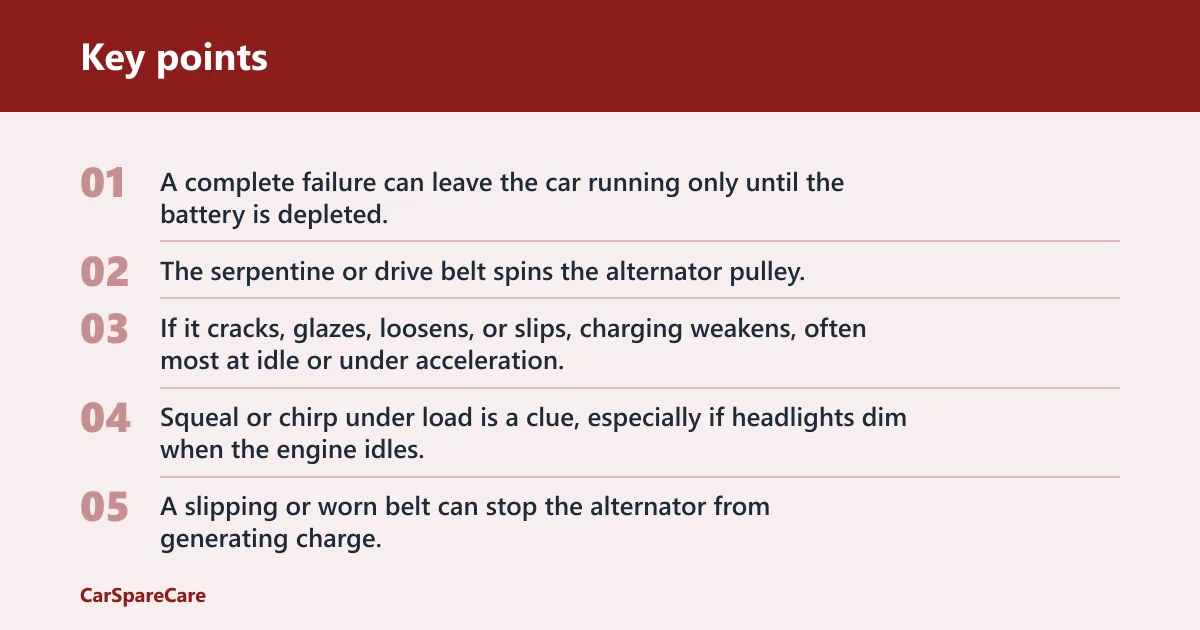
If engine-running voltage stays near resting voltage, or falls as accessories are switched on, the alternator may not be producing enough power. A complete failure can leave the car running only until the battery is depleted.
Drive belt slip or breakage
The serpentine or drive belt spins the alternator pulley. If it cracks, glazes, loosens, or slips, charging weakens, often most at idle or under acceleration. Squeal or chirp under load is a clue, especially if headlights dim when the engine idles.
A slipping or worn belt can stop the alternator from generating charge. Check belt routing, tension, and visible wear before replacing electrical parts.
Bad terminals, cables, or ground
Battery terminals and cable ends can interrupt charging if they are loose, frayed, or corroded. White or blue-green powder on the posts is a corrosion clue, and the negative ground cable matters as much as the positive lead.
Loose or damaged battery cables can cause intermittent or no charging. A simple clean-and-tighten fix may restore the connection if the battery and alternator are otherwise healthy.
Why is my car battery not charging with a charger?
If a charger is connected but the battery still will not recover, the battery may be too weak to accept a charge, the charger may be set incorrectly, or the connection at the terminals may be poor. A bad charging-system fault can also make a fresh charge disappear as soon as the car is used.
Battery is too weak or aged
Older batteries may not hold a charge well, and repeated charging failure can point to replacement rather than another recharge. Car batteries may need replacement if they are more than four years old, especially if testing shows poor recovery after charging.
If the battery has been deeply discharged many times, sulfation can reduce acceptance of charge. In that case, a charger may show activity without the battery returning to useful capacity.
Charger setup or compatibility issue
Some chargers need the correct battery type, voltage setting, and connection sequence. If the charger is unsuitable for the battery’s size or chemistry, it may stop early, refuse to start, or indicate a fault even though the battery is not full.
Check that the charger leads are clipped to clean, solid metal contact and that the charger is designed for the vehicle battery you are charging. If the charger is the wrong match, the battery may never reach a usable state.
Connection problem at the terminals
Corrosion, loose clamps, or frayed ends can block charging current. Clean the posts and cable ends, then tighten the clamps so they do not twist by hand. If the battery still does not charge, inspect both the positive and negative connections, not only one side.
Why is my car battery not charging when driving?
If the battery does not recover while driving, the alternator may be weak at idle, the belt may be slipping, or the regulator may be limiting output. Short trips can also fail to replace the energy used by starting, so the battery keeps drifting lower instead of recovering.
Idle-only charging weakness
Some charging faults show up first at idle, then improve slightly with engine speed. If voltage rises only when you rev the engine, that points toward belt slip, alternator output weakness, or a pulley issue.
Dimming headlights at idle and recovery at higher rpm fit this pattern. Do not ignore a charging light that comes and goes with speed.
Voltage regulator or alternator output problem
The voltage regulator controls alternator output voltage, and on many modern vehicles it is built into the alternator. A bad regulator can cause undercharging or overcharging, and the fix may be alternator replacement or rebuild rather than a small external part.
If running voltage stays below about 13.7 volts, the charging system may not be keeping up. If it climbs too high, that can damage the battery and electronics.
Short trips that never recover charge
A brief commute may not restore a battery that was already weak or partially discharged. Frequent short drives, heated seats, rear defrost use, and stop-start traffic can pull more from the system than the alternator replaces in a few minutes.
Say your battery starts the car, but the car is driven only 10 minutes to work and 10 minutes back. If voltage stays low after parking, the issue may be a battery that needs a longer charge or a charging system that cannot keep up under real use.
Battery charging decision table
| Symptom or test result | Most likely fault | Next check | Safe next action |
|---|---|---|---|
| 12.6 volts engine off, but below 13.5 volts running | Alternator or regulator output problem | Recheck voltage with lights and blower on | Inspect charging system before replacing the battery |
| Below 12.4 volts after sitting overnight | Weak battery or parasitic drain | Charge fully, then retest after parking | Test battery health and look for drain if it falls again |
| Battery light on with engine running | Charging-system fault | Check belt, terminals, and running voltage | Limit driving and arrange diagnosis soon |
| Headlights dim at idle, brighten when revved | Belt slip or weak alternator output | Inspect belt for glazing, cracks, looseness, squeal | Repair belt or charging hardware before the battery is depleted |
| White or blue-green corrosion on posts | Poor terminal connection | Check clamp tightness and cable condition | Clean and tighten both terminals, then retest |
| Frayed or cracked alternator cable | Wiring fault | Inspect for broken insulation or loose ends | Repair the cable before further charging tests |
| Battery will not charge with a charger | Aged or sulfated battery, poor connection, or charger mismatch | Verify charger settings and terminal contact | Retest battery health; replace if it fails again |
| New alternator, but no charging | Fuse, fusible link, ground, or sensor fault | Check charging fuse and ground path | Inspect wiring and battery sensor before replacing the alternator again |
| Problem worse in cold weather | Battery output drops in cold conditions | Test voltage after the vehicle sits overnight outside | Charge fully and assess battery condition before winter use |
| Battery keeps dying after parking | Parasitic electrical drain | Isolate accessories, lamps, radio, or alarms | Track down the draw before replacing parts at random |
Why is my car battery not charging with a new alternator?
A new alternator does not necessarily guarantee charging. If voltage is still low, the problem may be a blown fuse, a fusible link, a bad ground, damaged wiring, a battery sensor issue, or a regulator problem built into the replacement unit. The rest of the circuit still has to carry current.
Blown fuse or fusible link
Charging current can be blocked before it reaches the battery if a fuse or fusible link has failed. Check the charging circuit protection listed for the vehicle, especially if the alternator was replaced after another electrical fault.
If the alternator output wire has power at the unit but not at the battery, the break may be in the fuse path rather than the alternator itself.
Loose ground or damaged wiring
Loose or damaged battery cables can cause intermittent or no charging, and a poor engine ground can do the same. Cracking or fraying in alternator cables is a clear sign something is off. Look for rubbed insulation, broken terminals, or a ground strap that is loose or corroded.
Picture a new alternator installed, but the battery light stays on and the voltage never rises above resting level. If the ground strap is loose, the alternator may be fine while the circuit is not.
Battery sensor or regulator fault
Many modern systems use battery current sensors or smart charging logic. If the sensor is faulty or not calibrated correctly after repairs, the charging system may undercharge the battery or behave inconsistently.
Because the voltage regulator is often built into the alternator, a replacement unit can still fail if the regulator is defective or the vehicle needs a relearn or programming step.
What to do if the battery keeps dying
If the battery keeps dying after charging or jump starting, stop treating it as a simple battery-only problem. Repeated discharge can come from a parasitic drain, a weak alternator, short trips, or a battery that is already past its useful life.
Parasitic drain checks
Parasitic electrical drain can discharge the battery while the car is parked. Common causes include lights, radio and entertainment systems, alarms, and accessories that stay awake after shutdown.
-
Verify the resting battery voltage.
Let the car sit long enough for surface charge to settle, then measure the battery. Around 12.6 volts off and stable points to a charged battery; a lower reading after sitting suggests loss while parked or a battery that is not holding charge.
-
Remove obvious loads.
Make sure interior lights, glovebox lights, cargo lights, and accessories are off. A simple lamp or module can flatten a battery overnight.
-
Check for repeat failure.
If the battery goes flat again soon after charging, the problem is less likely to be the charger and more likely to be a drain, weak battery, or charging fault that needs diagnosis.
Cold-weather charging problems
Why is my car battery not working in the cold? Cold weather reduces battery output and makes weak batteries fail more often, so a borderline charging system can look fine in mild weather and fail in winter. Charging also slows, which makes short trips less useful after a cold start.
If the battery is already old, cold weather can expose the problem sooner. A battery that seems acceptable in warm weather may fail at the first hard frost.
When battery replacement is the next step
Age matters. If the battery is more than four years old, has needed repeated charging, or still fails after the charging system checks out, replacement becomes more likely than another recharge. Professional testing can help avoid replacing a battery that is only suffering from a wiring or alternator fault.
A battery that will not hold 12.6 volts after a proper charge, or that drops quickly after a short sit, is a strong candidate for replacement.
Frequently asked questions
Why is my car battery not charging with jumper cables?
Jumper cables can start a car with a dead battery, but they do not fix the cause. If the car dies again soon after the jump, suspect the alternator, belt, bad cables, or a parasitic drain. A jump only provides temporary current.
What causes a car battery not to charge?
Common causes include alternator failure, belt slip, corroded terminals, loose or damaged cables, regulator problems, and parasitic drain. The quickest way to sort them is to compare resting voltage with running voltage, then follow the symptoms that appear at idle, under load, or after parking.
What to do if your car battery won’t charge?
Check the battery reading first, then inspect the belt, terminals, and cable ends. If the engine-running voltage remains below about 13.7 volts, focus on the charging system. If the battery keeps dying while parked, look for a drain instead of replacing parts at random.
Why is my car battery not charging fully?
Partial charging often happens when the alternator output is weak, the belt slips at idle, or the battery is too far gone to accept a full charge. Short drives make it worse because they replace only part of the energy used to start the engine, especially in cold weather.

Hi, I’m Melvin, an automobile engineer with extensive experience in automobile equipment. I currently work for a local automobile firm, where I specialize in the car parts industry. I’ve had the opportunity to collaborate with seasoned inspectors, gaining invaluable hands-on experience that goes beyond just theory.
My passion for automotive care started at a young age, which led me to create CarSpareCare. Through CarSpareCare, I share the knowledge and skills I’ve acquired over the years to help others navigate the world of car maintenance and repairs.
My goal is to provide practical tutorials, essential safety advice, and the latest industry insights so that anyone—whether a beginner or an expert—can confidently tackle their automotive projects.