
Change automatic transmission fluid about every 30,000–60,000 miles in severe use and 60,000–100,000 miles in normal use; if you have a CVT or the fluid is dark, smells burnt, or the shift quality changes, service it now. Skipping it can lead to rough shifting, overheating, and repairs that cost far more than a fluid change. This guide gives a mileage rule, a severity check, transmission-specific timing, and a simple now-soon-defer decision.
Change intervals by fluid type and driving severity


The safest answer is: follow the owner’s manual first, then shorten the interval for severe use or symptoms. A conventional automatic often lands in the 60,000–100,000-mile range for normal service, while severe-duty driving can pull that into the 30,000–60,000-mile range. If the fluid is dark, burnt-smelling, or shifts change, do not wait.
Transmission fluid is not just lubricant. It also helps cool the unit, clean internal parts, and carry hydraulic pressure so the transmission applies clutches and bands at the right time. Heat and contamination break that fluid down faster, which is why driving pattern matters as much as mileage.
Automatic, CVT, and manual service needs differ
Automatic transmission fluid, CVT fluid, and manual gear oil are not interchangeable, and they do not all age the same way. A conventional automatic may tolerate a different interval than a CVT, while a manual gearbox often uses gear oil and follows a separate schedule. The owner’s manual is the first source to check.
Transmission fluid decision table
Use this table to decide whether to service now, schedule soon, or check the manual first. It combines driving pattern, transmission type, mileage band, and fluid condition so you can act without guessing.
| Driving pattern | Transmission type | Mileage band | Fluid condition | Action |
|---|---|---|---|---|
| Severe use: towing, hauling, mountains, hot climate, taxi or delivery work | Automatic | 30,000–60,000 miles | Any fluid that is dark, burnt-smelling, or unknown | Service now |
| Normal use with no severe-service warning in the manual | Automatic | Under the manual interval | Pink or red, no burnt smell, shifts normal | Check manual first |
| Normal use | Automatic | At or near the manual interval | Fluid still looks and smells normal | Schedule soon |
| Any use with frequent stop-and-go, towing, or heat | CVT | Earlier than a conventional automatic in the same vehicle class | Any sign of darkening or burnt odor | Service now |
| Normal use | Manual | As listed in the manual | Gear oil looks contaminated or shifts feel rough | Check manual first |
| High-mileage vehicle with unknown history | Any | High mileage, service history unknown | Very dirty fluid, burnt smell, or harsh shifting | Service now if the transmission still shifts normally; otherwise inspect first |
| Highway use, no heavy load, service history known | Automatic | Below the manual interval | Clean-looking fluid, no symptoms | Check manual first |
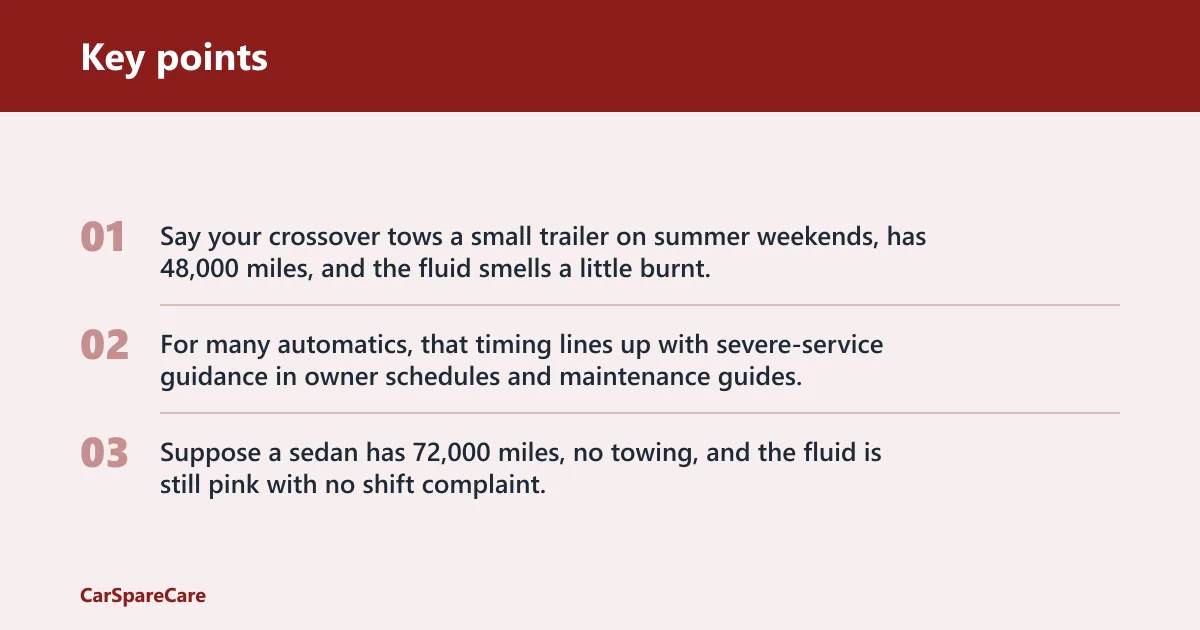
Say your crossover tows a small trailer on summer weekends, has 48,000 miles, and the fluid smells a little burnt. That fits the severe-use side of the chart, so service now is the safer choice even if the manual has a longer normal interval. For many automatics, that timing lines up with severe-service guidance in owner schedules and maintenance guides.
Suppose a sedan has 72,000 miles, no towing, and the fluid is still pink with no shift complaint. That points to schedule soon or check the manual first, depending on whether the maker lists a routine change for that transmission. Toyota’s maintenance guidance is a good example of how some schedules separate normal use from special operating conditions.
Which transmissions need service sooner?
CVTs usually deserve earlier attention than a conventional automatic because the fluid has to protect a belt or chain system under constant load. Manuals can be different again, but they still need their own schedule. The right interval depends on the transmission family, fluid spec, and whether the vehicle sees severe use.
CVT service timing
CVT fluid is highly specific, and many CVT schedules are shorter than conventional automatic schedules. If the manual gives a CVT interval, use that number rather than borrowing the interval from a regular automatic. If the fluid is dark, smells burnt, or the transmission feels different, treat that as a reason to move service up rather than wait.
Manual transmission timing
Manual transmissions usually use gear oil rather than ATF, and their service pattern can be different from an automatic or CVT. Some manuals go a long time between changes, but contaminated fluid or notchy shifting is a reason to inspect the schedule sooner. The owner’s manual remains the deciding guide.
What counts as severe driving?
Severe driving means the fluid spends more time hot, loaded, or cycling through shifts. Towing, hauling, hills, stop-and-go traffic, hot climates, taxi or delivery work, and frequent short trips all shorten fluid life. A vehicle that works hard needs earlier service than a commuter that cruises steadily.
Towing, hauling, and hills
Towing and heavy loads raise fluid temperature and stress clutches, seals, and valves. The 2018 Toyota Camry guide calls towing and heavy loading “Special Operating Conditions,” which is a good example of how makers separate hard use from normal commuting. Trucks and SUVs often see more of this kind of duty than small sedans.
Heat, traffic, and commercial use
Stop-and-go traffic and hot climates add heat even without a trailer. Taxi and delivery use can be harder still because the transmission may cycle through gear changes and idle time all day. If that describes the vehicle, the shorter end of the service range is the better planning point.
What if the vehicle has high mileage or unknown history?
High mileage does not automatically mean immediate service, but unknown history changes the risk. If the transmission still shifts normally and the fluid is simply old, service is usually safer than waiting. If the fluid is heavily burnt, contaminated, or the unit already shifts poorly, inspect first so the underlying problem is not missed.
That distinction matters. A vehicle with clean-ish fluid and normal operation can often be serviced now, while one with harsh shifts, delayed engagement, or a burnt odor may need diagnosis before any fluid change. Age alone is less important than current shift behavior and fluid condition.
When to service now
Service now when the transmission still works normally but the fluid is dark, old, or overdue by the schedule. That is the lower-risk choice when there is no major symptom yet. A drain-and-refill can refresh part of the fluid without forcing a full-system exchange.
When to inspect first
Inspect first when fluid is heavily burnt, the transmission slips, bangs into gear, flares, or delays engagement. Those signs can point to internal wear that fluid alone will not fix. In that situation, a shop should confirm the cause before choosing the service method.
Drain-and-refill or flush?
A drain-and-refill is often the conservative choice. It usually replaces only part of the fluid, but that can be safer on many units because it changes the fluid without forcing a full-system exchange. A flush moves more fluid at once, but it is not the default answer for every vehicle.
Use the service method the transmission was designed to accept, and let age, symptoms, and history guide the decision. On some high-mileage or unknown-history vehicles, a gentler service is the lower-risk first move. If the unit already shifts badly, diagnosis should come before any aggressive service choice.
Drain-and-refill
Testing Autos notes that a drain-and-refill only drains about 30-45% of the fluid. That is why a single service does not reset the whole system, especially on units with torque converters and cooler lines. Some pans do not have drain plugs, so the pan may need to come off for service.
Flush machine
A flush machine can exchange more fluid, but a full exchange is not automatically better. On some high-mileage or unknown-history vehicles, a gentler drain-and-refill is the lower-risk first move. If a shop recommends a flush, ask how the transmission is filled, how fluid level is verified, and whether the vehicle’s schedule supports that method.
Do you need a new filter too?
Sometimes, yes. But not every fluid change requires a filter, and not every transmission makes filter service easy. If the pan comes off, the filter is often accessible; if it does not, filter replacement may not be part of the job. The manual and pan design decide the path.
Pan removal and filter access
Mobil says a pan/filter service is needed to change the transmission filter. That means filter replacement usually happens when the pan comes off, not during a simple drain from the drain plug. If the transmission has no drain plug, the service path can be more involved.
How often filters are changed?
Wayne’s Automotive says the transmission fluid filter typically needs replacement every second or third fluid change. That is a practical rhythm, not a universal rule for every vehicle. Use it as a planning guide only when the service history is known and the pan is already being removed.
How do you know if transmission fluid needs changing?
Look for dark color, a burnt smell, delayed shifts, slipping, or flare between gears. Those signs point toward service, but they do not by themselves prove the transmission is failing. If there is no dipstick, a shop may need to inspect it through the fill or level plug.
Color and smell
Healthy ATF is usually pink to red. If it turns dark, brown, or smells burnt, the fluid has likely seen excessive heat or contamination. Many newer vehicles do not have a transmission dipstick, so fluid condition may need to be checked through the fill plug, a level plug, or a shop procedure.
Slip, flare, and rough shifts
Overdue fluid may show up as slipping, flare between gears, delayed engagement, or rough shifts. These symptoms can also point to deeper internal problems, so fluid service is not a cure-all. If the transmission already shifts harshly, a fluid change may still be part of the plan, but it should not be treated as the only fix.
Frequently asked questions
How often should you change transmission fluid in a car?
For a car, the best answer is the owner’s manual first, then the driving pattern. If the fluid is dark or burnt, service it sooner.
How often should you change transmission fluid on a CVT?
CVTs often need service sooner than conventional automatics because the fluid works hard to protect the belt or chain system. Follow the manual closely, and treat towing, heat, traffic, or burnt-smelling fluid as a reason to move service up rather than wait.
How often should you change transmission fluid and filter?
The filter does not always need replacement at every fluid service. A common pattern is every second or third fluid change, and it is usually replaced during pan removal. If the pan is not coming off, filter service may not be part of the job.
How often should you change transmission fluid on a manual?
Manual transmissions use different fluid, usually gear oil rather than ATF. The interval varies by model, so the manual is the main source. If shifting gets notchy, the fluid looks contaminated, or the car sees severe use, check the schedule sooner.
Is a transmission flush better than a drain and refill?
Not always. A drain-and-refill is often the safer conservative choice because it replaces part of the fluid without forcing a full exchange. A flush machine moves more fluid, but it is not the right answer for every unit, especially when history is unknown.

Hi, I’m Melvin, an automobile engineer with extensive experience in automobile equipment. I currently work for a local automobile firm, where I specialize in the car parts industry. I’ve had the opportunity to collaborate with seasoned inspectors, gaining invaluable hands-on experience that goes beyond just theory.
My passion for automotive care started at a young age, which led me to create CarSpareCare. Through CarSpareCare, I share the knowledge and skills I’ve acquired over the years to help others navigate the world of car maintenance and repairs.
My goal is to provide practical tutorials, essential safety advice, and the latest industry insights so that anyone—whether a beginner or an expert—can confidently tackle their automotive projects.

