A wheel spacer is generally considered safe only when it is hub-centric, torqued to spec, sits flat with full-thread engagement, and shows no cracks, looseness, or stud damage. Poor installation can cause vibration, broken studs, wheel wobble, or wheel separation. This guide gives you a yes/no checklist for inspecting spacers on a daily driver, tow rig, or off-road setup.
Wheel spacer safety basics
Wheel spacers push the wheel outward and change effective offset. A 15 mm spacer moves the wheel 15 mm farther from the suspension and fender, so the fit changes even if the wheel itself stays the same. Offset is stamped as ET on most wheels.
That change is not automatically unsafe. Safety depends on fitment, spacer design, thread engagement, and correct torque. RealTruck says most failure risk comes from incorrect install, not the concept itself.
Hub-centric spacers are preferred because the center bore matches the hub and carries load through the hub rather than the studs. That cuts vibration risk and helps the wheel stay centered. Lug-centric designs rely more on the studs for location, which is less forgiving when the fit is off.
Safe use versus unsafe installation
Good spacers can be safe when installed correctly. Cheap or poorly made spacers are risky, and thickness matters because more thickness increases load on studs and bearings. The spacer itself is only one part of the decision.
A thin slip-on spacer with full thread engagement can be a reasonable fitment fix. A thick spacer with the wrong thread pitch, short studs, or a wobble after driving is not.
Is your spacer setup safe?
Use a yes/no flow: if every fitment, hardware, and symptom check passes, the setup can stay on the vehicle for now. If one check fails but there is no visible damage, stop driving at speed, recheck torque and fitment, and verify the spacer and wheel hardware. If you find cracks, stripped threads, or looseness that returns after re-torque, remove the spacer.
Keep, recheck, or remove
- Keep driving if the spacer is hub-centric, flat, correctly torqued, and free of symptoms after a short road test.
- Recheck if you have fresh installation, a small vibration, or any doubt about thread engagement or torque.
- Remove if you see cracks, damaged threads, stripped studs, persistent wobble, or repeated loosening.
Spacer safety inspection checklist
| Check | Pass | Fail |
|---|---|---|
| Spacer sits flat against the hub with no gap or rocking | Yes | No |
| Hub bore / center bore matches the vehicle hub | Yes | No |
| Spacer is hub-centric, not only lug-located | Yes | No |
| Wheel and spacer bolt pattern match the vehicle | Yes | No |
| Wheel offset change still clears suspension, fender, and steering lock | Yes | No |
| All studs, bolts, and lug nuts match the correct thread pitch | Yes | No |
| Full thread engagement is present on every fastener | Yes | No |
| Final lug torque matches vehicle specification with a torque wrench | Yes | No |
| After a short drive, there is no vibration or wobble | Yes | No |
| No clunking, clicking, or loose-feeling steering shows up | Yes | No |
| No fresh witness marks, heat marks, or rubbing appear | Yes | No |
| No cracks, corrosion, bent studs, or damaged hardware are visible | Yes | No |
Does the spacer fit the hub and wheel?
A safe spacer has the right center bore, the right bolt pattern, and enough clearance after the wheel moves outward. If the hub bore or center bore does not match, the wheel may mount off-center. That can create vibration even when the lugs feel tight.
Hub-centric fitment is preferred over lug-centric fitment because the hub carries the weight and keeps the wheel centered. A spacer that only “sort of” fits is not acceptable.
Hub bore and center bore match
Check that the spacer’s center bore matches the vehicle hub exactly enough to seat properly. The spacer should slide on without forcing, sit flush, and center the wheel without relying on the studs. If the spacer rocks, binds, or needs hammering, it fails.
Bolt pattern and wheel offset
Wheel offset changes when the spacer is installed. Higher offset pulls the wheel inward. Lower offset pushes it outward. If the spacer creates too much poke, contact can happen at the fender lip, inner liner, upper control arm, or brake hose area during steering or suspension travel.
Say your truck gains a 15 mm spacer and the tire now kisses the liner at full lock. That is not a “normal break-in” sign. It means the offset change is too much for that wheel, tire, and steering range.
Are the studs, bolts, and nuts correct?
Fasteners decide whether the spacer stays put. Thread pitch must match the lug hardware, and the wheel studs or spacer studs must be long enough for full thread engagement. A torque wrench should be used for final torque and re-torque checks, not impact-only tightening.
Slip-on spacer thread engagement
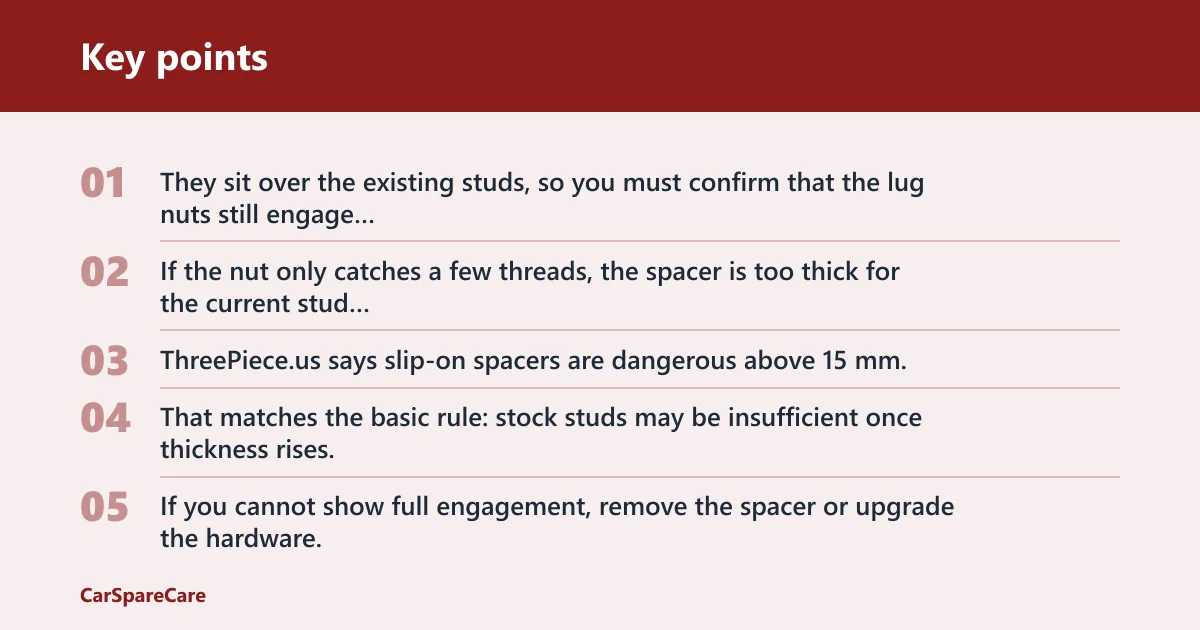
Slip-on spacers are typically 3–15 mm. They sit over the existing studs, so you must confirm that the lug nuts still engage enough thread after the spacer is added. If the nut only catches a few threads, the spacer is too thick for the current stud length.
ThreePiece.us says slip-on spacers are dangerous above 15 mm, and extended ARP studs become mandatory over 15 mm thickness. That matches the basic rule: stock studs may be insufficient once thickness rises. If you cannot show full engagement, remove the spacer or upgrade the hardware.
Bolt-on spacer hardware and fresh studs
Bolt-on wheel spacers are typically 15–30 mm and up. These units use their own hardware and fresh studs, which is why they are common once thickness grows. Quality spacers often use grade 8 or stronger hardware, and good machined parts are often made from 6061-T6 billet aluminum.
Cheap cast aluminum is a warning sign. So are soft studs, mismatched nuts, or hardware that looks like an afterthought. The spacer should feel like a machined part, not a rough casting with questionable fasteners.
Thread pitch and torque wrench checks
Thread pitch must match the vehicle’s lug hardware and any spacer studs or bolts. A mismatch can strip threads fast, and a damaged thread may still “feel tight” right up until it fails. Use the correct lug nut type for the studs in front of you.
Torquing by feel or with an impact gun alone is not enough. Tighten to vehicle specification with a torque wrench, then re-torque after driving. ThreePiece.us recommends re-torquing after 100 miles.
What symptoms mean the spacer is unsafe?
Symptoms tell you a lot. Vibration, wobble, clunking, and fresh contact marks usually point to a fitment or hardware problem, not a harmless quirk. If the symptom appears after installation and stays after a torque check, treat the spacer as suspect.
Vibration and wobble
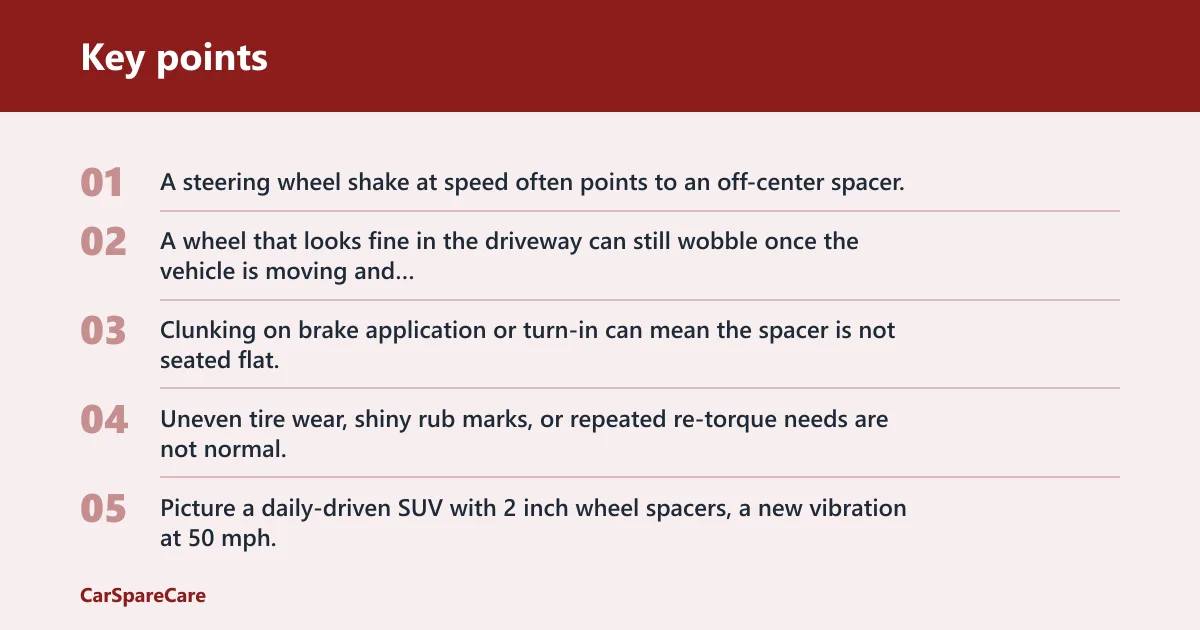
A steering wheel shake at speed often points to an off-center spacer, poor hub bore match, or uneven clamp load. A wheel that looks fine in the driveway can still wobble once the vehicle is moving and the loads change.
Clunking, loosening, and uneven wear
Clunking on brake application or turn-in can mean the spacer is not seated flat, the hardware is loosening, or the studs are moving in the flange. Uneven tire wear, shiny rub marks, or repeated re-torque needs are not normal.
Picture a daily-driven SUV with 2 inch wheel spacers, a new vibration at 50 mph, and fresh shiny marks on the inner liner. The size alone is not the issue. The mix of thickness, contact marks, and vibration means the setup should be removed and checked.
Heat, noise, or fresh contact marks
Excess heat around the hub, metallic clicking, or new wear marks near the brake dust shield or fender liner means something is rubbing or moving. That can happen even with a spacer that seemed fine during the first few miles.
Truck spacer safety and 2 inch cases
Are wheel spacers safe on trucks? They can be, but trucks ask more of the hardware. Payload, towing, and rough roads increase the loads acting on the spacer, studs, and hub. That means a setup that passes on an empty truck may deserve a closer look once the bed is loaded or a trailer is attached.
Payload and towing concerns
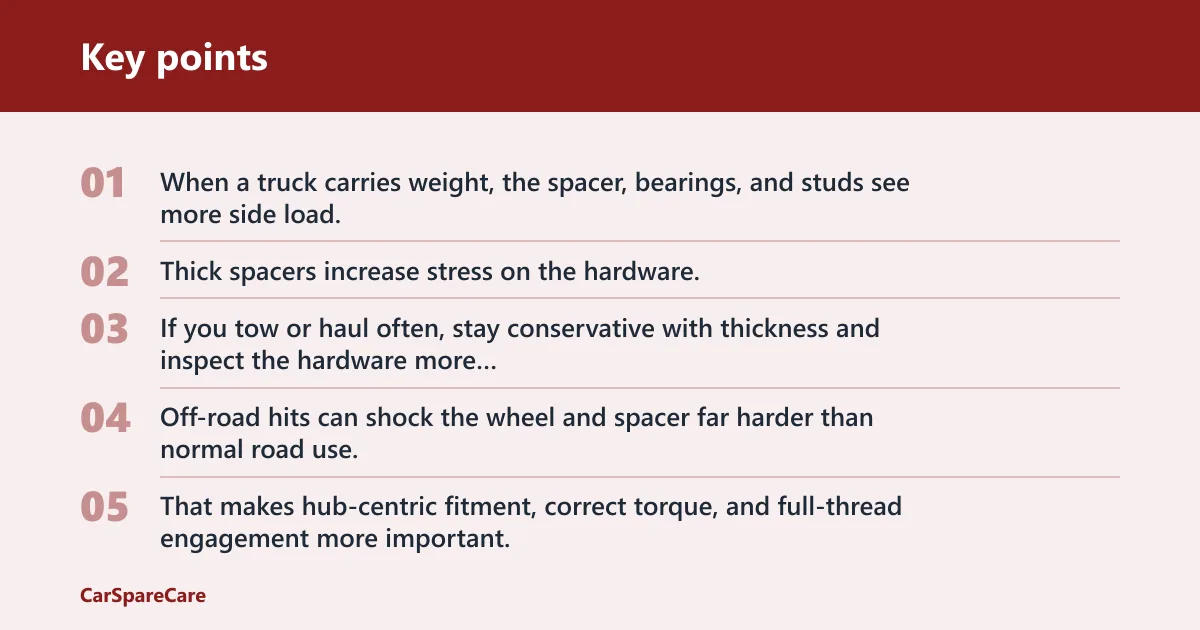
When a truck carries weight, the spacer, bearings, and studs see more side load. Thick spacers increase stress on the hardware, so the chance of a bad fit or marginal parts goes up. If you tow or haul often, stay conservative with thickness and inspect the hardware more often.
Off-road load and impact stress
Off-road hits can shock the wheel and spacer far harder than normal road use. That makes hub-centric fitment, correct torque, and full-thread engagement more important. A wheel spacer that survives pavement use may still fail if it is abused on rocks, ruts, or washboard roads.
When thick spacers need more caution
Are 2 inch wheel spacers safe? They can be, but they are generally a bigger commitment than a small slip-on spacer. At that thickness, you are deep into offset change, extra load, and hardware length concerns. For daily driving, thick spacers deserve a stricter yes/no check than thin ones.
Frequently asked questions
Is it safe to use wheel spacers?
Yes, if the spacer is the right type for the vehicle, the center bore fits the hub, the hardware matches the thread pitch, and final torque is correct. Safety depends more on fitment and installation quality than on spacer use alone.
Are wheel spacers safe to use?
They can be safe when the setup is hub-centric, flat, and properly torqued. The main risks come from wrong hardware, poor thread engagement, non-matching bore size, and skipped re-torque checks after the spacer settles in.
Are wheel spacers safe on trucks?
They can be, but trucks add payload, towing, and impact load. That makes thickness, stud length, and hub-centric fitment more important. A truck with spacers should be checked more often than a light-duty car used only on smooth roads.
Are 2 inch wheel spacers safe?
They can be safe only with the right spacer type, correct studs or bolt-on hardware, and enough clearance for steering and suspension travel. At 2 inches, the load change is large, so the setup needs a very careful inspection and regular rechecks.
Do wheel spacers cause problems?
They can if the install is wrong or the spacer is poorly matched to the vehicle. Common problems include vibration, loosening, rubbing, and uneven wear. A correct hub-centric setup with proper torque is much less likely to cause trouble.

Hi, I’m Melvin, an automobile engineer with extensive experience in automobile equipment. I currently work for a local automobile firm, where I specialize in the car parts industry. I’ve had the opportunity to collaborate with seasoned inspectors, gaining invaluable hands-on experience that goes beyond just theory.
My passion for automotive care started at a young age, which led me to create CarSpareCare. Through CarSpareCare, I share the knowledge and skills I’ve acquired over the years to help others navigate the world of car maintenance and repairs.
My goal is to provide practical tutorials, essential safety advice, and the latest industry insights so that anyone—whether a beginner or an expert—can confidently tackle their automotive projects.