
Replace tires at about 4/32 inch for better wet-road grip, note that 2/32 inch is commonly the legal minimum in many places, and have tires closely inspected around 10 years old, even if the tread still looks fine. Waiting too long raises the risk of hydroplaning, longer stopping distances, blowouts, and uneven wear that can damage suspension parts. This guide gives the tread and age rule, plus a fast check for damage, cracking, bulges, and uneven wear so you can decide whether to keep driving, inspect soon, replace soon, or replace immediately.
Tire replacement decision table
Use this table as the fast rule. If either tread depth or age crosses a safety threshold, treat that tire as due for replacement or close inspection. Damage and uneven wear can move the decision from “replace soon” to “replace immediately.”
| Tire type / condition | Tread depth | Age | Visible damage or wear | Action |
|---|---|---|---|---|
| All-season tire | 4/32 inch or more | Under 5 years | No bulges, cracks, cuts, or uneven wear | Keep driving |
| All-season tire | Between 4/32 inch and 2/32 inch | 5 to 10 years | No structural damage, but tread is getting low | Inspect soon |
| All-season tire | At 4/32 inch | Any age | No damage | Replace soon |
| All-season tire | At 2/32 inch | Any age | No damage | Replace immediately |
| Winter tire | 5/32 inch to 6/32 inch | Any age | No damage | Inspect soon |
| Winter tire | 4/32 inch | Any age | No damage | Replace soon |
| Low-mileage or garage-kept tire | Good tread, but age is 6 years or more | 6 to 10 years | May look fine on the outside | Inspect soon |
| Low-mileage or garage-kept tire | Good tread | 10 years or more | May show cracking or stiffness | Replace immediately |
| Spare tire | Deep enough to use, but age is unknown or old | 5 years or more | Stored, little use, and no recent inspection | Inspect soon |
| Any tire | Any tread depth | Any age | Bulge, blister, deep cut, or sidewall crack | Replace immediately |
| Any tire | Uneven tread across the surface | Any age | Edges worn, center worn, one shoulder worn, or cupping | Inspect soon |
Tread depth to action
For most drivers, tread depth is the first filter. Michelin says to replace at 2/32 inch, which matches the legal minimum in many places, while 4/32 inch is a practical shopping point because wet grip drops before the legal limit. Winter tires need earlier replacement than all-season tires.
Age to action
Age matters even when tread looks healthy. The same source recommends annual professional inspection after five years and replacement ten years after the manufacture date. In hot climates, some experts advise a closer look around 6 years because heat speeds aging. That makes age a separate decision rule, not a backup check.
Damage and wear to action
Any bulge, crack, cut, or blister changes the answer fast. Those are not cosmetic issues when they affect the casing or sidewall. Uneven wear is also a warning sign, because it often points to pressure, alignment, or suspension problems that may keep damaging the tire after replacement.
Type-specific notes for winter, low-mileage, and spare tires
Winter tires follow a stricter tread rule. Kal Tire says winter tires should be replaced at 4/32 inch, and 5/32 inch is a point where snow-covered-road use should stop. Low-mileage and garage-kept tires can age out before they wear out. Spare tires can hide age problems because they are used rarely.
When should tires be replaced by age?
Replace tires by age when the DOT code shows they are at or near 10 years from manufacture, even if tread looks fine. After 5 years, they should get an annual professional inspection. In hot climates, some experts recommend paying closer attention around 6 years because aging can outpace visible tread wear.
How to read the DOT date code
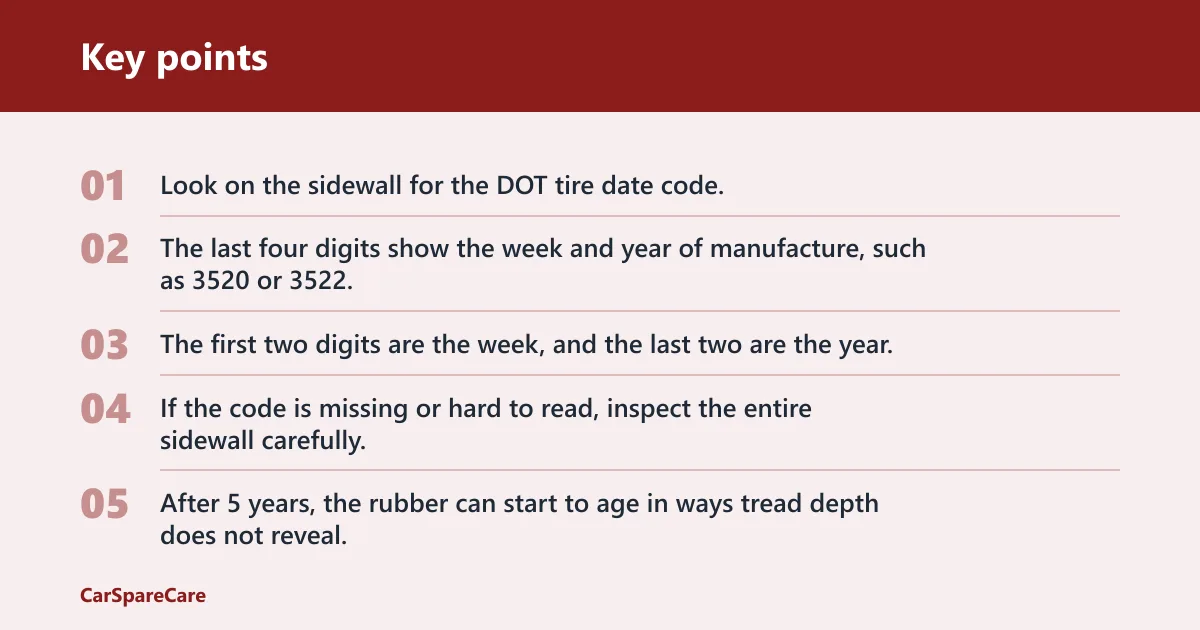
Look on the sidewall for the DOT tire date code. The last four digits show the week and year of manufacture, such as 3520 or 3522. The first two digits are the week, and the last two are the year. If the code is missing or hard to read, inspect the entire sidewall carefully.
What changes after 5 years
After 5 years, the rubber can start to age in ways tread depth does not reveal. Cracking, stiffness, and loss of flexibility matter because they affect grip and durability. The same source recommends annual professional inspection after five years of service, so age becomes a regular check, not a one-time note.
Why 10 years is the outer limit
Ten years from the manufacture date is the outer replacement limit used by Michelin and echoed by many guides. That rule applies even to low-mileage tires that still look clean. A tire can have usable tread and still be too old for safe service if the rubber has aged internally.
Say your car has all-season tires with 7/32 inch of tread, but the DOT code reads 2215. The tread looks fine. The age does not. That tire belongs in the inspect-now category at minimum, and it may be due for replacement if cracking or stiffness appears.
When should tires be replaced by tread depth?
Replace tires by tread depth when they hit 4/32 inch for wet-weather shopping, or at 2/32 inch as the legal minimum used by many sources. Winter tires need earlier replacement because snow traction falls faster than all-season traction. Wear bars and simple coin checks can help you spot the change quickly.
2/32 inch legal minimum
The same source says replace when tread reaches 2/32 inch, and Practical Auto notes that most regions use 2/32 inch, or 1.6 mm, as the legal minimum. Wear bars in the grooves sit at that depth. When the tread is flush with the wear bars, the tire has reached its minimum.
4/32 inch practical replacement point
Consumer Reports says 4/32 inch is the point to start shopping for new tires. Treddur also notes that many experts recommend replacement at 4/32 inch for wet driving. That is why 4/32 inch works as a practical early warning, especially if you drive in rain, slush, or standing water. (Consumerreports)
Winter tire thresholds
Winter tires need more tread to work properly in snow. The same source says winter tires should be replaced at 4/32 inch, and 5/32 inch is a caution point on snow-covered roads. Treddur says winter traction needs 5/32 inch to 6/32 inch, which is higher than the usual all-season margin.
How to check tread depth fast
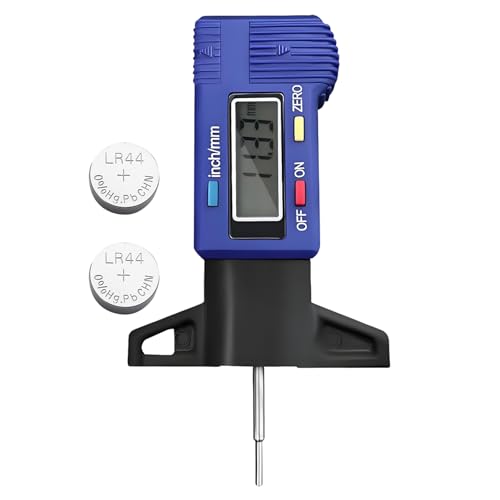
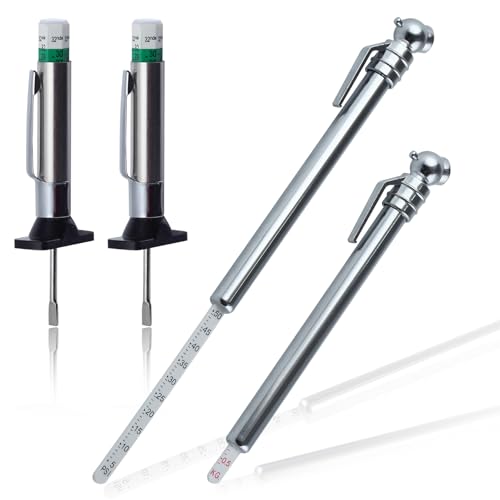
Use a quick three-step check: look at the wear bars, try the quarter test, then confirm with a tread gauge if the result is close to a decision point. The quarter test is a fast screen, not a precision tool. It is useful for spotting tires that are near 4/32 inch.
- Find the tread wear bars in the main grooves.
- Check whether the bars are flush with the tread surface.
- Insert a quarter with Washington’s head down into the groove.
- If the top of Washington’s head is visible above the tread, treat the tire as ready for replacement.
- If the result is near 4/32 inch, confirm with a tread gauge.
Wear bars in the tread grooves
Wear bars are built into the grooves and sit at 2/32 inch. Once the tread is level with those bars, the tire has reached the minimum tread depth. That is the simplest visual sign that the tire should be replaced immediately rather than monitored further.
Quarter test with Washington’s head
The quarter test is a fast check for shallow tread. Place a quarter into the groove with Washington’s head facing down. If you can see space above the head, the tire is shallow enough to treat as replacement-ready. Use it as a quick screen, then verify with a gauge if needed.
When to use a tread gauge
Use a tread gauge when the result matters for a decision today. It is the best way to tell whether a tire is above 4/32 inch, near 2/32 inch, or somewhere in between. A gauge also helps when tires on the same axle do not wear evenly.
Age and tread together
The safest rule is to combine tread depth and age, then add a quick damage check. A tire with deep tread can still be too old. A newer tire with shallow tread can still be unsafe, especially in rain or snow. Mixed-condition sets need the same two-factor check.
Old tires with good tread
Do tires need replacing if tread looks fine but they are old? Yes, if age has crossed the safety limit or if inspection shows cracking or stiffness. A stored tire can look clean and still be aged out. Low-mileage vehicles, garage-kept cars, and spare tires are common places where this mistake happens.
Newer tires with shallow tread
New tires that wear quickly are not automatically due to age, but they may still need replacement for tread depth alone. If a tire is at 4/32 inch, it is already at the practical shopping point for wet weather. At 2/32 inch, it is past the legal minimum in many places.
Mixed-condition sets and one older tire
Picture a front pair with 6/32 inch of tread and a rear pair with 9/32 inch, but one rear tire is three years older than the others. Replace decisions should follow the oldest weak point, not the deepest tread alone. Mixed-condition sets need inspection by age, tread, and wear pattern before you choose a pair or a full set.
Damage that means inspect now
Any bulge, crack, cut, or blister means inspect now. If the damage is structural, the tire cannot be repaired safely. A pothole hit or curb strike can create hidden damage even if the tread still looks normal. Sidewall damage gets immediate attention.
Bulges, cracks, cuts, and blisters
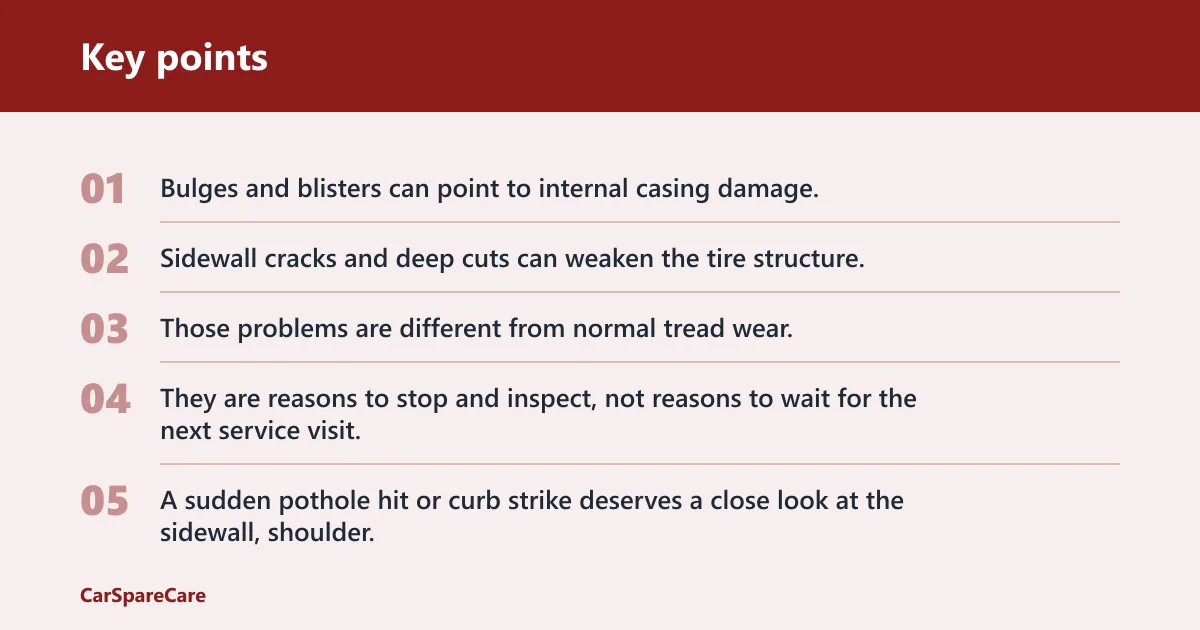
Bulges and blisters can point to internal casing damage. Sidewall cracks and deep cuts can weaken the tire structure. Those problems are different from normal tread wear. They are reasons to stop and inspect, not reasons to wait for the next service visit.
After potholes and curb strikes
A sudden pothole hit or curb strike deserves a close look at the sidewall, shoulder, and bead area. Even if the tire still holds air, hidden damage may be present. If a bulge appears later, that tire should be replaced immediately.
Uneven wear patterns
Edges worn usually point to underinflation. Center worn usually points to overinflation. One shoulder worn often suggests an alignment problem. Cupping can indicate shocks, struts, or balance issues. Uneven wear does not always mean immediate replacement, but it does mean inspect soon and correct the cause.
When sidewall damage is not repairable
Sidewall damage is often not repairable when it affects the tire’s structure. That includes bulges, blisters, and many deep cuts or cracks. If the damage is in the sidewall, replacement is usually the safe move. Do not treat a sidewall repair the same as a tread puncture repair.
A common first-timer mistake is to look only at tread blocks. Suppose a winter tire still has 6/32 inch, but the outer shoulder is worn far faster than the rest of the tread. That points to an alignment or pressure issue, and the tire needs inspection even before it reaches the normal tread limit.
Frequently asked questions
When to replace tires based on age
Replace tires based on age when the DOT code shows they are 10 years from manufacture, even if the tread still looks good. After 5 years, they should be inspected annually. A closer limit around 6 years in hot climates, where heat speeds aging.
When should tires be replaced by age: tires should be replaced?
Tires should be replaced by age at 10 years from the manufacture date. The DOT code on the sidewall tells you the week and year they were made. If the tire is 5 years old or more, schedule an inspection each year and watch for cracks, stiffness, or other aging signs.
What age to replace tires
A practical answer is 10 years maximum, with annual inspections after 5 years. If the car lives in a hot climate, some experts advise treating 6 years as a closer watch point. Age matters even when the tread depth still seems usable.
When to replace tire tread
Replace tire tread at 4/32 inch if you want a practical wet-weather shopping point, and no later than 2/32 inch, which is the legal minimum in many places. Winter tires need earlier replacement because snow traction falls faster than all-season traction.
How old before replacing tires
How old before replacing tires depends on service and storage, but 10 years is the outer limit used by Michelin. If the tire is 5 years old or more, inspect it every year. If it is a spare, stored, or low-mileage tire, age can matter more than wear.
Can you replace tires at 4/32 instead of 2/32?
Yes. Replacing at 4/32 inch is a common safety choice, especially for wet roads. The same source says that is the time to start shopping, and many experts prefer it over waiting for 2/32 inch. For winter tires, 4/32 inch is already a replacement point.
Do tires need replacing if tread looks fine but they are old?
Yes, if the age limit has been reached or the tire shows aging signs. Tread can look fine while the rubber is aging inside the casing. Check the DOT code, inspect for cracks or stiffness, and treat 10 years as the outer limit even on low-mileage vehicles.

Hi, I’m Melvin, an automobile engineer with extensive experience in automobile equipment. I currently work for a local automobile firm, where I specialize in the car parts industry. I’ve had the opportunity to collaborate with seasoned inspectors, gaining invaluable hands-on experience that goes beyond just theory.
My passion for automotive care started at a young age, which led me to create CarSpareCare. Through CarSpareCare, I share the knowledge and skills I’ve acquired over the years to help others navigate the world of car maintenance and repairs.
My goal is to provide practical tutorials, essential safety advice, and the latest industry insights so that anyone—whether a beginner or an expert—can confidently tackle their automotive projects.

