
A cold car can need about 5 to 15 minutes of steady driving to warm up. If the gauge still sits low after about 15 to 20 minutes, suspect a fault. Ignoring it can waste fuel, leave the cabin weakly heated, or point to a cooling-system problem that can overheat the engine later. This guide explains normal winter warm-up, the clues that point to thermostat, coolant, oil, or battery trouble, and when to get it checked.
Why winter warm-up takes longer
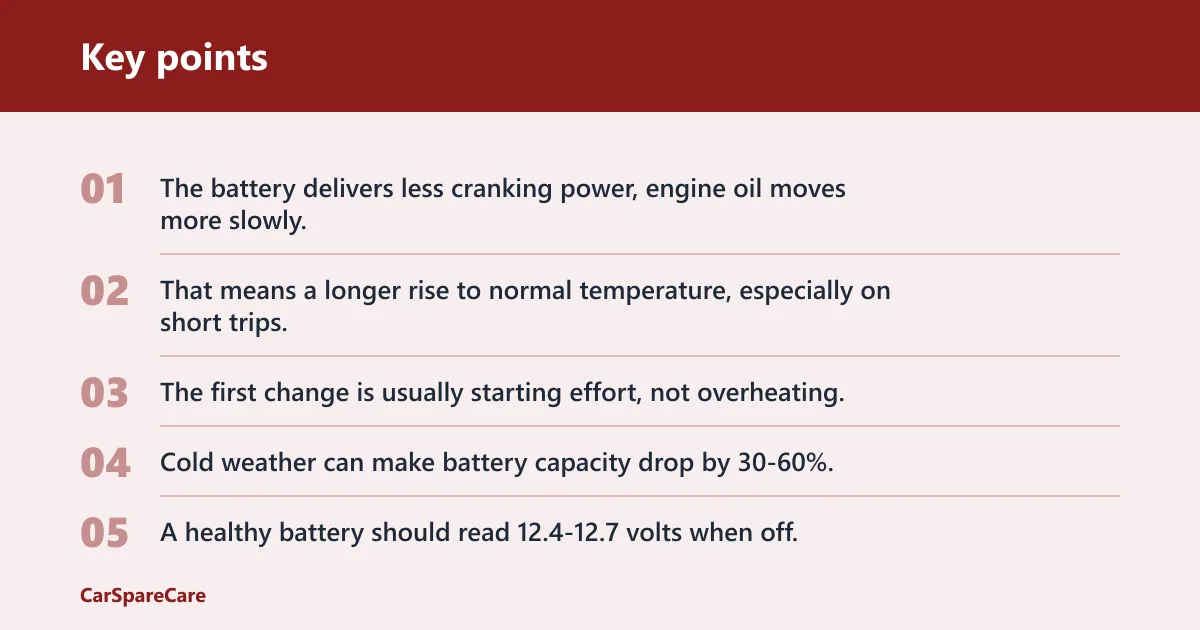


Cold weather slows several systems at once. The battery delivers less cranking power, engine oil moves more slowly, and the engine starts with colder metal, colder coolant, and colder intake air. That means a longer rise to normal temperature, especially on short trips.
What cold weather changes first
The first change is usually starting effort, not overheating. Cold weather can make battery capacity drop by 30-60%, so a marginal battery may crank slowly or need more tries. A healthy battery should read 12.4-12.7 volts when off, and below 12.4 volts suggests the battery needs charging or replacement. When running, charging voltage should be 13.5-14.5 volts.
Cold weather can also make engine oil thicken like molasses. That slows lubrication right after startup, so the engine may sound busy for a short time before it settles. Some modern engines run rich until they heat up to about 40 degrees Fahrenheit, which is normal during the first minutes after a cold start.
Why the temperature gauge lags behind startup
The engine coolant temperature gauge often stays low at first because the engine is warming the coolant, the oil, the block, and the heater core at the same time. That is normal. A healthy system usually shows a gradual climb, then settles near the normal mark once the thermostat begins regulating flow.
A gauge that rises a little, then sits at the low end for a long time, is different from a gauge that never moves. The first pattern can still be normal in cold weather. The second pattern often points to a thermostat stuck open, low coolant, or a sensor issue.
What a normal warm-up looks like
A normal winter warm-up is gradual. The idle may be a little higher for a short time, cabin air may stay cool at first, and the gauge may not reach its midpoint right away. The gauge should rise steadily, the heater should improve, and the engine should not overheat or trigger a warning light.
What you should feel from the heater
Cabin heat does not appear the moment the engine starts. The heater core uses hot coolant, so it can only deliver warm air after the coolant itself heats up. In freezing weather, weak heat for the first few minutes is normal. Heat that never improves, or only gets warm at highway speed, is a useful clue.
How long is still normal in freezing weather?
Many modern fuel-injected gas cars do not need a long idle. Gentle driving often warms them faster than sitting still. A typical healthy car may need about 5 to 15 minutes of steady driving to feel fully warm in very cold weather. If it still feels cold after 15 to 20 minutes, start looking for a fault.
Older carbureted vehicles and many diesels behave differently. Carbureted engines often needed more warm-up to run smoothly. Diesel engines can also take longer to build cabin heat because they are efficient and produce less waste heat at idle. That is normal for the segment, but a diesel with no heat and a rising gauge still needs attention.
How long should you wait?
For most modern cars, you should not wait long. Start the engine, clear the glass, and drive gently after the idle stabilizes. Extended stationary warm-up is usually unnecessary and can waste fuel. Gentle driving warms the engine faster than idling because the drivetrain and cooling system work under light load.
Idle time versus gentle driving
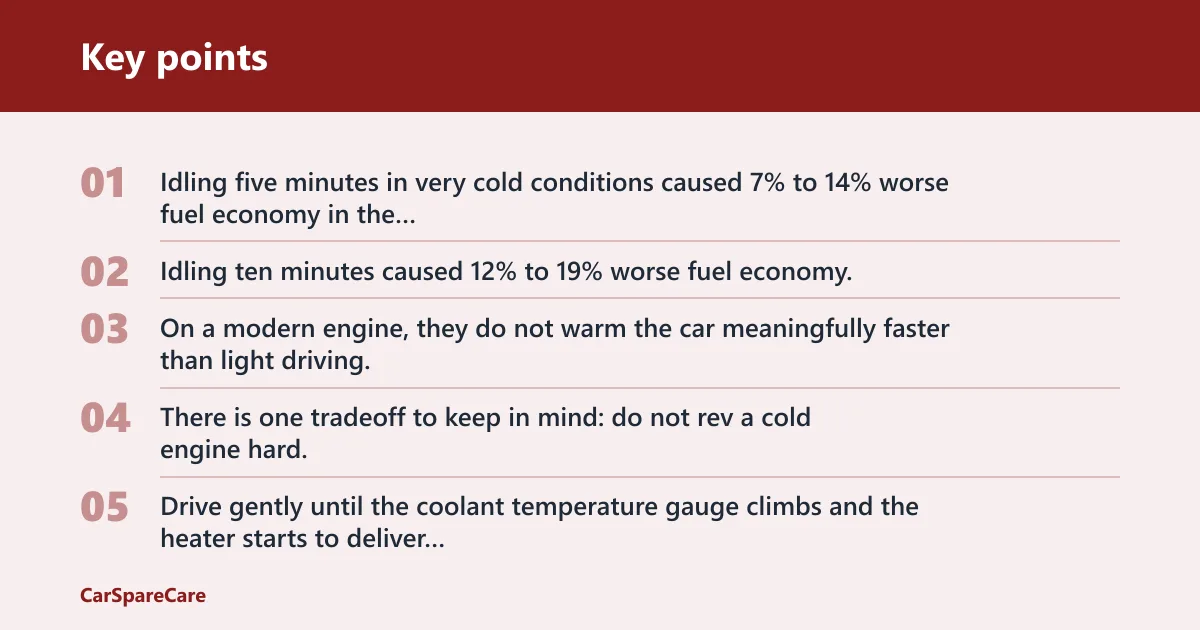
Idling five minutes in very cold conditions caused 7% to 14% worse fuel economy in the cited experiment. Idling ten minutes caused 12% to 19% worse fuel economy. Long idle periods also add emissions. On a modern engine, they do not warm the car meaningfully faster than light driving.
There is one tradeoff to keep in mind: do not rev a cold engine hard. Drive gently until the coolant temperature gauge climbs and the heater starts to deliver steady warm air. That gives the oil time to circulate without wasting time at a standstill.
Why older vehicles and diesels differ
Older carbureted engines often ran better with a short warm-up because fuel metering was less precise. Modern fuel-injected gas cars use sensors and control strategies that reduce that need. Diesel engines can idle for a while and still feel cold inside, especially in deep winter, so heater lag by itself is not proof of a fault.
Picture a 2.0-liter gasoline car parked overnight at 15°F. It starts cleanly, the gauge begins to move within a few minutes of driving, and the heater is warm before the end of the commute. That is normal. Now picture the same car still sitting at the low end after a 20-minute drive. That is not normal.
When a long wait is a bad sign
If the gauge stays low, the heater stays cold, or the engine runs rough long after startup, treat that as a diagnosis question. A healthy car can warm slowly in winter. A car that never seems to reach normal temperature, or only warms under certain conditions, needs a closer look.
Winter warm-up diagnosis matrix
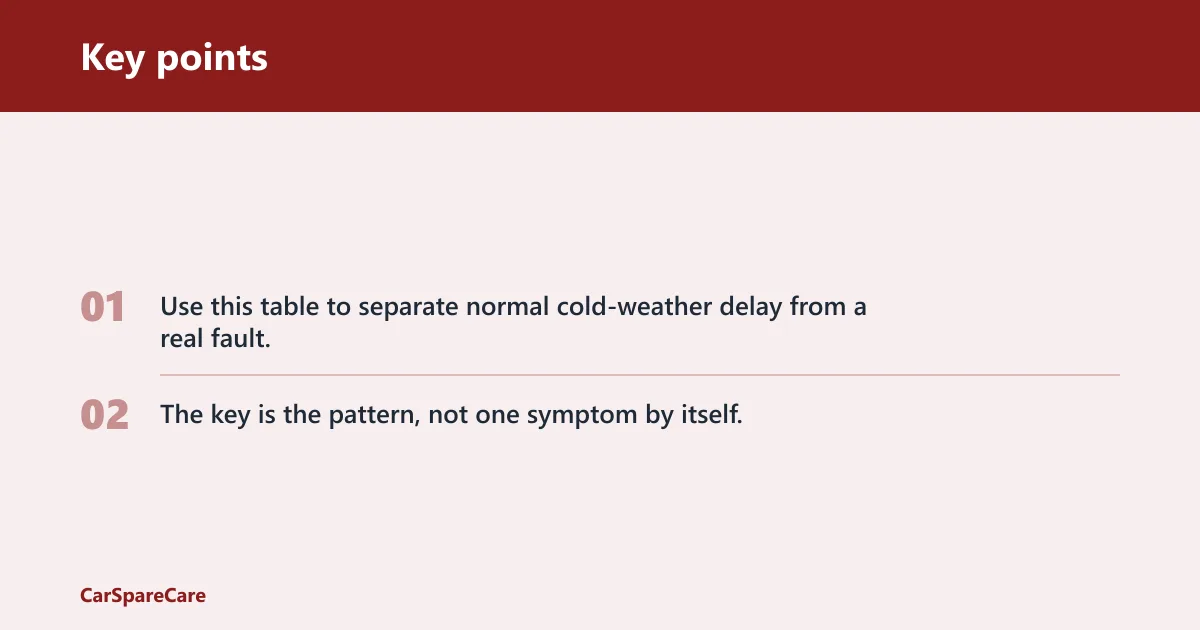
Use this table to separate normal cold-weather delay from a real fault. The key is the pattern, not one symptom by itself.
| Symptom | Likely cause | Normal or abnormal | Quick check | Urgency |
|---|---|---|---|---|
| Gauge takes 15 to 20 minutes to reach midpoint | Very cold ambient temperature, short trip, efficient engine | Normal if the gauge still rises steadily | Compare a cold morning drive with a milder day | Monitor |
| Gauge stays low after 20 minutes of driving | Thermostat stuck open, low coolant, sensor fault | Abnormal | Check coolant level when cold and watch for weak heat | Book a mechanic visit |
| Weak cabin heat at idle but warm while driving | Low coolant, air in system, weak water pump flow | Abnormal if it persists | See whether heat improves above idle | Book soon |
| Heat never gets warm | Low coolant, thermostat stuck open, heater core flow issue | Abnormal | Check reservoir level and dash gauge behavior | Book soon |
| Rough cold idle that clears within a few minutes | Cold oil, rich warm-up fueling, weak battery, plugs | Often normal if brief | See whether it smooths out as the gauge rises | Monitor |
| Rough idle that continues after warm-up | Misfire, vacuum leak, sensor issue, fuel delivery fault | Abnormal | Check for warning lights or stored codes | Book soon |
| Temperature rises on the highway, then falls in town | Thermostat stuck open or cooling fan issue | Abnormal | Watch for unstable gauge movement | Book soon |
| Temperature climbs into the red zone | Severe coolant loss, thermostat stuck closed, flow blockage | Abnormal and urgent | Pull over safely and shut the engine off | Stop driving |
| Slow start, dim lights, and weak cranking on cold mornings | Battery weak from cold or age | Abnormal if repeatable | Test resting voltage and charging voltage | Book soon |
Could the thermostat be the problem?
Yes. The thermostat opens and closes to regulate coolant flow between the engine and the radiator. When it stays closed long enough, the engine warms quickly. When it opens at the wrong time, the engine can stay too cool and the cabin heat can lag. Either failure mode changes warm-up behavior.
Stuck-open signs
A thermostat stuck open usually causes slow warm-up, a low gauge, and weak heat on cold days. The engine may run cooler than expected at highway speed. If the gauge never settles near normal, a stuck-open thermostat is one of the first things to suspect.
Stuck-closed signs
A thermostat stuck closed is more dangerous. Coolant cannot move through the radiator as intended, so the temperature can climb quickly. If the gauge moves toward the red zone, or a warning light comes on, stop driving as soon as it is safe. This is an overheating problem, not just a slow warm-up issue.
Can coolant or oil cause this?
Yes. Coolant level and coolant mix both matter. So does oil viscosity in winter. Low coolant can leave the heater core short of hot fluid, while thick oil can make the first minutes after startup feel sluggish even when the cooling system is fine.
Low coolant and wrong mix symptoms
Low coolant often shows up as weak cabin heat, a gauge that behaves oddly, or repeated temperature swings. Water condensation in the fuel tank can freeze and block fuel lines, which can also make a cold morning start worse. Keeping the fuel tank at least half full in winter helps reduce condensation.
The coolant mixture also matters because it affects freeze protection. A wrong mix can reduce protection in freezing weather and can change how the engine warms and sheds heat. Check the coolant interval and mix guidance in the owner’s manual, because service schedules vary by vehicle.
Why thick oil slows early operation
Cold weather can cause engine oil to thicken like molasses, and below 32°F some guidance describes it as slow-flowing enough to be called sludge. That does not mean the oil is ruined. It means the first minutes after startup are harder on the engine if the oil grade is too thick for the weather.
Many winter guides point to 0W-20 synthetic oil for cold-flow performance. Synthetic oil generally flows better at low temperatures than conventional oil of the same grade, which can help reduce startup drag. Follow the owner’s manual for the correct grade for your engine.
Winter checks worth doing
- Check the coolant reservoir only when the engine is cold.
- Compare the level to the MIN and MAX marks.
- Look for pink, green, orange, or white crust around hoses and caps.
- Check the dipstick and oil cap area for signs of contamination.
- Confirm the battery voltage before assuming the warm-up issue is only a coolant problem.
Why is the cabin heater slow?
Cabin heat depends on coolant temperature. If the engine is still cold, the heater core has little hot fluid to work with. That is why the vents may blow cool air for a few minutes after a winter start. The heater is often slower than the engine itself.
Weak heat at idle versus while driving
If the heater gets warmer while driving but cools at idle, think about flow or coolant level. At idle, the engine produces less heat and may move coolant more slowly. If the heater never gets warm, or the defroster struggles even after a long drive, that points more strongly to a cooling-system issue.
Say your compact sedan warms up on the highway but the windshield stays foggy at stoplights. That pattern can point to low coolant, trapped air, or a thermostat issue. The heater core is telling you the engine is not delivering steady hot coolant at idle.
Defrost performance clues
Defrost that works poorly at first, then improves, is usually normal. Defrost that stays weak while the gauge also stays low is more concerning. If the temperature gauge never comes up and the vents stay cold, do not assume it is only a weather issue.
When should you stop driving?
Stop driving if the temperature gauge enters the red zone, if a red warning light appears, or if you see steam from under the hood. That means an overheating risk, not a harmless delay. Pull over safely and shut the engine off once you can do so without danger.
Rising temperature after highway driving
If the gauge rises after a highway run, then stays high in town, the cooling system may be losing control of temperature. A thermostat, radiator flow problem, cooling fan fault, or low coolant can cause that pattern. A healthy system should not keep climbing after the engine has already warmed.
When to book a mechanic visit
Book a mechanic visit if the gauge stays low after 15 to 20 minutes, the heater never gets hot, the engine idles rough well past warm-up, or the battery keeps struggling in cold weather. Those patterns are more than winter delay. They point to a part that needs testing.
Frequently asked questions
How long does your car need to warm up in cold weather?
Most modern cars need only a short idle before gentle driving. In cold weather, 5 to 15 minutes of steady driving is often enough for normal warm-up. If the gauge stays low after 15 to 20 minutes, or the heater never improves, treat it as a possible fault.
How long does it take for a car to warm up in cold weather?
That depends on engine size, ambient temperature, and vehicle type. A healthy fuel-injected gas car often begins warming within minutes of driving. Older carbureted engines and some diesels can take longer. The key sign is steady gauge rise, not a fixed minute count.
How long should I wait for my car to warm up in winter?
Usually not long. Start the car, let it stabilize briefly, then drive gently. Extended idling is usually unnecessary on modern engines and wastes fuel. If you need more than a short wait for safe visibility, use that time to clear windows rather than sit and idle.
How long for car to warm up in winter?
For many cars, the useful answer is the first 5 to 15 minutes of driving. That is when coolant, oil, and heater performance usually improve together. If the gauge stays low much longer, or the heater remains cold after the drive begins, look for thermostat or coolant trouble.
Why does my car idle rough when it’s cold?
A brief rough idle can be normal when oil is thick and the engine is running a richer cold-start mixture. It should settle as the temperature rises. If the roughness continues after the engine warms, or if a warning light appears, the cause is more likely a misfire or sensor issue.
Is it normal for the heater to blow cold air at first?
Yes. The heater core needs hot coolant, and the coolant is often cold right after startup. Cold air for the first few minutes is normal, especially in freezing weather. What is not normal is a heater that stays cold for the whole drive or only works at highway speed.
Can cold weather make a healthy car take longer to warm up?
Yes. Cold weather can slow battery output, thicken oil, and delay coolant and cabin heat. A healthy car can still take longer to reach normal temperature on a freezing morning. The difference is that the gauge still rises steadily and the heater eventually becomes warm.
When is slow warm-up a sign of thermostat or coolant trouble?
If the gauge stays low after 15 to 20 minutes, the heater never gets warm, or the temperature swings unusually, suspect thermostat or coolant trouble. A stuck-open thermostat often causes underheating. Low coolant can do the same and can also leave the heater core short of hot fluid.
Should I idle my car to warm it up in winter?
Usually no. Modern fuel-injected cars warm up well under gentle driving, and long idling wastes fuel and adds emissions. A brief idle for safe oil pressure and clear windows is fine. Then drive gently until the gauge rises and the heater starts delivering steady warm air.

Hi, I’m Melvin, an automobile engineer with extensive experience in automobile equipment. I currently work for a local automobile firm, where I specialize in the car parts industry. I’ve had the opportunity to collaborate with seasoned inspectors, gaining invaluable hands-on experience that goes beyond just theory.
My passion for automotive care started at a young age, which led me to create CarSpareCare. Through CarSpareCare, I share the knowledge and skills I’ve acquired over the years to help others navigate the world of car maintenance and repairs.
My goal is to provide practical tutorials, essential safety advice, and the latest industry insights so that anyone—whether a beginner or an expert—can confidently tackle their automotive projects.

