Quick verdict: charging in place is often safe for a conventional flooded 12-volt battery if the vehicle and charger manuals allow it; use caution with AGM, EFB, or modern battery-sensor vehicles; and do not charge in place if the battery is swollen, leaking, frozen, damaged, or the manual says to remove it first. In hybrids and EVs, follow the vehicle manual for the 12-volt battery and service procedures; do not improvise with the high-voltage system.
- Safe to charge in place: conventional flooded 12-volt batteries in vehicles whose manuals allow in-car charging, using the correct charger mode and a low charging rate. (Howacarworks)
- Use caution: AGM and EFB batteries, cars with battery monitoring systems, start/stop vehicles, and vehicles with sensitive electronics; use the charger’s battery-specific mode and follow the manual. (charger manual)
- Do not charge in place: if the battery is swollen, cracked, leaking, frozen, very hot, or the vehicle or charger manual requires battery removal before charging.
Charging in place is generally unsafe if the battery is swollen, leaking, frozen, or in a vehicle that requires battery removal before charging. If you get this wrong, you can damage control modules, trigger sparks, or ruin the battery. This guide covers when in-car charging is safe, what to disconnect first, and how to reduce electronic risk.
Can you charge a car battery without disconnecting it?
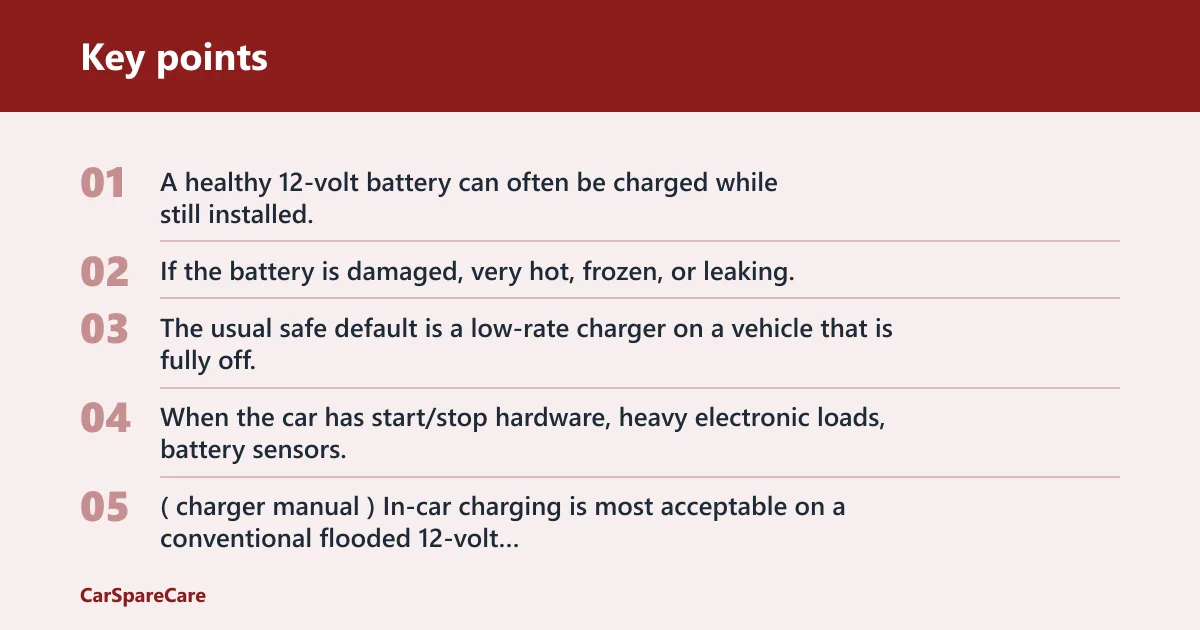


Yes, sometimes. A healthy 12-volt battery can often be charged while still installed, but the safer choice depends on the battery type, the car’s electronics, and the charger’s output and mode. If the battery is damaged, very hot, frozen, or leaking, stop and inspect or replace it first.
The usual safe default is a low-rate charger on a vehicle that is fully off, with good ventilation and no sparks near the battery. When the car has start/stop hardware, heavy electronic loads, battery sensors, or a vehicle manual that calls for removal, follow the manual rather than a generic rule. (charger manual)
When in-car charging is acceptable
In-car charging is most acceptable on a conventional flooded 12-volt battery in an older car, or on a battery that the vehicle maker allows to be charged in place. Use the charge rate and mode specified by the vehicle and charger instructions rather than relying on a fixed amp number. (Howacarworks)
When you should remove the battery instead
Remove the battery if it is swollen, cracked, leaking, frozen, or too hot to touch. Remove it as well when the charger manual, the vehicle manual, or the battery label does not allow in-car charging. In many vehicles, the negative lead should be disconnected from the battery or moved to a designated chassis ground point first when the manual calls for isolation; follow the vehicle and charger instructions rather than using a blanket negative-to-negative rule. If the vehicle manual specifically says to disconnect the battery before charging, do that before attaching the charger. (battery terminals)
What you’ll need
- A 12-volt battery charger with a matching battery type setting
- A smart charger or maintainer if the battery is AGM or EFB
- A charger manual and the vehicle owner’s manual
- Gloves and eye protection
- A ventilated, dry parking spot
- Optional: a pigtail or quick connector with eyelet-style leads for easier maintenance charging
A car battery charger uses a charging voltage above the battery’s resting voltage, not the battery’s resting 12 volts. The correct rate varies by charger and battery type, so the safest choice is the lowest rate that the charger manual and vehicle manual allow for in-car charging. (Howacarworks)
Battery charging decision checklist
| Can charge without disconnecting? | Why | Best charger type / max safe use case |
|---|---|---|
| Usually yes | Conventional flooded batteries can often be charged in place if the charger and vehicle manual allow it. | Use a basic or smart 12V charger at the lowest rate the manual allows, often around 2 amps for cautious in-car charging. |
| Only with the right mode | AGM batteries used in start/stop vehicles generally need a smart charger and the correct AGM mode. | Use a charger that explicitly supports AGM and follow the charger manual for the selected mode. (charger manual) |
| Only with the right mode | EFB batteries in start/stop vehicles also generally need a smart charger and are not suited to a conventional charger. | Use a charger that explicitly supports EFB, or charge the battery off the car if the charger cannot match the type. (charger manual) |
| Sometimes, but check first | Some vehicles require the battery to be isolated before charging, especially when battery monitoring hardware or sensitive electronics are involved. | Follow the vehicle manual; if it calls for disconnection, remove or isolate the battery before charging. (battery terminals) |
| Often no | Modern ECU-heavy cars can lose settings or suffer faults if the wrong charger is used or if voltage is unstable. | Use a smart charger approved for the vehicle, or disconnect the battery if the manual recommends it. (charger manual) |
| No, not as a fix | A deeply discharged battery may need recovery steps or replacement; a charger may not wake it safely. | Follow the charger manual for recovery mode, or have the battery tested and replaced if it will not hold charge. (charger manual) |
| Yes, if it is a maintainer job | A maintainer charges as needed automatically during storage or parking periods, and is meant to keep a charged battery ready. | Use a maintainer, or a smart charger with maintenance mode, for long-term parking. |
How do you charge it in place?
Use the charger manual and the vehicle manual together. The safe sequence is simple: turn the vehicle off, confirm the battery type, connect positive to positive, and use the correct charge mode. For the negative lead, follow the vehicle and charger manual; many vehicles prefer the negative clamp or lead to be attached to a designated chassis ground away from the battery instead of directly to the negative post. Keep the charger away from the battery face as much as the lead length allows, because hydrogen gas can build up while charging.
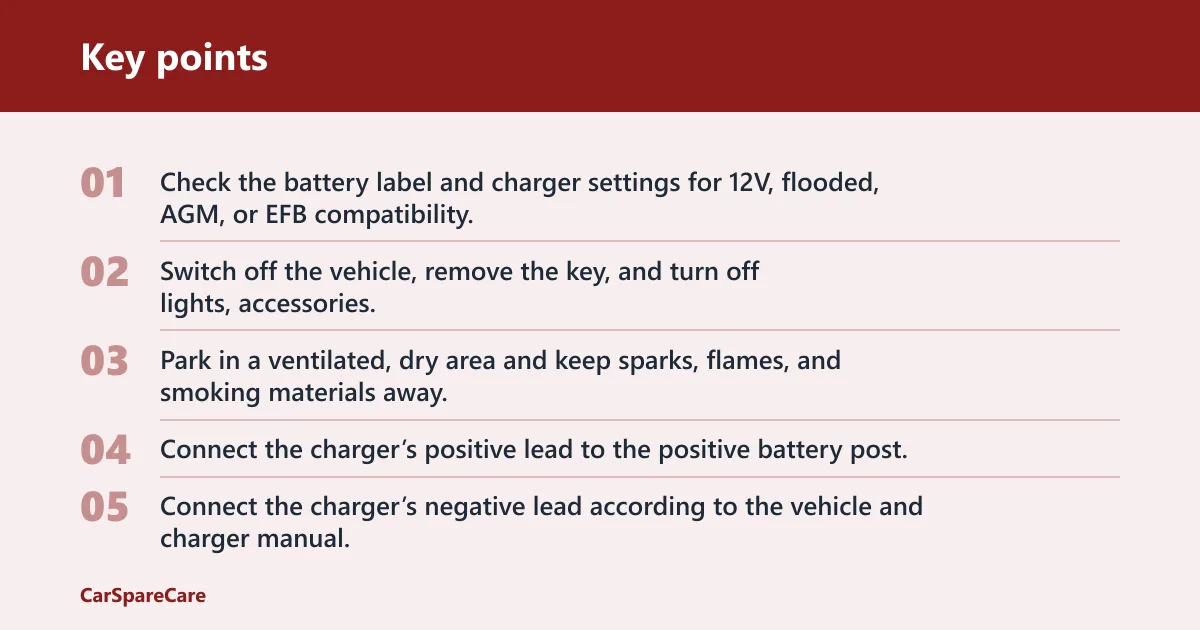
- Check the battery label and charger settings for 12V, flooded, AGM, or EFB compatibility.
- Switch off the vehicle, remove the key, and turn off lights, accessories, and the infotainment system.
- Park in a ventilated, dry area and keep sparks, flames, and smoking materials away.
- Connect the charger’s positive lead to the positive battery post, usually marked red or plus.
- Connect the charger’s negative lead according to the vehicle and charger manual; if a chassis-ground connection is specified, use that point instead of the battery post.
- Select the correct mode and charge rate for the battery and vehicle.
- Watch the battery and stop if it heats, swells, leaks, or smells unusual.
- When charging ends, unplug the charger before removing the clips.
Say your sedan has a standard flooded battery and a simple charger set to the low rate recommended by the charger instructions. That is a typical setup. If the same car had an AGM battery from a start/stop system, the charger would need the AGM mode instead of the plain lead-acid setting. (charger manual)
Should you use a battery maintainer?
Use a maintainer for storage or parking periods, not for reviving a dead battery. A maintainer keeps a stored car ready by topping up the battery as needed, rather than delivering a recovery charge. That makes it a better fit when the car sits for weeks and you want the battery maintained without overcharging.
A smart charger may have a maintenance function, but a maintainer is not the same thing as a recovery charger. If the battery is deeply discharged, a maintainer may not restart it. In that case, use the charger’s recovery instructions or test the battery. (charger manual)
Picture a car parked for a month in a driveway with alarm memory, radio presets, and a battery monitoring system. A maintainer on a proper pigtail connector is usually the cleaner choice than repeated manual charging, because it supports storage without constant clipping and unclipping.
What about AGM and EFB batteries?
AGM and EFB batteries need more care than a basic flooded battery. Start/stop cars commonly use AGM or EFB batteries, and both types should be charged with a smart charger that has the correct mode for the battery chemistry. A conventional charger may not charge them correctly, and the wrong setting can shorten battery life. (charger manual)
Do not treat AGM and EFB as interchangeable with a plain charger. The charger manual should list compatibility with the battery type. If it does not, stop and check the vehicle manual or battery label before attaching clips.
Why the manual matters more than habit: start/stop vehicles can have a battery monitoring system, current-sensing hardware, and sensitive control units. The battery may still sit in the car, but the charging method should match the vehicle maker’s instructions instead of a generic rule. (charger manual)
How to reduce risk on modern cars
Modern ECU-heavy cars are the ones most likely to object to a casual charging setup. The risk is not only the battery. Control modules, alarm memory, infotainment presets, and battery monitoring systems can all be affected by voltage spikes, bad charger settings, or a poor connection.
- Use a smart charger with the correct 12V battery type mode.
- Confirm the charger will stop automatically or switch to maintenance mode when full.
- Keep the vehicle off and avoid turning on loads during charging.
- Use a pigtail or quick connector for repeated maintenance charging, because it reduces clip handling.
- If the manual calls for battery disconnection, disconnect the negative terminal first and reconnect it last.
The negative terminal or cable is the one to remove first if the battery is coming out, because that reduces spark risk. If the battery is removed, reconnect the positive terminal first and the negative last. When you disconnect or reconnect, avoid touching the two terminals with a tool at the same time. If the vehicle manual specifies a chassis ground point for charging or jump-starting, use that point instead of the negative post. (battery terminals)
Common mistakes
Most charging problems come from using the wrong mode or ignoring battery condition. A battery that is cracked, swollen, leaking, frozen, or very hot should not be charged until it is inspected or replaced. Charging a damaged battery can make the problem worse fast.
- Charging a damaged battery: stop immediately if it is swollen, leaking, frozen, or hot.
- Using a plain charger on AGM or EFB: select the battery-specific smart mode instead.
- Ignoring ventilation: hydrogen gas can collect while charging, so keep sparks away.
- Assuming every car is the same: battery sensors, ECU-heavy layouts, and start/stop systems all change the charging approach.
- Using a high-output charger when you do not need one: higher output can charge faster, but it can stress the battery plates if the battery or manual calls for a lower rate.
If that did not work, move to a battery test. A battery that will not hold charge after a proper charge cycle may be near the end of its service life. A charger can fill it, but it cannot repair worn plates.
For cars that sit, use a maintainer rather than letting the battery drop low and recover repeatedly. A maintainer is made for storage charging, not repeated rescue work.
Frequently asked questions
Is it safe to charge a car battery without disconnecting it?
It can be safe on some 12-volt lead-acid batteries if the charger matches the battery type and the vehicle is off. It is not safe to assume that every car allows it. If the battery is damaged, or the car uses AGM, EFB, battery sensors, or sensitive electronics, check the manuals first.
Can you charge a car battery without disconnecting it first?
Yes, in some cases. That said, the vehicle manual and charger manual decide the final answer. If the battery must be removed, disconnect the negative terminal first and reconnect it last. That sequence helps reduce spark risk during removal and refitting. (battery terminals)
Can you charge a car battery without disconnecting terminals?
Sometimes, yes. Some batteries can stay in the car while charging, but that depends on the vehicle, the battery type, and the charger settings. For AGM and EFB batteries, use a smart charger with the correct mode. If the charger does not list that support, do not guess.
Can you trickle charge a car battery without disconnecting it?
Often yes, if the charger is appropriate for the battery type and the car’s manual allows in-car charging. For storage, a maintainer is usually the better fit because it turns on and off as needed.
Can you charge a car battery without unplugging it?
Yes, but only when the battery, charger, and vehicle all allow it. Do not use that approach on a swollen, leaking, frozen, or very hot battery. If the battery will not hold charge after charging, it likely needs testing or replacement.
Should you charge a car battery without disconnecting it?
Only when that method fits the battery type and the vehicle manual. For many conventional batteries, in-car charging is acceptable. For AGM, EFB, battery-sensor-equipped vehicles, and models whose manuals require isolation, the safer choice may be a smart charger, battery removal, or a maintainer. (charger manual)

Hi, I’m Melvin, an automobile engineer with extensive experience in automobile equipment. I currently work for a local automobile firm, where I specialize in the car parts industry. I’ve had the opportunity to collaborate with seasoned inspectors, gaining invaluable hands-on experience that goes beyond just theory.
My passion for automotive care started at a young age, which led me to create CarSpareCare. Through CarSpareCare, I share the knowledge and skills I’ve acquired over the years to help others navigate the world of car maintenance and repairs.
My goal is to provide practical tutorials, essential safety advice, and the latest industry insights so that anyone—whether a beginner or an expert—can confidently tackle their automotive projects.