
Low tire pressure can cause a mild pull, especially if one front tire is lower than the other. A bigger or persistent pull can point to alignment, brake drag, or a tire fault. Ignoring it can wear tires unevenly, waste fuel, and hide a brake or alignment problem. This guide shows how to spot the symptom pattern and check pressure, road crown, alignment, and brake drag in minutes.
How underinflation causes pull and how to check it
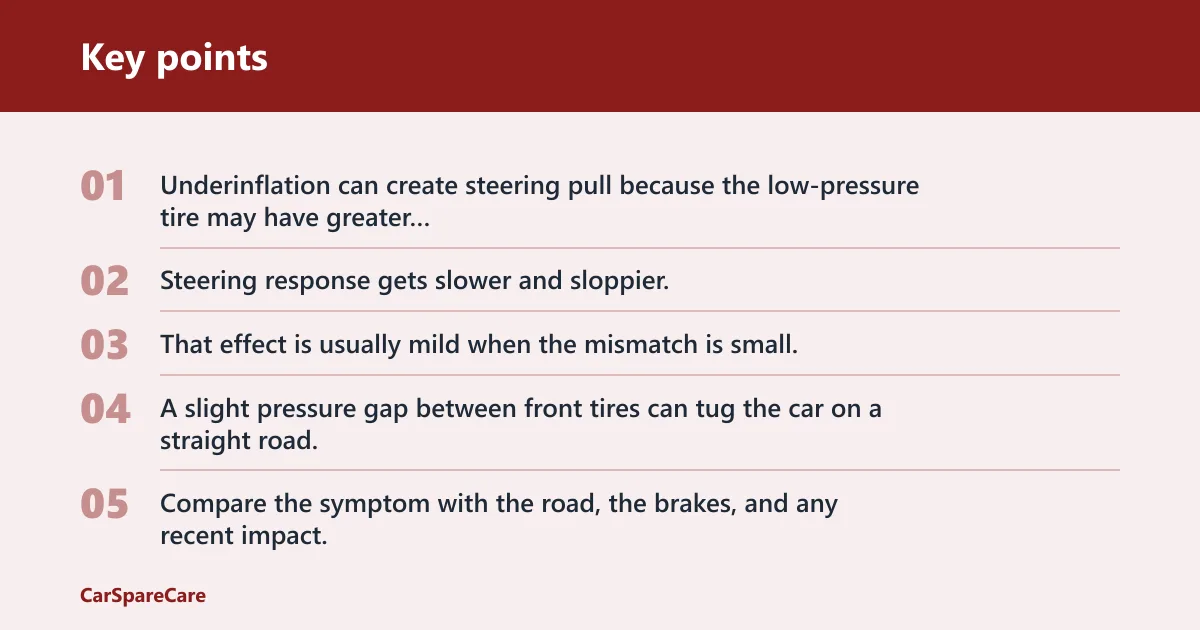
Underinflation can create steering pull because the low-pressure tire may have greater rolling resistance and may drift toward its side. Low pressure also hurts handling. Steering response gets slower and sloppier, and the sidewall flexes more during cornering and braking.
That effect is usually mild when the mismatch is small. A slight pressure gap between front tires can tug the car on a straight road, but a strong pull or one that keeps coming back should make you look beyond pressure. Compare the symptom with the road, the brakes, and any recent impact.
What pressure differences matter most
There is no single psi gap that explains every vehicle. Small differences matter more on some cars than others, especially on vehicles with sensitive steering geometry. Run-flat tires and staggered setups can also react differently to the same pressure change.
Use the doorjamb placard or owner’s manual as the target, not the sidewall. The sidewall lists maximum values, not the recommended running pressure. Inflate tires according to the manufacturer’s recommended pressure, which is the standard used in owner manuals rather than the tire’s maximum printed rating.
Start with a cold tire-pressure gauge and check all four tires before driving. Compare each reading with the placard or owner’s manual. If one tire is low and the car drifts toward that side on a straight road, pressure is a strong suspect. This is the fastest way to separate a simple inflation issue from a real steering or brake problem.
Repeat-low pressure matters too. If the same tire keeps dropping, the issue may be a slow leak, valve problem, or puncture. That is not a steering fault. It is a tire problem that needs a leak check.
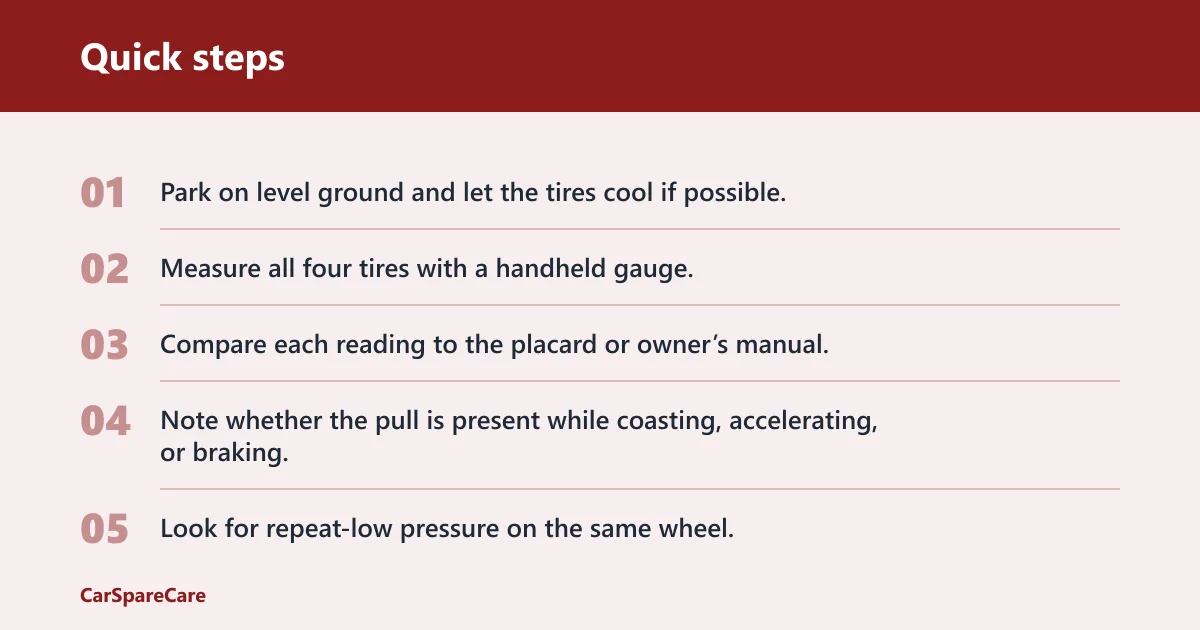
- Park on level ground and let the tires cool if possible.
- Measure all four tires with a handheld gauge.
- Compare each reading to the placard or owner’s manual.
- Note whether the pull is present while coasting, accelerating, or braking.
- Look for repeat-low pressure on the same wheel.
Suppose the left-front tire reads 31 psi and the right-front tire reads 36 psi on a car that asks for 35 psi cold. A mild drift left is plausible because the lower-pressure tire can create more rolling resistance. If the car still pulls after both fronts are corrected, pressure was not the whole story.
Tire pull diagnostic matrix
| Pull pattern | Likely cause | First checks | Urgency |
|---|---|---|---|
| Straight-line drift | Low tire pressure, alignment, road crown | Cold pressure check, compare to placard, test on a level road | Medium |
| Pull after a pothole | Alignment shift, bent wheel, tire damage | Inspect tire sidewalls, wheel condition, steering-wheel center, alignment | High |
| Pull only under braking | Sticking brake caliper, uneven braking force | Feel for heat, smell for burning odor, inspect one-wheel wear | High |
| Pull after tire rotation | Bad tire, tire conicity, pressure mismatch, wheel issue | Swap pressure readings, compare side-to-side behavior, inspect the tire | Medium |
| Pull that changes with road camber | Road crown or camber effect | Test on a flatter road in both directions | Low to medium |
This table is the fast filter. A pull only while braking points more toward the brakes than the tires. A drift that changes with the slope of the road often points to crown rather than a fault. A pull that starts after a pothole deserves an alignment and tire inspection. For a broader decision tree on tracking the cause, see car pulls in different driving conditions.
Why road crown can mimic a fault
Road crown can make a car drift slightly to one side even when tire pressure is correct. That is normal on many roads because the surface slopes for drainage. The key clue is that the drift often changes when you drive in the other lane or on a different road.
A true steering pull usually feels more consistent. If the car drifts the same way on several level roads, and the steering wheel sits off-center, a fault becomes more likely. If it only leans one way on crowned roads, the road may be the reason.
How to test on a level road
Use a flat, straight road with light traffic. Hold a steady speed and note whether the car tracks straight with the wheel centered. Then drive in the opposite direction on the same road, if safe. A crown-related drift often changes direction or reduces.
Do not treat every slight drift as a problem. A road that slopes right can make many vehicles drift right. The test is whether the behavior stays the same on different surfaces and in both directions.
Could wheel alignment be the real problem?
Yes. Wheel alignment problems can cause straight-road drift and an off-center steering wheel. Toe, camber, and caster all matter. A pothole or curb strike can move those angles enough to change how the vehicle tracks.
Alignment issues are more likely when the pull started after an impact, tire change, or suspension repair. They are also more likely when the steering wheel is no longer centered even though the car is driving straight. That clue is hard to ignore.
What toe, camber, and caster change
Toe affects whether the front tires point slightly inward or outward. Camber changes the tilt of the wheel. Caster helps the steering self-center. If any of those angles are off, the car may drift, tug, or feel unstable at the wheel.
Low pressure can mimic a mild alignment issue, but it does not usually create a lasting off-center steering wheel by itself. If pressure is correct and the steering wheel still sits crooked, alignment moves higher on the list.
What else causes pulling besides tire pressure?
Several faults can cause a pull besides pressure. A sticking brake caliper can create uneven braking force, and the car may pull only under braking. Worn suspension or steering parts can also make the vehicle wander or refuse to hold a line.
Look for pattern clues. If the car pulls while cruising, then straightens when you brake lightly, pressure or alignment is more likely. If it pulls mainly when the pedal goes down, brake drag becomes a stronger suspect.
Signs of brake drag
One common clue is heat. Another is a burning smell after a short drive. One-wheel wear can also show up if a caliper drags that corner harder than the others. This is a safety issue, not just a comfort issue: if a brake is dragging, check the caliper, hose, slide pins, and pad movement before further driving.
A common first-timer mistake is blaming the tire because the pull happens on the same side every time. If the pull appears only when braking, one side of the braking system may not be operating correctly. Brake drag should be inspected promptly because heat can rise fast and damage the rotor, pads, and fluid.
Suspension and tire setup notes
Loose ball joints, tie rods, control-arm bushes, and shocks can contribute to poor tracking. They do not always cause a dramatic pull, but they can make the steering feel vague and let the car wander more than it should.
Run-flat tires, staggered setups, and some vehicles with sensitive steering geometry deserve extra care. A small pressure difference may feel larger on those vehicles. That is one reason a simple gauge check should come before deeper diagnosis.
TPMS, warnings, and pressure checks
TPMS is useful, but it is not a complete pressure check. On many 2008+ vehicles, the warning typically appears only after a tire is far below recommended pressure. That is severe underinflation, not an early warning for every small mismatch.
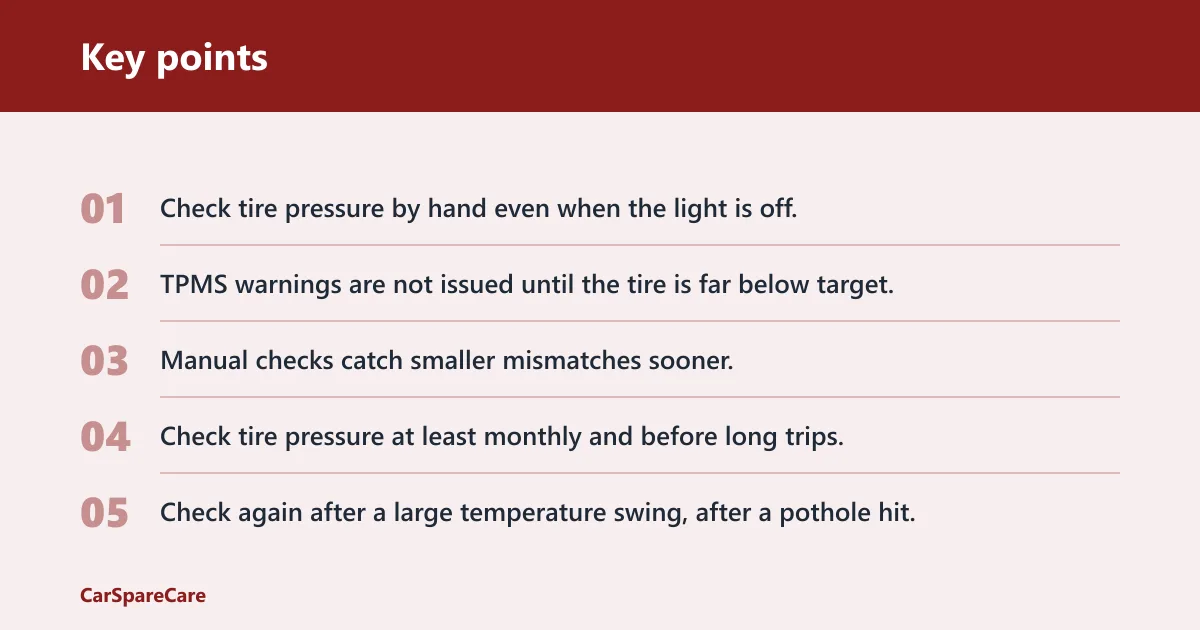
Check tire pressure by hand even when the light is off. TPMS warnings are not issued until the tire is far below target, so a car can pull before the system complains. Manual checks catch smaller mismatches sooner.
How often to check pressure
Check tire pressure at least monthly and before long trips. Check again after a large temperature swing, after a pothole hit, or if the car starts to drift. Cold readings are the standard because driving heats the air inside the tire and changes the number.
If one tire keeps going low, treat that as a repeat problem rather than a handling quirk. A slow leak, valve issue, or puncture needs repair before the car is used much more.
When to stop driving: Stop and inspect the car right away if the pull is sudden and severe, if the steering wheel jerks under braking, if you smell burning brake material, if one wheel is much hotter than the others, or if a tire is visibly low, damaged, or losing air quickly. Those are signs of an active brake, tire, or suspension problem that can become unsafe fast.
Quick decision guide
Use this sequence if the car starts to pull. It separates tire-pressure pull from road crown, alignment, and brake drag without guessing. Move step by step instead of changing several things at once.
- Check all four tires cold with a handheld gauge.
- Set each tire to the manufacturer’s recommended pressure.
- Drive on a flat road and note whether the pull remains.
- Brake lightly and note whether the pull appears only then.
- Inspect for pothole or curb damage if the symptom started after impact.
- Watch for repeat-low pressure on the same tire.
Picture a compact car that begins drifting right after a front-right tire loses air overnight. The gauge shows a lower reading on that corner, and the drift softens after inflation. That pattern fits pressure-related pull. Now picture the same car still pulling right after the tires match; alignment or brake drag moves up the list.
Frequently asked questions
Can low tire pressure cause steering pull?
Yes. Low tire pressure can cause a mild steering pull because the underinflated tire has greater rolling resistance and may drift toward that side. The effect is usually mild, but a larger or persistent pull often points to alignment, brake drag, road crown, or a tire fault.
Why does my car pull to one side when I drive straight?
A car that pulls on a straight road may have uneven tire pressure, alignment trouble, road-crown drift, or brake drag. If the pull changes with the road surface, crown is possible. If the steering wheel is off-center, alignment moves higher on the list.
How do I know if low tire pressure is causing the pull?
Check all four tires cold with a handheld gauge and compare them to the placard or owner’s manual. If one tire is low and the car drifts toward that side on a level road, pressure is likely involved. If the pull stays after correction, look deeper.
What tire pressure difference causes a car to pull?
There is no universal number for every vehicle. Even a small mismatch can matter on some cars, especially with sensitive steering geometry. A small difference between front tires can create a mild pull, but a strong pull usually needs another explanation too.
Will inflating the tires fix a steering pull?
Sometimes. If the pull comes from uneven tire pressure, inflating the tires to the manufacturer’s recommended pressure can reduce or remove it. If the pull remains after that, the cause is more likely alignment, brake drag, a tire defect, or road crown.
What else causes a car to pull besides tire pressure?
Wheel alignment problems, a sticking brake caliper, worn suspension parts, and a damaged tire can all cause pulling. If the pull appears only under braking, brake force is the first place to look. If it began after a pothole, inspect for alignment or wheel damage.
Can TPMS catch low tire pressure before the car pulls?
Not reliably. TPMS usually warns only after a tire is far below recommended pressure. A car can drift or handle poorly before that point, so manual pressure checks are still needed even when the warning light is off.

Hi, I’m Melvin, an automobile engineer with extensive experience in automobile equipment. I currently work for a local automobile firm, where I specialize in the car parts industry. I’ve had the opportunity to collaborate with seasoned inspectors, gaining invaluable hands-on experience that goes beyond just theory.
My passion for automotive care started at a young age, which led me to create CarSpareCare. Through CarSpareCare, I share the knowledge and skills I’ve acquired over the years to help others navigate the world of car maintenance and repairs.
My goal is to provide practical tutorials, essential safety advice, and the latest industry insights so that anyone—whether a beginner or an expert—can confidently tackle their automotive projects.

