

A starter fault usually gives a single click or a slow crank with a fully charged battery, while an alternator fault can let the car start, then voltage may drop below 13.5 V with the engine running and the battery light may come on. Guess wrong and you can buy the wrong part or strand the car again. This guide shows a simple decision tree, quick symptom checks, and the voltage tests that separate starter, alternator, battery, and cable faults. Typical references for 12-volt systems place resting battery voltage near 12.6 V, cranking minimum near 9.6 V, and charging voltage commonly in the 13.5 V to 14.8 V range, with exact targets varying by vehicle and temperature (Battery Council International; AAA; Bosch).
| Factor | Starter | alternator | Winner |
|---|---|---|---|
| When the fault shows up | During cranking | After the engine starts | Tie |
| Most common symptom pattern | Clicking, no-crank, slow crank, or grinding | Battery warning light, dimming lights, start-and-die, or dead battery after driving | Tie |
| Best quick check | Cranking voltage and starter circuit voltage drop | Running voltage at the battery terminals | Tie |
| Driving risk | Usually a no-start risk | Can leave you stranded once the battery drains | Starter |
| Common overlap with other faults | Battery, cables, relay, ignition switch, ground | Belt slip, bad battery, bad cables, parasitic drain | Alternator |
When the fault shows up
A starter problem shows up when the key is turned or the start button is pressed. An alternator problem usually shows up after the engine is already running, because the alternator’s job is to recharge the battery and supply the electrical load while you drive. A battery light that comes on only after startup is a classic charging-system clue (NHTSA; AAA).
Most common symptom pattern
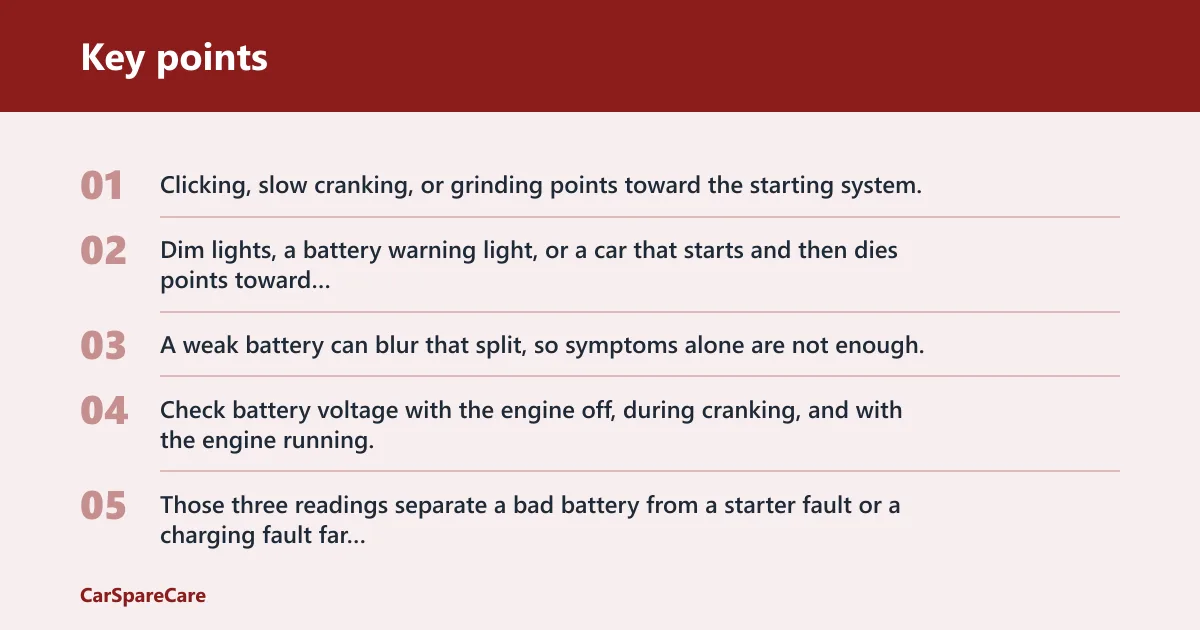
Clicking, slow cranking, or grinding points toward the starting system. Dim lights, a battery warning light, or a car that starts and then dies points toward the charging system. A weak battery can blur that split, so symptoms alone are not enough.
Best quick check
A multimeter gives the fastest answer. Check battery voltage with the engine off, during cranking, and with the engine running. Those three readings separate a bad battery from a starter fault or a charging fault far better than guesswork does. Readings around 12.6 V off, about 9.6 V or higher while cranking, and roughly 13.5 V to 14.8 V running are the usual targets for many 12-volt systems (Battery Council International; Bosch).
Driving risk
A bad starter usually leaves you stuck before the engine starts. A bad alternator may still let you drive for a short time, but once the battery discharges, the car can stall and refuse to restart. That makes an alternator fault a towing decision more often than a starter fault, especially if the battery light stays on while driving (AAA; NHTSA).
Common overlap with other faults
Corroded battery terminals, loose cable ends, a bad ground, a failing relay, or a slipping belt can imitate either part. That is why the decision has to include the battery, the charging system, and the starting circuit, not just the two major components. For terminal cleanup and inspection, see the battery posts guidance.
Quick diagnosis guide
Start with the symptom pattern, then confirm it with voltage. No-crank with a healthy battery leans toward the starter or its circuit. Start-and-die, dimming lights, or a battery light with the engine running leans toward the alternator or belt drive.
Say your dashboard lights come on strongly, but the key produces one click and the engine does not turn. That is more consistent with a starter circuit problem, a weak battery, or corroded cables than with a bad alternator.
Suppose the car starts with a jump, then stalls after a few minutes and the battery light glows. That pattern fits a charging problem better than a starter problem, but a loose belt or bad battery can still be part of the chain.
How can I tell if my starter is bad or my alternator is bad?
Use the engine state. If the problem happens at crank time, suspect the starter, battery, relay, ignition switch, or cables. If the problem shows up after startup, suspect the alternator, belt, battery, or charging connections. The engine-off, cranking, and running voltage checks below make that split much clearer.
What you’ll need
- Digital multimeter set to DC volts
- Safety glasses and gloves
- Helper to turn the key or press the start button
- Basic hand tools for battery terminals and cable ends
- Wire brush or terminal cleaner for corrosion
Step 1: Check the battery first
The battery is the first filter because a weak battery can mimic both failures. Measure voltage at the battery posts with the engine off, not on the cable clamps. Then inspect the terminals, cable ends, and ground straps for white corrosion, loose clamps, or frayed cables. Poor terminal contact can lower available system voltage enough to imitate a starter or alternator failure.
- Set the multimeter to DC volts and read the battery with the engine off.
- A fully charged battery is usually about 12.6 V at rest; about 12.2 V is only partly charged, and around 12.0 V is weak.
- Clean corrosion from the terminals, tighten the clamps, and recheck.
- If the reading is still low, charge the battery before chasing the starter or alternator.
Can a weak battery make me think the starter or alternator is bad?
Yes. Low resting voltage can keep the starter solenoid from pulling in hard enough, and it can also make the alternator seem weak because the battery never reaches a normal charge. A jump start may get the engine running, but that only proves the battery was low enough to block cranking; it does not clear the starter or alternator.
Step 2: Read the cranking symptoms
Cranking behavior separates many starting faults from charging faults. A single click often points to the starter solenoid, a relay, a bad battery, or a bad cable connection. Rapid clicking usually means the battery voltage is collapsing under load. During cranking, many healthy systems stay above about 9.6 V; a lower reading is a strong clue that the starting circuit is under strain (Battery Council International).
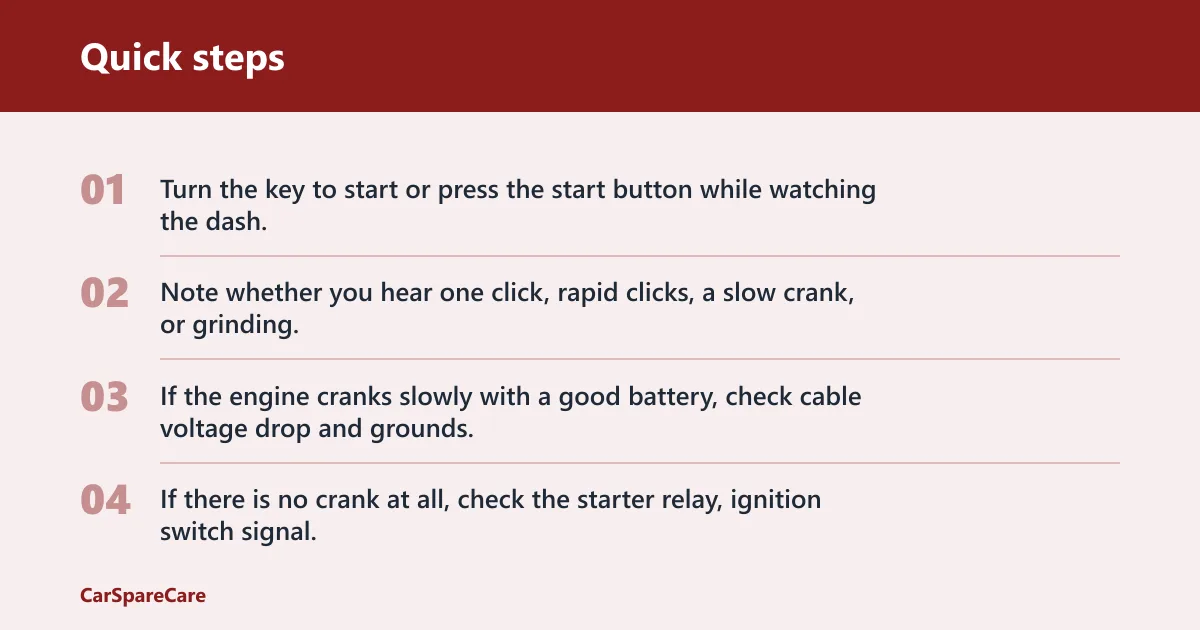
- Turn the key to start or press the start button while watching the dash.
- Note whether you hear one click, rapid clicks, a slow crank, or grinding.
- If the engine cranks slowly with a good battery, check cable voltage drop and grounds.
- If there is no crank at all, check the starter relay, ignition switch signal, and starter connection.
What does a clicking sound mean when trying to start the car?
A single click usually means the starter solenoid is trying to engage but the motor is not turning, or the battery voltage is too low to finish the job. Rapid clicking usually points more strongly to low battery voltage or a bad connection than to a dead alternator. Grinding points to starter gear engagement trouble.
Will the car crank if the alternator is bad?
Usually yes, if the battery still has enough charge. The alternator only charges while the engine runs, so a failed alternator does not stop cranking right away. The car may start, then run poorly or die later once the battery is drained. That’s why a charging fault can be hidden until the next restart.
Manual vs automatic and push-button systems
Manual cars add a clutch switch, and automatics add a park/neutral switch. Push-button start systems add more relay logic and can be less forgiving of low battery voltage. If the car only starts in neutral, only with the clutch fully depressed, or only after a battery jump, include those interlocks in the check.
Step 3: Check charging voltage
If the engine starts, move to the charging system. The alternator should raise system voltage above resting battery voltage once the engine is running. Most passenger vehicles commonly show roughly 13.5 V to 14.8 V at the battery with the engine running, though exact targets vary by vehicle and temperature. A battery light that stays on with the engine running is one of the most useful charging-system warnings (AAA; Bosch).
- Leave the multimeter on DC volts and read the battery with the engine idling.
- Blip the throttle slightly and watch whether voltage rises smoothly or stays low.
- Turn on headlights and rear defrost to see whether voltage holds in range.
- If voltage stays below about 13.5 V, inspect the serpentine belt, tensioner, alternator connections, and grounds.
What voltage should a car battery and alternator have?
A common rule of thumb is about 12.6 V at rest for a healthy, fully charged 12-volt battery. During cranking, voltage should usually stay above about 9.6 V. With the engine running, charging voltage should usually sit around 13.5 V to 14.8 V at the battery terminals. Some smart-charging systems deliberately idle lower at times, especially after the battery is replenished or under light electrical load (Bosch; AAA).
Can a bad alternator sound like a bad starter?
Sometimes. A failing alternator can leave the battery too weak to crank, which sounds like a starter or battery issue. It can also produce bearing whine or belt noise, but the key separator is timing: starter faults show up at crank, while alternator faults show up after start or while driving.
Starter, alternator, and voltage decision table
This table gives the most useful three-state check. Use the same meter on the battery posts each time. If a reading falls in the weak zone, follow the next check rather than replacing a part immediately.
| Test state | Expected battery voltage range | Likely fault | Next check |
|---|---|---|---|
| Engine off | About 12.6 V is healthy; 12.2 V or less is weak | Battery, terminals, or parasitic drain | Clean terminals, charge battery, then retest |
| During cranking | Usually stays above about 9.6 V | Starter circuit, battery, relay, cables, or grounds | Check cable voltage drop and starter relay signal |
| Engine running | About 13.5 V to 14.8 V | Alternator, belt, wiring, or regulator issue | Inspect belt tension and alternator output at the battery |
Example readings: 12.6/10.4/14.2
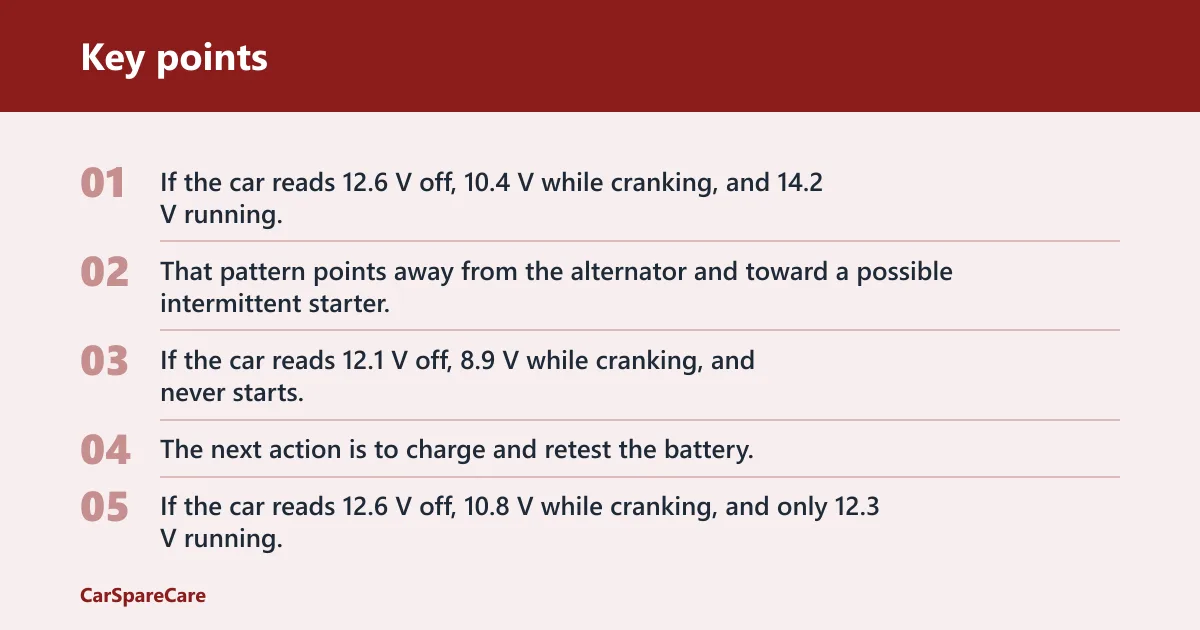
If the car reads 12.6 V off, 10.4 V while cranking, and 14.2 V running, the battery is charged, cranking voltage is acceptable, and charging voltage is normal. That pattern points away from the alternator and toward a possible intermittent starter, relay, or cable issue if the symptom is still present.
Example readings: 12.1/8.9/no-start
If the car reads 12.1 V off, 8.9 V while cranking, and never starts, the battery is weak and the starting load is pulling voltage too low. The next action is to charge and retest the battery, then inspect cables and grounds before condemning the starter. Low battery state can be the whole problem.
Example readings: 12.6/10.8/12.3 running
If the car reads 12.6 V off, 10.8 V while cranking, and only 12.3 V running, the battery can crank reasonably but the charging system is not lifting voltage enough. The likely fault is the alternator, belt drive, wiring, or regulator, and the next step is charging-system inspection rather than starter replacement.
If that didn’t work, try this next
If the engine-off reading is low, charge the battery first and repeat the test after the charge rests. If cranking voltage drops hard, inspect the positive cable, engine ground, and starter main cable before condemning the motor. If running voltage stays low, check the belt and alternator connector before replacing the alternator.
Common mistakes
Replacing the starter before checking battery voltage drop is a common waste of time. So is calling the alternator bad when the belt is slipping or the battery terminals are loose. A successful jump start also does not prove the alternator is healthy.
- Do not test at the cable clamps if the posts are corroded.
- Do not skip the running-voltage check after a jump start.
- Do not ignore a slow crank that turns out to be a bad ground.
- Do not assume a battery light means the alternator alone failed; belt drive and wiring can do the same thing.
- Do not keep trying to start a car with repeated clicks if the battery is already weak.
Picture a car with 12.6 V at rest, one clean click at start, and no crank. That points away from the battery and toward the starter circuit, relay, or cables. Now change one thing: if the same car starts with a jump and then dies after ten minutes, the alternator or belt becomes the stronger suspect.
Choose Starter if…
Choose Starter if the engine will not crank, you hear a single click or a dead silent start request with a good battery, or the cranking speed stays too slow even after the terminals are clean and tight. That is the cleaner pick when the fault is present only at start time.
Choose alternator if the car starts normally, then voltage falls below the normal running range, the battery light comes on, or the battery goes flat after driving. If the belt is loose or damaged, fix that first because a belt problem can imitate a failed alternator.

Frequently asked questions
What are the symptoms of a bad starter versus a bad alternator?
A bad starter usually causes a click, no-crank, slow crank, or grinding right when you try to start. A bad alternator usually shows up after the engine is running, with a battery warning light, dimming lights, or a battery that keeps going flat. The engine state matters more than the sound alone.
How do I test the starter and alternator at home?
Use a multimeter at the battery posts. Check engine-off voltage, crank voltage, and running voltage. If the battery is healthy but the engine will not crank, inspect the starter relay, cables, and starter connection. If the engine runs but voltage stays low, check belt drive and alternator output.
How do I know if I need a new starter or alternator?
Replace neither until the voltage checks point clearly there. A starter replacement makes sense when battery voltage is sound, cranking voltage collapses, and the rest of the circuit checks out. An alternator replacement makes sense when running voltage stays below about 13.5 V and the belt and wiring are intact.
What happens if I keep driving with a bad alternator?
The battery will run the car for a while, then voltage will fall, accessories will shut down, and the engine can stall. Once that happens, the car may not restart. If the battery light stays on and voltage stays low, stop driving and arrange service or towing. That risk is why low-system-voltage driving is not just inconvenient; it can become a no-restart event quickly (NHTSA; AAA).

Hi, I’m Melvin, an automobile engineer with extensive experience in automobile equipment. I currently work for a local automobile firm, where I specialize in the car parts industry. I’ve had the opportunity to collaborate with seasoned inspectors, gaining invaluable hands-on experience that goes beyond just theory.
My passion for automotive care started at a young age, which led me to create CarSpareCare. Through CarSpareCare, I share the knowledge and skills I’ve acquired over the years to help others navigate the world of car maintenance and repairs.
My goal is to provide practical tutorials, essential safety advice, and the latest industry insights so that anyone—whether a beginner or an expert—can confidently tackle their automotive projects.

