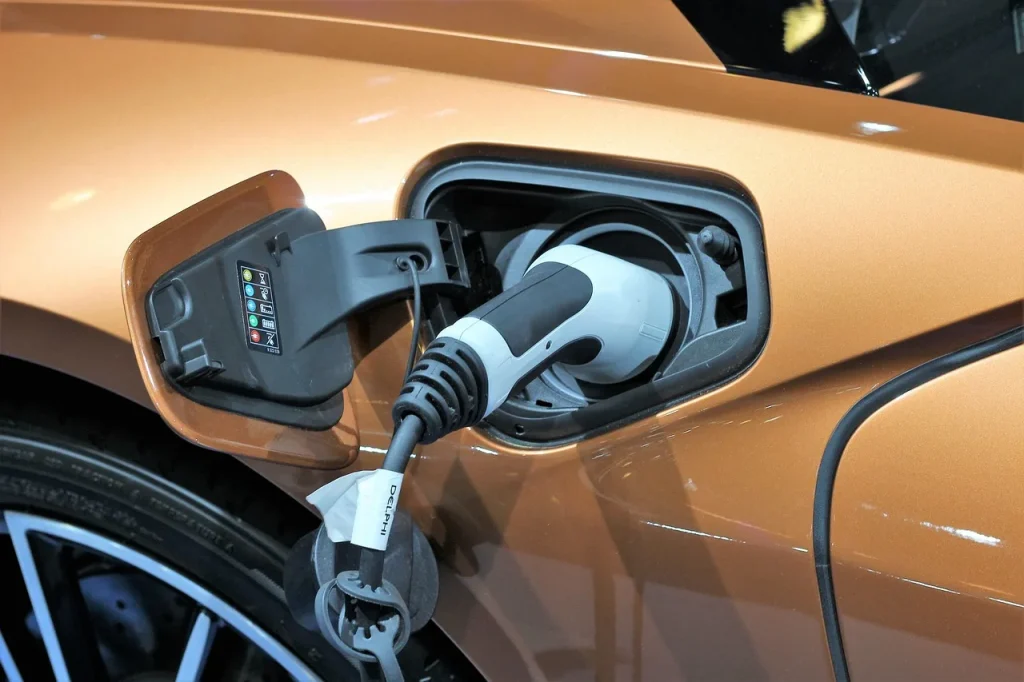
A battery tender is a low-amp maintainer that helps keep a healthy 12V battery topped off during storage; use one if your vehicle sits for more than about 2 to 4 weeks. Ignore that, and a parked car can come back with a flat battery, missed starts, and shortened battery life. This guide explains what a battery tender does, how it differs from a charger, and how to choose the right one.
What is a battery tender?



A battery tender is a maintenance charger, also called a battery maintainer. It keeps a fully charged battery near the correct storage voltage with very low output, usually by switching to an automatic float mode or a similar maintenance stage. It is generally not built to bring a dead battery back to life quickly.
Most smart maintainers are designed for healthy lead-acid batteries that only need offsetting for self-discharge and small vehicle loads. Battery Council International notes that self-discharge and parasitic loads can gradually drain stored batteries, while the U.S. Department of Energy explains that chargers and maintainers serve different roles: a charger restores energy, and a maintainer holds charge once full.
Battery tender vs. battery charger
A battery charger restores a discharged battery. It usually has higher output and may charge in several stages. A battery tender has lower output and is meant to hold charge after the battery is already full. If the battery is deeply discharged, a charger is often the first tool to reach for.
Think of it this way: a charger pushes energy into a low battery, while a tender keeps a full battery from drifting down during storage. That difference matters because a maintainer on a flat battery often gives little useful recovery, and a battery that has been deeply discharged should be tested rather than assumed recoverable.
Float mode and maintenance charging
Float mode is the stage after a battery reaches full charge. The device drops to a safe maintenance voltage to limit self-discharge without forcing the battery harder than needed. Good smart tenders switch into that mode automatically, which cuts overcharge risk during long storage.
That matters most when a vehicle sits in a garage, a seasonal parking spot, or airport parking for weeks at a time. Cold weather can make battery drain worse, and short-trip use often leaves the battery undercharged. U.S. Battery and battery industry guidance also note that stored batteries self-discharge faster in warm conditions and more slowly in the cold, but any battery loses charge over time.
Battery types it is made
Flooded lead-acid batteries are the traditional serviceable type found in many older vehicles. AGM batteries use absorbed glass mat construction and are common in start-stop vehicles. Gel batteries need more caution because some chargers are not compatible. Match the tender to the battery chemistry before you plug it in.
AGM and gel batteries are not interchangeable with every maintainer setting. A battery label or owner’s manual should control the choice, because overvoltage or the wrong charging profile can shorten service life. If the unit does not explicitly support AGM or gel, do not guess.
Battery tender decision matrix
This table helps you decide whether a battery tender fits the job. The right call depends on how often the vehicle runs, how long it sits, and what battery type is installed.
| Vehicle use pattern | Storage length | Battery type | Warning signs | Recommended action |
|---|---|---|---|---|
| Daily driver | Less than 1 week parked | Flooded, AGM, or gel if specified by the vehicle | Normal starts, no slow crank, no battery warning light | Usually no tender needed; drive often enough for the alternator to keep the battery charged |
| Weekend car | 1 to 3 weeks between drives | Flooded or AGM | Slow crank after sitting, clock reset, weak first start | A maintainer is useful if the car sits more than 2 to 4 weeks |
| Seasonal storage | 1 month to several months | Flooded, AGM, or gel with compatible setting | Battery voltage drops during storage, hard start after winter | Use a smart battery tender in float mode during storage |
| Classic car | Weeks to months | Often flooded lead-acid, sometimes AGM conversion | Parasitic draw from clocks, alarms, or accessories | Use a maintainer; consider a quick-disconnect lead set for regular storage use |
| Motorcycle | 2 weeks or longer | Small lead-acid, AGM, or gel as specified | Hard starting after storage, battery drains fast in cold weather | Use a low-amperage maintainer matched to the battery type and voltage |
| Car with parasitic draw | Even a few days to a week | Flooded or AGM | Repeated dead battery after sitting, drain from modules or accessories | A tender may help if parking is long enough; also diagnose the draw if the battery keeps going flat |
Not the right tool: A battery that is already deeply discharged, sulfated, frozen, or internally damaged usually needs testing and often replacement. A maintainer will not revive a failed battery.
Do you need one?
You need a battery tender when the vehicle sits long enough for self-discharge and parasitic draw to matter. If you drive every day and the charging system is working normally, you usually do not need one. If the vehicle is stored for weeks, used only on weekends, or left in cold weather, a maintainer can help.
When daily driving is enough
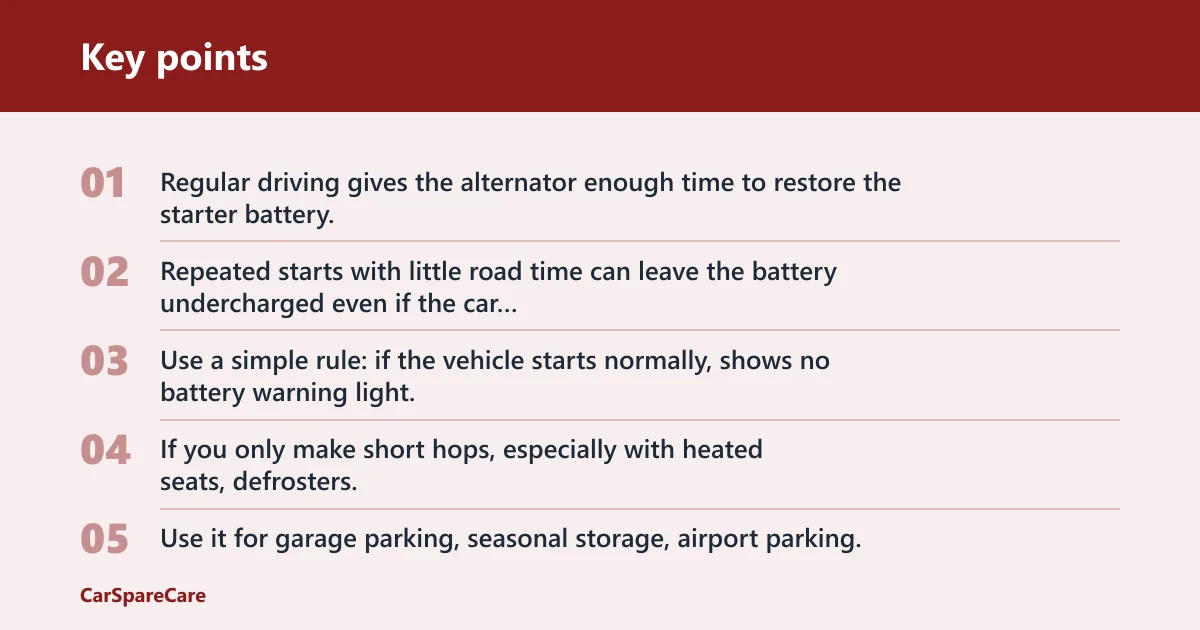
Most daily drivers do fine without a tender. Regular driving gives the alternator enough time to restore the starter battery, especially after longer trips. Short trips are different, though. Repeated starts with little road time can leave the battery undercharged even if the car is driven often.
Use a simple rule: if the vehicle starts normally, shows no battery warning light, and gets at least occasional longer drives, the charging system may be enough. If you only make short hops, especially with heated seats, defrosters, and headlights in winter, a maintainer can help offset what the alternator does not replace.
When storage time makes a maintainer useful
A battery tender is a storage tool. Use it for garage parking, seasonal storage, airport parking, or any long gap between starts. A healthy battery still self-discharges, and many modern vehicles keep drawing current for memory, security, or telematics systems even when parked.
If the vehicle sits more than 2 to 4 weeks, a maintainer often makes sense. That is the point where many owners begin to see slow cranking, lost presets, or a no-start after storage. For seasonal vehicles, the threshold is closer to one month or more, especially if the battery is not new.
When a charger is the better first step
If the battery is already flat, a charger is usually the better tool. Use a charger when the engine will not crank, the battery voltage is very low, or the vehicle has been left unused so long that the battery seems dead. A maintainer should come after the battery is recovered, not before.
A quick triage helps: charger first if the battery is merely low; replace if the battery will not hold charge after recovery; diagnose parasitic draw if a good battery keeps going dead after sitting. If the battery is frozen, swollen, or deeply discharged for an extended time, do not rely on maintenance charging alone—test it first because internal damage may already be present.
How to connect a battery tender to a car battery
Connect the red lead to battery positive and the black lead to battery negative, or to a clean chassis ground if the manufacturer allows it. Make the connection with the tender unplugged or switched off, check for corrosion and loose clamps, then power the unit. Reversed polarity can damage the charger or the vehicle’s electronics.
- Park the vehicle in a ventilated area and turn the ignition off.
- Inspect the battery case, terminals, and cables for swelling, cracks, or heavy corrosion.
- Attach red to positive.
- Attach black to negative, or to a clean, unpainted chassis ground point if the vehicle or charger instructions allow it.
- Plug in the tender and confirm that the status light shows charging or maintenance mode.
- Recheck the connection after a few minutes to make sure the clips or ring terminals stay secure.
Using a quick-disconnect lead set
A quick-disconnect lead set makes repeat use easier. Many owners install a ring-terminal lead once, route the connector to an accessible spot, and leave the lead attached for storage. That setup is useful for motorcycles, classic cars, and vehicles that sit for long periods.
Alligator clips are fine for temporary use, but a ring-terminal lead is usually safer and more secure for long storage because it resists accidental loosening.
Connection checks before you plug it
Before you power the unit, make sure the battery voltage matches the tender’s rating, usually 12V for passenger vehicles. Check that the cable insulation is intact, the clamps are not touching each other, and the battery terminals are clean enough to make solid contact. A poor connection can stop charging or create heat.
Battery tender safety basics
Smart tenders are generally safe for long storage because they move to float mode after the battery is full. That said, no charger can fix a battery that is already failing. A swollen case, a battery that will not hold charge, or repeated low-voltage warnings point to a deeper problem.
Overcharge risk and smart maintenance mode
Can a battery tender overcharge a battery? A smart model is designed to reduce that risk by dropping into maintenance mode after full charge. A basic or incorrect charger can still overcharge a battery if it is left on the wrong setting or used with the wrong chemistry. Match the device to the battery and follow the charge mode instructions.
Reversed polarity and damaged cables
Reversed polarity is one of the most common setup mistakes. Red goes to positive, black goes to negative or ground. If the clamps are damaged, the cable jacket is cut, or the terminals are loose, stop and fix the issue before connecting the tender. Do not use a unit with cracked insulation or frayed leads.
Leaving it connected overnight or longer
Are battery tenders safe to leave on overnight? Yes, a quality smart maintainer is built for that use, and many owners leave one connected for long storage. The battery still needs proper ventilation, a sound charger, and a healthy battery. A failed battery should not stay on any charger indefinitely.
Which battery type do you have?
Battery chemistry decides which setting or model you should buy. The main choices in passenger vehicles are flooded lead-acid, AGM, and gel. The wrong setting can reduce charging quality, and in some cases it can stress the battery or shorten its life.
Flooded lead-acid batteries
Flooded lead-acid batteries are common in older vehicles and many standard cars. They work well with most basic 12V maintainers. If the battery is serviceable and the vehicle is stored for weeks at a time, a maintainer can help keep voltage up during the off-season.
AGM batteries in start-stop vehicles
AGM batteries are often used in start-stop systems, luxury vehicles, and cars with higher electrical demand. Many smart chargers and tenders have a specific AGM mode. Use that setting if the battery label calls for it. If the tender does not list AGM compatibility, choose another model.
Gel batteries and charger settings
Gel batteries are less common, but they need the correct charging profile. A standard automotive mode may not be ideal. Check the battery label and the charger manual before connection. If the device does not support gel batteries, do not assume it will work safely.
When a tender will not help
A battery tender will not rescue a battery that is already deeply discharged, sulfated, or internally damaged. If the battery has been flat for a long time, has frozen, shows a bulged case, or fails a load test, the maintainer is not the answer. That battery usually needs testing and often replacement.
Picture a hatchback that sat through winter with an interior light left on. The battery voltage is extremely low, and the car will not crank. A maintainer may show charging, but the battery can still fail to recover because the plates have been damaged. In that case, a charger and battery test come first.
Another common first-timer mistake is assuming a tender can fix every no-start. If the engine cranks slowly after a charge, or the battery dies again within a day or two, the problem may be the battery itself, the charging system, or a parasitic drain that needs diagnosis.
Frequently asked questions
What’s a battery tender used for?
Use it to maintain charge during long storage, weekend-only driving, airport parking, or any situation where parasitic draw and self-discharge can flatten the battery. It is especially useful for classic cars, motorcycles, and vehicles that sit more than 2 to 4 weeks.
Will a battery tender charge a dead battery?
Usually no. A maintainer is designed to hold a healthy battery, not recover one that is deeply discharged or damaged. If the battery is flat, start with a charger and then test the battery. If it will not hold charge, replacement is likely.
How do you choose the correct battery tender?
Match the tender to 12V use and to the battery chemistry listed on the battery or in the owner’s manual. Look for AGM compatibility if the vehicle uses start-stop technology, and check for gel support if needed. A low-amperage smart model with float mode is the safest choice for storage.
Are battery tenders safe to leave on overnight?
Yes, if the unit is a quality smart maintainer and the battery is healthy. These devices are built to switch into float mode after full charge. Do not leave a damaged battery on any charger, and keep the cables and terminals in good condition.
What’s the difference between a battery tender and a charger?
A charger restores a discharged battery and often delivers more current. A tender maintains a charged battery over time with lower output. If the battery is already dead or very low, use a charger first. If the vehicle is stored and the battery is healthy, use a tender.
Can one battery tender maintain two batteries?
Only if the model is designed for that use. Some maintainers have dual-bank outputs or can manage two connected batteries in a specific setup, but many cannot. Do not assume a single-output tender should be split between two batteries unless the manufacturer says so.
Where to buy a battery tender
You can buy one at auto parts stores, online retailers, and battery specialty sellers. Before you buy, check voltage, battery chemistry compatibility, and whether the model supports AGM or gel. A quick-disconnect lead set is worth considering if you plan to use the tender often.

Hi, I’m Melvin, an automobile engineer with extensive experience in automobile equipment. I currently work for a local automobile firm, where I specialize in the car parts industry. I’ve had the opportunity to collaborate with seasoned inspectors, gaining invaluable hands-on experience that goes beyond just theory.
My passion for automotive care started at a young age, which led me to create CarSpareCare. Through CarSpareCare, I share the knowledge and skills I’ve acquired over the years to help others navigate the world of car maintenance and repairs.
My goal is to provide practical tutorials, essential safety advice, and the latest industry insights so that anyone—whether a beginner or an expert—can confidently tackle their automotive projects.