Pick the charger for the job first, then verify chemistry, voltage, and amperage. A common rule of thumb is to use 1–2 amps for storage or maintenance, 4–10 amps for routine charging, and a smart charger with the correct lead-acid or lithium mode for the battery you own. The wrong charger can overcharge, charge too slowly, or fail to recover a flat battery when you need the car. This guide shows how to pick charger type, amp output, and battery compatibility for home use, winter maintenance, storage, and emergency recovery.
This guide is part of our Car battery maintenance guide series.
The NOCO Genius5 is the overall pick for most drivers because The Drive named it best overall, it works with 6- or 12-volt batteries, and it can charge batteries as low as one volt with a Force mode for zero-voltage recovery. (Thedrive)
Quick picks
If you already know the battery and the job, these shortcuts help narrow the choice fast. Storage and maintenance call for low-amp smart charging; AGM and stop-start vehicles need AGM support; dead batteries need recovery features, not just a maintainer. The wrong match is usually more important than the brand name.
- Best for winter storage: Battery maintainer with automatic on/off behavior and a pigtail lead.
- Best for weekly drivers: Smart charger in the 1A to 3A range for periodic top-ups.
- Best for AGM-equipped cars: Smart charger with AGM mode, like the NOCO Genius5.
- Best for dead-battery recovery: Smart charger with force mode, not a basic maintainer.
Battery charger decision table
This table is the fast way to avoid a mismatch. Start with the battery type, then check whether the car uses stop-start or AGM, whether winter charging matters, and whether you need jump-start portability or true recovery. The most common mistake is buying a charger that is “strong” on paper but wrong for the battery.
| Use case | Battery type | Recommended charger type | Safe amp range | Must-have safety features | What not to buy |
|---|---|---|---|---|---|
| Winter storage | 12V lead-acid or AGM | Battery maintainer | 1A to 2A | Automatic on/off, reverse polarity protection, float mode | High-amp recovery charger or manual trickle charger |
| Weekly drivers | 12V lead-acid, AGM, or lithium if supported | Smart charger | 1A to 4A | Automatic charging stages, reverse polarity protection | Clamp-only charger with no maintenance mode |
| AGM-equipped cars | AGM | Smart charger with AGM mode | 2A to 10A | AGM-specific charging mode, temperature compensation if available | Basic charger with no AGM support |
| Fully dead battery | 12V lead-acid | Smart charger with force mode | 4A to 10A, sometimes higher for larger batteries | Force mode, reverse polarity protection, clear status display | Maintainer only, or a charger that cannot start near-zero-voltage recovery |
| Long-term garage use | Car, motorcycle, marine, or RV battery | Smart maintainer or smart charger with float mode | 1A to 3A for small batteries, 4A to 10A for larger ones | Automatic modes, pigtail quick connector, reverse polarity protection | Manual charger that needs constant attention |
How do you choose the right charging path?
Choose the charger by the job first, then match chemistry, voltage, and amperage. A maintainer is for parked vehicles and storage. A trickle charger is for slow replenishment and needs monitoring. A smart charger is the best all-around choice when you want automatic stages, battery-type support, and less guesswork.
Picture a car that sits for three weeks at a time. A maintainer is the right tool because it turns on and off as needed and keeps the battery near full, rather than trying to resurrect a flat one.
Battery maintainer for parked vehicles
A battery maintainer is best for storage, seasonal vehicles, and cars that sit for long stretches. Consumer Reports notes that maintainers turn on and off as needed, which is what you want when the goal is to keep charge level stable rather than rebuild a dead battery.
Look for float behavior, reverse polarity protection, and a quick-connect lead if the battery lives under a seat or in a tight engine bay. A pigtail connector is often safer than clips because it reduces the need to reach around live terminals every time you connect the charger.
Trickle charger for monitored top-offs
A trickle charger supplies slow replenishment, but it is not a set-and-forget device. The same source says basic trickle chargers need manual monitoring and disconnection, so they fit users who can check the battery and unplug the unit when it is topped off.
That makes trickle chargers a poor fit for unattended storage. They can still be useful for older setups or simple lead-acid batteries, but a smart maintainer is usually the safer choice for home use.
Smart charger for automatic charging
A smart charger is the most flexible option for most drivers. It uses automatic charging modes, often includes AGM-specific charging, and may add desulfation or reconditioning modes for batteries that have sat unused.
The same source notes that smart chargers often have AGM-specific modes. That matters because AGM batteries need proper charging support, especially in newer vehicles with stop-start systems.
Jump starter combo for emergencies only
A charger with a jump starter is useful if you want one box for roadside emergencies and occasional charging. It is not the default answer for routine maintenance, because a jump starter solves a start problem, while a charger solves battery upkeep and recovery over time.
Choose this only if emergency portability matters more than long-term charging features. For storage or garage use, a dedicated smart charger or maintainer is usually the better buy.
What amp rating do you need?
Match amperage to battery size and the job. In the consumer range, about 1A to 15A is commonly enough for most needs. Lower amps are better for maintenance and small batteries. Higher amps shorten charge time, but too much current for a small battery can be the wrong fit.
A common mistake is buying the highest number on the box. A 10-amp unit is helpful for larger car batteries, but a 1A or 2A maintainer is often the better choice for storage, motorcycles, and small batteries.
1A to 3A for maintenance and small batteries
Use 1A to 3A for battery maintenance, motorcycles, powersports, and other small lead-acid batteries. Battery Tender Junior is positioned as the best value charger and has an 800mA output with a four-step charging program, which fits the slow-maintenance job it is meant to do.
That lower output is slower, but it is easier on small batteries and better for long storage. It is not the right choice if you need to bring a deeply discharged car battery back quickly.
4A to 10A for most cars and SUVs
For most cars and SUVs, 4A to 10A is the practical range. Popular Mechanics lists the Noco Genius 10 as best general-purpose charger, and its 10-amp charger power rating makes it a fit for faster charging without jumping into extreme output.
This range is a good middle ground for drivers who want one charger for routine top-ups, seasonal storage, and occasional recovery. It is still important to match the battery size to the charger, especially on smaller batteries.
10A to 15A for larger batteries and faster recovery
Choose 10A to 15A for larger batteries, deeper recovery jobs, or vehicles with more reserve capacity, such as some marine or RV batteries. The higher output helps reduce charge time, but only when the battery chemistry and size can accept it safely.
Do not use high amperage as a shortcut for every battery. If the battery is small, or if it only needs maintenance, a high-output charger adds risk without real benefit.
Which voltage and battery type matter?
Voltage and chemistry are non-negotiable. Most car chargers are built for 12V systems, but many also support 6V for motorcycles, classic vehicles, marine gear, and some small equipment. You should also confirm whether the charger supports lead-acid, AGM, and lithium as needed.
Say your garage has a motorcycle and a lawn tractor. A charger with 6V and 12V support can cover both, but only if its battery modes match the chemistry you actually own.
6V and 12V compatibility
Choose 6V and 12V support if you need one charger for multiple vehicle types. That is useful for motorcycles, cars, marine batteries, and RV setups. The NOCO Genius5 works with 6- or 12-volt batteries, which widens its fitment compared with a 12V-only unit.
If you only own one 12V car, you may not need 6V support. But if you maintain more than one battery type, the extra compatibility is worth paying attention to.
AGM battery charging support
AGM batteries need a charger with the correct mode. Do not treat AGM support as optional on an AGM-equipped car. The same source notes that smart chargers often include AGM-specific modes, and that is the safer path for modern vehicles using stop-start systems.
A charger without AGM support may still power on, but that does not mean it is charging the battery correctly. Use a smart charger that names AGM compatibility plainly.
Lead-acid versus lithium compatibility
Check the chemistry label before you buy. Some chargers work with lead-acid and lithium, while others are limited to one type. Battery Tender Junior is listed for lead-acid and lithium batteries, so it can cover more than one battery chemistry in a small format.
Do not assume any charger that turns on is safe for lithium. The battery type has to match the charger mode, not just the plug shape or voltage rating.
What safety and recovery features matter?
For home use, safety features matter as much as charge speed. Reverse polarity protection protects both charger and battery. Force mode helps with near-zero-voltage batteries, but it is not universal. Desulfation mode can help lead-acid batteries that have sat too long.
Pigtail quick connectors also matter more than many buyers expect. They make it easier to connect and disconnect the charger without repeated clamp handling near the battery terminals.
Reverse polarity protection
Reverse polarity protection is one of the most important features for home users. It reduces the chance of damage if the clamps are connected backward, and Battery Tender Junior is said to automatically detect reverse polarity.
That feature is especially useful for casual users, garage storage, and anyone charging a battery in low light. It is a basic safeguard worth prioritizing.
Force mode for near-zero-voltage batteries
Force mode is for chargers that can attempt recovery on batteries that have fallen to very low voltage. The NOCO Genius5 can charge batteries as low as one volt, and its Force mode can handle dead batteries down to zero volts.
Use this carefully. Not every dead battery can or should be recovered, and a battery that has failed internally may not hold a charge after recovery. A maintainer will not do this job.
Temperature compensation for cold-weather charging
Temperature compensation matters in winter because cold changes how a battery accepts charge. If a charger explicitly includes temperature adjustment, that is a trust signal for cold-weather use. NOCO’s published product details for the Genius line note temperature compensation, which is especially relevant for storage in unheated garages.
If the label does not mention temperature compensation, treat winter charging more cautiously. Cold-weather charging is not just about more power; it is about the charger adjusting its output appropriately.
Desulfation mode for neglected batteries
Desulfation mode is useful when a lead-acid battery has sat unused and developed sulfation. Many smart chargers include a reconditioning or desulfation function that can help extend usable life, especially after seasonal storage.
It is not a cure for every weak battery. It is a recovery aid for lead-acid batteries that still have a chance of being brought back into regular service.
Pigtail quick connector versus clamp leads
A pigtail quick connector is the better setup for frequent charging and storage vehicles. The same source notes that pigtail connectors can be safer than clips, and they also speed up connect and disconnect cycles.
Clamp-only setups are fine for occasional use, but they are less convenient when the charger will be used every week. For long-term garage charging, the pigtail is usually the cleaner choice.
Our picks by need

Winter storage: NOCO Genius1 6/12V smart battery charger
For winter storage, the main value is low-amp, automatic maintenance that can stay connected without babysitting. The best fit is a smart charger or maintainer with the right voltage and a stable float-style routine. In this category, the important spec is the charging behavior, not a flashy output number.

- Best use case: Parking a vehicle for weeks or months and keeping the battery topped off.
- Supported chemistries: Lead-acid and LiFePO4, per the product details quoted here.
- Voltage: 6V and 12V.
- Amp output: 1A.
- Standout safety features: Temperature adjustment and recovery support for very low-voltage batteries.
- Drawback: 1A is slow for larger batteries and the listed pack-of-6 format is more than most buyers need.
- What not to buy: A high-amp charger if your main goal is storage maintenance.
Based on the manufacturer’s specs and published product details, the NOCO Genius1 is a compact smart charger for storage and maintenance jobs. It handles lead-acid and LiFePO4 batteries, adjusts charge for temperature, and can charge very dead batteries, which makes it more versatile than a basic maintainer.
Its main drawback is output: 1A is slow for recovery and larger batteries. It fits storage better than fast turnaround, and the pack-of-6 format is more than many individual buyers need.
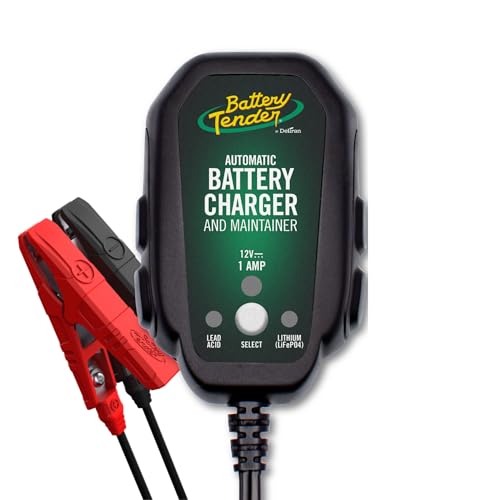
Weekly drivers: Battery Tender Junior 12V 800mA
If you drive weekly but not daily, the charger should be simple, automatic, and gentle enough to leave on for top-offs. The right fit is usually a low-amp maintainer with safety protections, not a fast charger that encourages overuse or guesswork.
- Best use case: Keeping a parked daily driver or powersports battery topped off between uses.
- Supported chemistries: Lead-acid and lithium, per the product details quoted here.
- Voltage: 12V.
- Amp output: 800mA.
- Standout safety features: Spark-proof lead connection and automatic reverse-polarity detection.
- Drawback: The low output is for maintenance, not quick recovery.
- What not to buy: A fast charger if your goal is only to keep a battery healthy in storage.
Based on specs and reviews, Battery Tender Junior is a value pick for 12V maintenance. It has a four-step charging program, works with lead-acid and lithium batteries, spark-proof lead connection, and automatically detects reverse polarity. That makes it a strong fit for parked cars and powersports batteries.
The drawback is capacity. At 800mA, it is slow, and it is not the right choice for dead-battery recovery. It is best when the goal is keeping a battery healthy, not reviving one from near zero.
Mistakes to avoid
The biggest mistakes are usually mismatches: buying a maintainer for a dead battery, buying the wrong chemistry mode, or choosing more amperage than the battery can comfortably accept. For AGM and stop-start cars, the safer path is a charger that explicitly lists AGM support. For winter use, temperature compensation matters.
- Buying a maintainer when you actually need recovery. A maintainer keeps charge level steady; it does not replace a recovery charger.
- Using the wrong mode on an AGM battery. AGM-equipped vehicles should have an AGM-capable smart charger.
- Choosing too much amperage for a small battery. Higher output is not automatically better.
- Relying on a charger with no safety protection. Reverse polarity protection should be near the top of the list for home use.
- Leaving a basic trickle charger unattended. Consumer Reports says it needs manual monitoring and disconnection.
- Expecting force mode to save every dead battery. Some batteries are beyond safe recovery.
A common first-timer mistake is buying a 10A charger for a motorcycle battery because the number sounds stronger. For a small battery that sits all winter, a low-amp maintainer is the more appropriate tool, and a pigtail lead makes regular charging easier.
How do I choose the right car battery charger?
Choose the charger by matching it to the exact job: storage, routine charging, AGM support, or recovery. Start with battery voltage and chemistry, then choose amperage based on battery size and how fast you need a charge. For most home users, a smart charger is the safest default.
What amp car battery charger do I need?
Use 1A to 3A for maintenance and small batteries, 4A to 10A for most cars and SUVs, and 10A to 15A only when the battery is larger or the recovery job justifies it. Too much amperage can be the wrong fit for small batteries.
Do I need a smart charger or a trickle charger?
Choose a smart charger if you want automatic stages, battery-type support, and lower risk for home use. Choose a trickle charger only if you can monitor it and disconnect it manually when the battery is topped off. For most drivers, smart is the better choice.
Can a charger revive a completely dead battery?
Sometimes, but not always. A smart charger with force mode can attempt near-zero-voltage recovery, and the NOCO Genius5 can charge batteries as low as one volt with force mode down to zero volts. If the battery has failed internally, recovery may not be safe or lasting.
Which charger works best for AGM batteries?
A smart charger with a specific AGM mode is the right match for AGM batteries. The same source notes that smart chargers often include AGM-specific modes, and that matters for modern vehicles. Do not treat generic charging as enough if your car uses AGM.
What features matter for long-term storage charging?
Look for automatic on/off behavior, float mode, reverse polarity protection, and a pigtail quick connector. Those features make storage charging safer and easier. A maintainer is the correct tool for a parked vehicle because it keeps charge level steady without constant oversight.
Should I buy a battery charger with jump starter combo?
Buy a combo only if you want emergency jump capability in the same package. It is not the best default for routine battery maintenance. For storage and garage use, a dedicated maintainer or smart charger usually gives better charging control and clearer battery care.
How do I choose a charger for cold weather use?
Choose a smart charger with temperature compensation if possible, especially for winter storage. Cold slows charging and can change how a battery accepts current. A charger that adjusts for temperature is better suited to winter maintenance than a basic manual unit.
How do I choose a charger for a stop-start car?
Choose a smart charger with AGM support, because stop-start vehicles commonly use AGM batteries. The charger should explicitly list AGM compatibility and have automatic charging stages. A generic 12V charger is not enough if the battery chemistry needs a specific mode.
What is the safest car battery charger for home use?
The safest home charger is a smart charger with reverse polarity protection, the right voltage support, and an automatic maintenance mode. Add a pigtail connector if you will use it often. That combination reduces handling errors and makes storage charging much easier.
How to choose the right car battery charger
Use the same rule: match charger type to the task, then match amperage and chemistry. If the car sits for weeks, choose a maintainer. If the battery is flat, choose a smart charger with recovery mode. If the car uses AGM, the charger must support AGM.
How to choose a car battery charger
Start with the battery label and the use case. Then check 6V or 12V support, charger amperage, reverse polarity protection, and whether the charger supports AGM or lithium as needed. That order keeps you from buying a charger that looks right but fits the wrong job.

Hi, I’m Melvin, an automobile engineer with extensive experience in automobile equipment. I currently work for a local automobile firm, where I specialize in the car parts industry. I’ve had the opportunity to collaborate with seasoned inspectors, gaining invaluable hands-on experience that goes beyond just theory.
My passion for automotive care started at a young age, which led me to create CarSpareCare. Through CarSpareCare, I share the knowledge and skills I’ve acquired over the years to help others navigate the world of car maintenance and repairs.
My goal is to provide practical tutorials, essential safety advice, and the latest industry insights so that anyone—whether a beginner or an expert—can confidently tackle their automotive projects.