Use a smart charger to recover a weak or discharged battery. Use a maintainer or trickle charger only for long storage on a healthy battery; for most car batteries, a roughly 2-amp to 4-amp maintainer is commonly treated as a safer hold-charge choice. Charge it wrong and you can shorten battery life, leave the car unable to start, or overcharge a battery that was already full. This guide explains the difference between smart chargers and trickle chargers, when each fits, and how battery type changes the choice.
This guide is part of our Car battery maintenance guide series.
Smart charger vs trickle charger: the core trade-off
The choice depends on battery condition, chemistry, and how long the charger stays connected. A smart charger is the better tool for recovery and chemistry-aware charging control. A trickle charger is a simple low-rate charger for basic top-off duty, but classic models may keep charging after full.
| Factor | Smart Charger | Trickle Charger | Winner |
|---|---|---|---|
| Charge control | Monitors battery voltage and adjusts output | Low-amperage output with basic models that may not stop at full | Smart Charger |
| Long-term unattended use | Can switch into float mode | May continue charging indefinitely | Smart Charger |
| Recovery from a weak or deeply discharged battery | Better fit for recovery charging | Often too slow and too basic for recovery duty | Smart Charger |
| Simple storage top-off on a healthy battery | Works if the model supports float maintenance | Can work if the manual allows it and the battery is healthy | Tie |
| Chemistry awareness | Often offers settings for lead-acid, AGM, and lithium LiFePO4 | Compatibility varies by model and is often less specific | Smart Charger |
Charge control
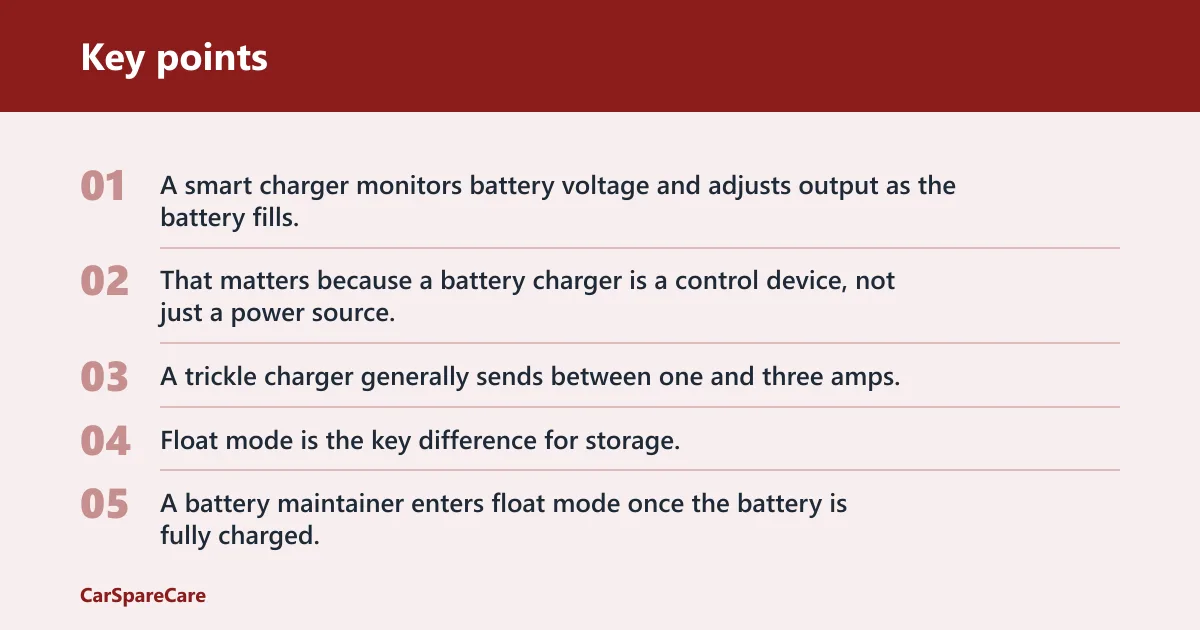
A smart charger monitors battery voltage and adjusts output as the battery fills. That matters because a battery charger is a control device, not just a power source. A trickle charger generally sends between one and three amps, but older designs can keep feeding current even after full charge.
Long-term unattended use
Float mode is the key difference for storage. A battery maintainer enters float mode once the battery is fully charged, then uses tiny pulses or reduced output to hold voltage near full without pushing it higher. (Thedrive)
Recovery versus top-off
Recovery charging is a different job from maintenance. A deeply discharged battery may need a smarter charging profile, while a healthy stored battery may only need a hold charge. Higher amperage can recharge faster, but maintenance use is about control, not speed.
Which charger fits your battery?
This matrix separates battery type, battery state, and storage time so the choice stays practical. Use it as a decision rule, not as a brand-name comparison. If your charger manual conflicts with this chart, follow the manual.
| Battery type | State of charge | Storage duration | Recommended device |
|---|---|---|---|
| AGM | Healthy or near full | Weeks to months | Smart Charger: Yes / Trickle Charger: No |
| AGM | Deeply discharged | Any | Smart Charger: Yes / Trickle Charger: No |
| Lead-acid | Healthy or near full | Weeks | Smart Charger: Yes / Trickle Charger: Yes, if the manual allows it |
| Lead-acid | Dead battery recovery | Immediate recovery | Smart Charger: Yes / Trickle Charger: No |
| Lithium LiFePO4 | Healthy or near full | Long-term storage | Smart Charger: Yes, with lithium-aware support / Trickle Charger: No |
| Lithium LiFePO4 | Deeply discharged | Any | Smart Charger: Yes, if compatible / Trickle Charger: No |
| Any supported chemistry | Dead battery recovery | Short-term recovery | Smart Charger: Yes / Trickle Charger: No |
| Any supported chemistry | Healthy | Long-term storage | Smart Charger: Yes if it has float mode / Trickle Charger: Only with careful supervision |
How to read the matrix
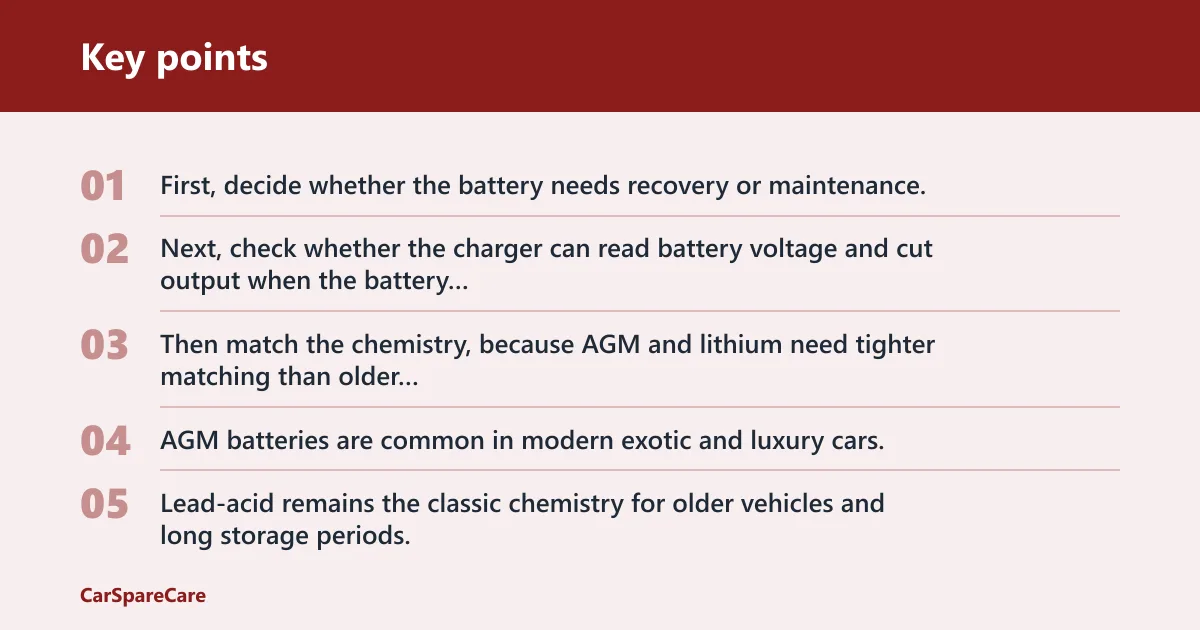
First, decide whether the battery needs recovery or maintenance. Next, check whether the charger can read battery voltage and cut output when the battery reaches full charge. Then match the chemistry, because AGM and lithium need tighter matching than older lead-acid batteries.
AGM, lead-acid, and lithium guidance
AGM batteries are common in modern exotic and luxury cars, and they are more sensitive to overcharging. Lead-acid remains the classic chemistry for older vehicles and long storage periods. Lithium LiFePO4 is a chemistry-specific case; compatibility is not universal, so check the charger listing and the vehicle manual.
Dead battery recovery and storage
A dead battery is generally a recovery problem rather than a maintenance problem. A healthy stored battery is the opposite. For that reason, a maintainer is the better plug-in tool for storage, while a smart charger is the better first step when voltage is low or the battery has fallen badly behind.
Smart charger vs trickle charger at a glance
Battery voltage is the main signal a smart charger uses to decide what to do next. A trickle charger does not usually adjust in the same way. That is why smart chargers are better for unattended charging and battery maintainers are often called float chargers or smart trickle chargers.
Battery voltage and charge control
A charger that watches voltage can tell when the battery is filling and when it is full. That is the difference between a charge cycle and a hold charge. If the charger does not manage voltage well, it can keep pushing current after the battery is already full.
Amp rating and charging speed
Trickle chargers generally send one to three amps to a vehicle battery. Some maintainers can provide more amperage than trickle chargers, which can help with recovery. For long storage, though, higher amperage is not automatically better; the safer choice is the device that can settle into float mode.
Overcharge risk and unattended use
Classic trickle chargers may continue charging even when the battery is full. That can lead to heat, gassing, and electrolyte loss on a lead-acid battery, and it is one reason a battery maintainer is described as ideal for plug-and-forget use. A maintainer resumes charging when voltage drops, then returns to float mode.
Is a smart charger better for AGM batteries?
Yes, in most cases a smart charger is the better choice for AGM batteries because it can control voltage more carefully and reduce the chance of overcharging. AGM batteries are often paired with smart maintainers, but a dedicated AGM setting is not always mandatory; check the charger listing and the vehicle manual.
Why AGM batteries need careful voltage control
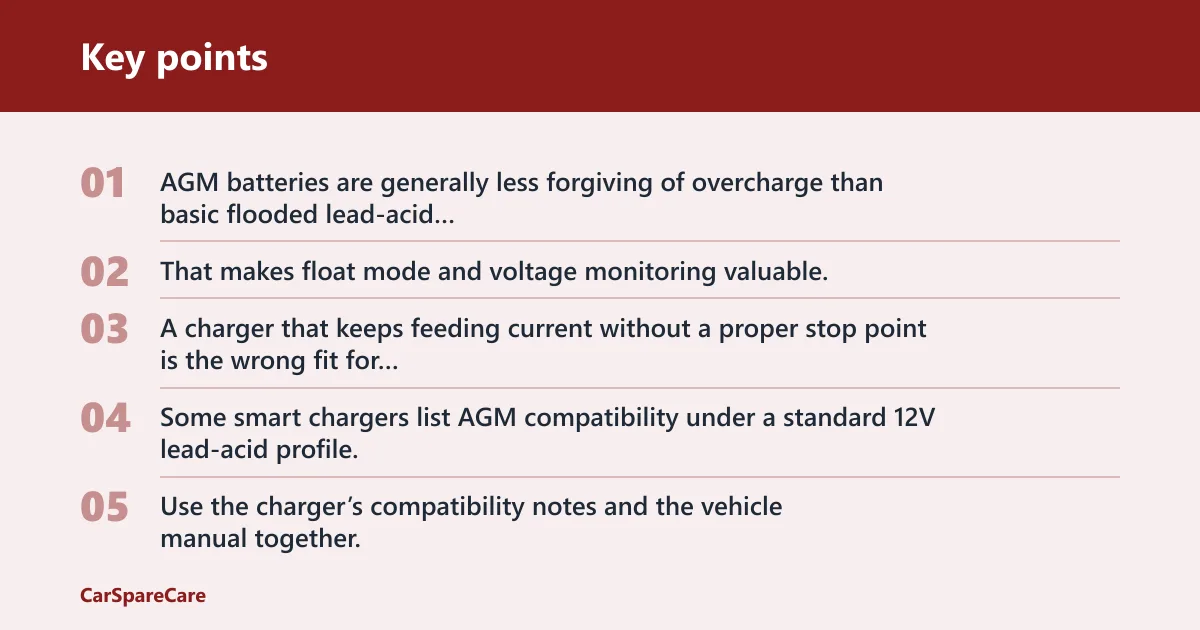
AGM batteries are generally less forgiving of overcharge than basic flooded lead-acid batteries. That makes float mode and voltage monitoring valuable. A charger that keeps feeding current without a proper stop point is the wrong fit for unattended AGM charging.
When a standard 12V profile may be enough
Some smart chargers list AGM compatibility under a standard 12V lead-acid profile. Others give AGM its own setting. Use the charger’s compatibility notes and the vehicle manual together; do not assume every AGM battery needs a separate button, and do not assume every 12V charger is suitable.
When to choose an AGM setting
Choose the AGM setting when the charger maker specifies it or when the vehicle maker requires it. That is especially relevant on start-stop systems and premium vehicles that are sensitive to charging behavior. If the listing is unclear, choose a model with explicit AGM support.
Say your coupe sits in a garage for three weeks and starts to crank slowly on return. A smart charger with an AGM setting is the safer choice if the battery is AGM, because it can recover the battery and then shift to float mode during the next storage period.
Can I leave a trickle charger on all the time?
Not always. A basic trickle charger can overcharge if it stays connected indefinitely, especially if it does not stop or taper at full charge. A battery maintainer is the safer plug-in choice for unattended storage because it uses float mode after the battery reaches full charge.
Why basic trickle chargers can overcharge
The problem is control. A simple trickle charger may keep sending current after the battery is full, and that is where the risk starts. REVCity describes trickle charging as continuous and unregulated, and that is the behavior you want to avoid for long storage.
When a maintainer is the safer plug-in choice
If the car sits for weeks and you want a charger connected the whole time, use a maintainer that clearly enters float mode. That is the use case maintainers are built for. They are meant to resume charging when battery voltage drops, then back off again.
Signs of overcharge: heat, gassing, electrolyte loss
Heat at the battery, visible gassing, and electrolyte loss are common warning signs. Disconnect the charger and inspect the battery if any of those appear. Follow the vehicle and product manuals, keep the area ventilated, and do not continue charging a battery that is already showing signs of stress.
Will a trickle charger recharge a dead car battery?
Sometimes it can help, but it is usually the wrong first tool for a dead battery. A dead battery needs recovery charging, and a low-output trickle charger may be too slow or too basic to bring the battery back in a controlled way. A smart charger is the better first step.
Why a dead battery is a recovery problem
A dead battery is not just a storage issue. Its voltage is low enough that the charger needs to decide how to start, how fast to charge, and when to stop. That is a voltage-control task, not a simple top-off task.
When a smart charger is the better first step
If the battery is deeply discharged but still serviceable, start with a smart charger that supports the chemistry in the vehicle. A higher amperage charger may recover faster than a trickle charger, but the real advantage is controlled charging, not speed alone.
When replacement or professional service may be needed
If the battery will not accept charge, gets hot, or shows signs of damage, replacement or professional testing may be the safer path. Do not keep forcing charge into a battery that behaves abnormally. That is true for AGM, lead-acid, and lithium batteries alike.
Suppose an older sedan has sat through winter and the battery reads too low to crank the engine. A trickle charger may be too slow to help in a useful timeframe, while a smart charger with the right chemistry setting gives the battery a better chance to recover without being pushed blindly.
How do I safely connect a charger to a car battery?
Follow the vehicle and product manual, and use a ventilated area. Connect the charger exactly as the manual directs; many setups call for red to positive and black to negative, but some in-vehicle charging procedures use a safe chassis or engine ground away from the battery. Do not improvise around fuel, sparks, or airbag zones.
- Turn the vehicle and charger off before connecting anything.
- Check the charger settings for battery type, voltage, and chemistry.
- Attach the leads in the order the manual specifies.
- If the manual calls for a remote ground point, use a safe chassis or engine ground away from the battery.
- Keep the charger and cables clear of belts, fans, fuel vapors, and hot parts.
- Start charging and recheck the battery and charger for abnormal heat or warning lights.
Follow the vehicle/product manual. Never work under a vehicle held only by a jack. Never exceed the vehicle’s rated roof/hitch/tow limit. Keep items out of airbag zones and the driver’s view, and check local laws.
Choose Smart Charger if… / Choose Trickle Charger if…
Choose a Smart Charger if the battery is deeply discharged, if the vehicle uses AGM or lithium LiFePO4 chemistry, or if you want unattended charging that can move into float mode. Choose a Trickle Charger only if the battery is healthy, the manual allows basic low-rate charging, and you are not relying on it for long-term plug-in storage.
Choose smart charger if…
- The battery is weak, deeply discharged, or dead.
- You need chemistry-aware charging for AGM or lithium LiFePO4.
- You want float mode for longer unattended storage.
- You want the charger to monitor battery voltage and reduce output at full charge.
Choose trickle charger if…
- The battery is healthy and only needs a low-rate top-off.
- The vehicle manual allows a basic low-amperage charger.
- You do not need recovery charging.
- You can supervise it and do not plan to leave it connected indefinitely.
Choose a maintainer instead of a charger if…
Use a battery maintainer for long storage and infrequent driving. That is the plug-and-forget choice when the battery is already charged and the goal is to hold voltage near full without overcharging. For most stored cars, that is the safest default.

Frequently asked questions
What is the difference between a smart charger and a trickle charger for a car battery?
A smart charger monitors battery voltage and changes its output as the battery fills, while a trickle charger usually sends a low, steady current. Smart chargers can enter float mode for maintenance. Basic trickle chargers may continue charging after full, which makes them a poorer choice for unattended storage.
Is a smart charger better than a trickle charger for AGM batteries?
Yes. AGM batteries are more sensitive to overcharging, so careful voltage control matters more than a simple steady feed of current. A smart charger or maintainer with AGM support is usually the better choice. Check whether the charger has a dedicated AGM setting or a compatible 12V profile.
How many amps should a battery maintainer use?
For most car batteries, a 2-amp to 4-amp maintainer is a sensible hold-charge choice. The exact need depends on the battery, the vehicle’s parasitic draw, and storage time. Higher amperage can recharge faster, but for maintenance the priority is float mode and chemistry compatibility, not raw output.
Can I use the same charger for lead-acid, AGM, and lithium batteries?
Only if the charger listing explicitly supports all three chemistries. Lead-acid and AGM are often covered by the same 12V platform, but lithium LiFePO4 is a different case and needs chemistry-aware charging. If the charger does not list the battery type clearly, do not assume it is compatible.

Hi, I’m Melvin, an automobile engineer with extensive experience in automobile equipment. I currently work for a local automobile firm, where I specialize in the car parts industry. I’ve had the opportunity to collaborate with seasoned inspectors, gaining invaluable hands-on experience that goes beyond just theory.
My passion for automotive care started at a young age, which led me to create CarSpareCare. Through CarSpareCare, I share the knowledge and skills I’ve acquired over the years to help others navigate the world of car maintenance and repairs.
My goal is to provide practical tutorials, essential safety advice, and the latest industry insights so that anyone—whether a beginner or an expert—can confidently tackle their automotive projects.