A car battery is overcharged when charging voltage stays above about 14.8 volts; that can boil off electrolyte, warp plates, and leave the battery damaged or dead. Ignore it, and you can ruin the battery, overwork the alternator, and risk a no-start. This guide shows how to tell whether the battery, alternator, voltage regulator, or all three need repair.
This guide is part of our Car battery maintenance guide series.
What overcharging does to a battery



Overcharging means too much voltage keeps entering the battery after it has already reached full charge. A healthy charging system should stay around 13.5 to 14.5 volts, with 13.8 to 14.5 volts as a common healthy range. Once charging climbs above about 14.8 volts, heat and gassing rise fast.
Lead-acid batteries take the hit first. Excess voltage drives the electrolyte off as gas, raises internal temperature, and can leave the battery hot to the touch. Overcharging can also cause leaking, and in severe cases it can cause a battery to explode. Midtronics notes that overcharging is highly destructive to lead-acid batteries.
Damage becomes harder to reverse when the case swells, vents, or dries out. In sealed batteries, electrolyte loss can be irreversible. That matters because a battery may still hold some charge after an overcharge event, but it may no longer hold enough capacity to be reliable.
Why lead-acid batteries suffer first
Most automotive batteries are lead-acid. That chemistry is especially vulnerable to heat and gassing. A flooded battery may show obvious fluid loss or venting. An AGM battery can be harmed even faster because it is more sensitive to overcharging and needs voltage-regulated charging.
Say your car sits on a charger overnight with the wrong setting selected. The battery may still crank the engine the next morning, but if the case is warm, the top is damp, and the smell is sharp and sulfur-like, the damage may already be deeper than a surface-level charge issue.
When damage is likely permanent
Not every overcharged battery is ruined, but some are. If the case is swollen, the battery has leaked, or the battery got hot enough to vent hard, replacement is usually the safer call. If the battery is sealed and electrolyte loss has already happened, recovery is often limited.
If the overcharge was brief and the battery shows no heat damage, no swelling, and no leak, the battery may still be usable after the charging fault is corrected. The test result, not the guess, should decide that.
How do you know a battery is overcharged?
You can usually spot the warning signs before you ever remove a terminal. Look for a rotten egg smell, a hot battery case, a swollen top or sides, visible venting, acid residue, and unusual corrosion around the posts. A dashboard battery light can appear too, but it does not tell you the whole story by itself.
A multimeter can help confirm overcharge. Check charging voltage with the engine running. If the reading stays above about 14.8 volts, that suggests overcharge. A healthy charging system should usually sit between 13.8 and 14.5 volts while the engine runs.
What to stop doing right away
Stop charging if the battery is hot, swollen, leaking, or smells strongly of sulfur. Do not smoke nearby. Do not create sparks. Do not keep running a charger that is clearly pushing too much voltage, and do not assume the warning light means the battery alone is the problem.
A common first-timer mistake is to keep driving because the car still starts. That can turn a recoverable charging fault into a battery replacement, a regulator replacement, and sometimes an alternator replacement if the fault keeps cooking the system.
What causes battery overcharging?
The most common causes are a faulty voltage regulator, failed alternator diodes, or charger misuse. A battery charger can overcharge a battery if it is left connected too long, set to the wrong amp rate, or set to the wrong voltage. Manual chargers are generally the highest-risk type; smart chargers can reduce that risk with automatic shutoff.
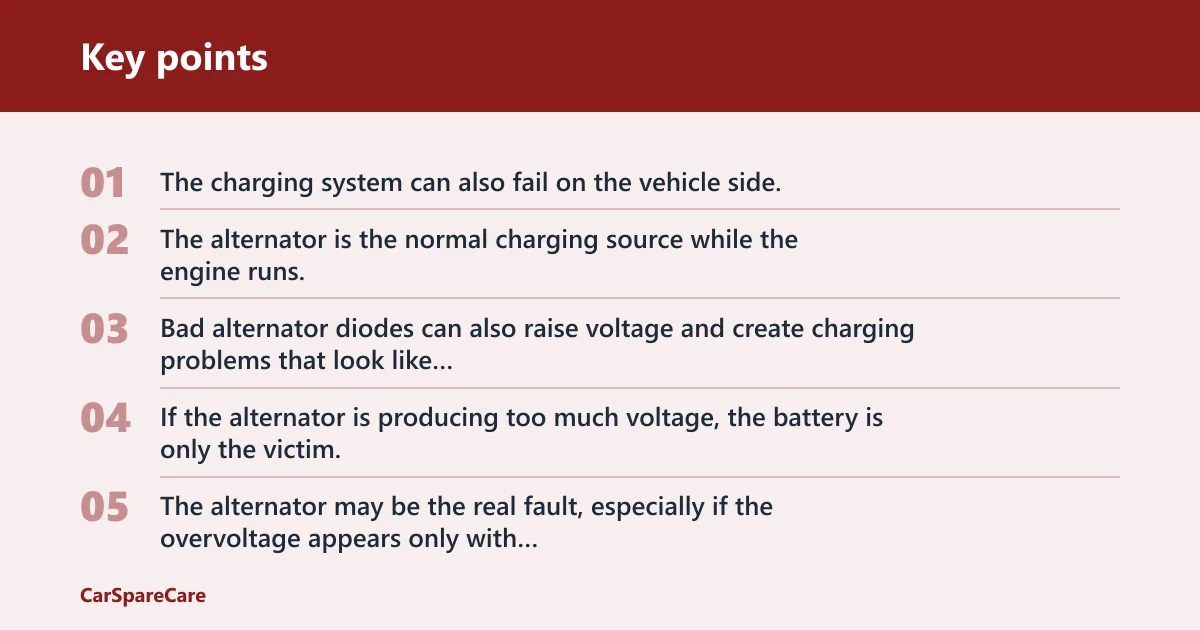
The charging system can also fail on the vehicle side. The alternator is the normal charging source while the engine runs, and if its output regulation fails, voltage can climb past safe limits. Bad alternator diodes can also raise voltage and create charging problems that look like a battery fault at first.
Alternator output that will not regulate
If the alternator is producing too much voltage, the battery is only the victim. The alternator may be the real fault, especially if the overvoltage appears only with the engine running. That is why a running-voltage test matters before you replace the battery.
Voltage regulator faults
The voltage regulator controls alternator output. If it fails, voltage can stay high instead of tapering back where it should. On some vehicles the regulator is replaceable separately. On others, it is built into the alternator, which changes the repair decision and the cost.
Charger misuse and wrong settings
Battery chargers can cause the same damage pattern. Leaving a manual charger on too long can keep pushing current after the battery is full. Wrong settings on a charger can do the same thing, especially on AGM batteries, which need regulated charging.
Suppose you have a 12-volt AGM battery on a manual charger set too high for hours. If the battery gets hot and the case starts to swell, the charger may be the only bad part. But if the vehicle also shows 15 volts at idle with the charger removed, there is a separate charging-system fault to chase.
Overcharged battery triage
| Symptom | Likely cause | Safe immediate action | Test to run next | Likely part to replace |
|---|---|---|---|---|
| Flooded battery smells like sulfur, case is warm, fluid level looks low | Vehicle charging voltage too high or charger left on too long | Stop charging and let it cool; keep all flame, smoking, and spark sources away | Multimeter test at the battery with engine running; look for above 14.8 volts | Battery if swelling, leaking, or weak after correction; alternator or regulator if voltage stays high |
| AGM battery gets hot, vents, or shows a swollen case | AGM sensitivity to overvoltage; regulated charging failure | Disconnect charging source if safe; do not reuse a hot charger setting | Check charging voltage, then inspect the alternator regulator output | Battery is often damaged; alternator or regulator if the vehicle is overcharging |
| Battery was connected to a manual charger and now smells hot or sulfur-like | Charger misuse, wrong setting, or no automatic shutoff | Unplug the charger and do not reconnect it | Measure battery voltage at rest, then verify vehicle charging voltage separately | Charger, and battery if it no longer holds charge |
This table is meant to shorten the next repair decision. If the battery is visibly damaged, the battery is usually the first replacement. If the battery looks harmed but the voltage only goes high with the engine running, the charging system needs diagnosis too.
Can a bad alternator overcharge a battery?
Yes. A bad alternator can overcharge a battery if the regulation inside the alternator fails. Failed diodes can also push voltage too high. When that happens, the alternator is often the main fault, and the battery may be the damaged result rather than the original cause.
The key is to separate engine-running voltage from battery-only condition. If the battery is resting normally but the charging voltage rises above about 14.8 volts once the engine starts, the alternator or its regulator may be the problem. If the voltage stays high even with the charger disconnected, do not blame the battery first.
What to replace first after testing
If charging voltage is too high at the battery terminals with the engine running, replace or repair the alternator side of the system before buying a battery. If the regulator is separate, that may be the cheaper fix. If the regulator is built into the alternator, the alternator assembly is usually the practical replacement.
If the battery also shows visible heat damage, swelling, or leakage, plan on replacing both the battery and the charging fault source. A cooked battery may not recover even after the alternator is fixed.
What to do when a car battery is overcharged
Start with safety. Stop charging, switch off the engine if it is running rough or the battery is getting hot, and keep open flame and sparks away from the battery area. Then inspect for swelling, leaks, or corrosion. If any of those are present, do not keep using the battery as-is.
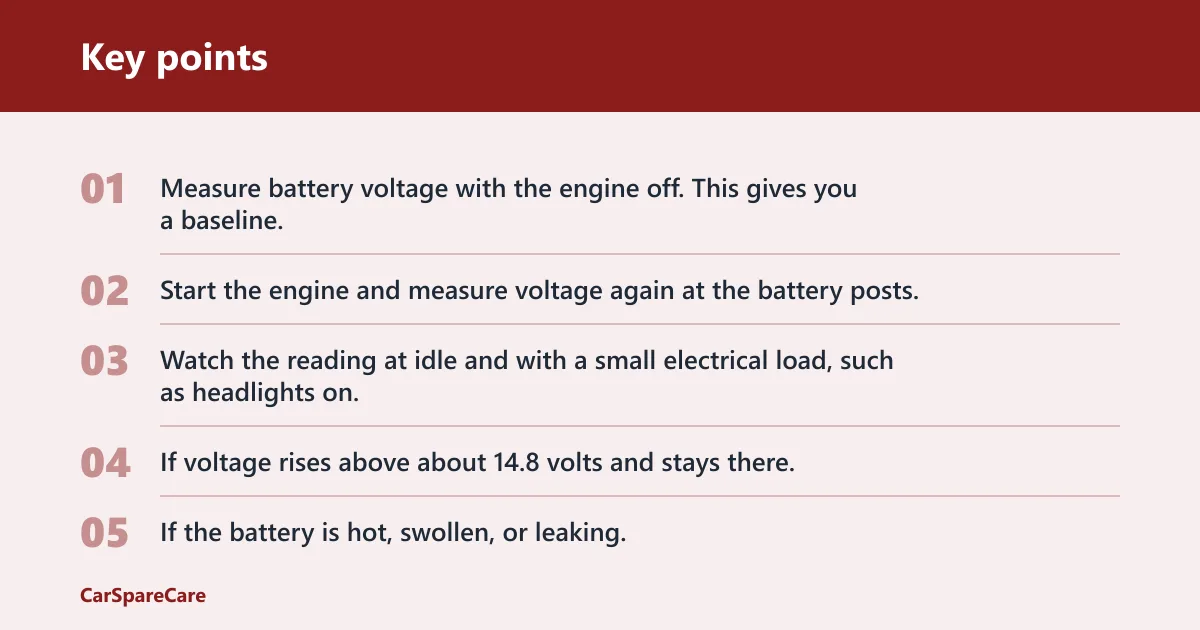
Next, verify the charging voltage with a multimeter. Check the battery with the engine off, then with the engine running. Resting voltage alone will not tell you whether the alternator or regulator is forcing the battery above safe limits. If you can, follow up with a charging-system scan or an alternator check.
The voltage checks to run next
- Measure battery voltage with the engine off. This gives you a baseline.
- Start the engine and measure voltage again at the battery posts.
- Watch the reading at idle and with a small electrical load, such as headlights on.
- If voltage rises above about 14.8 volts and stays there, suspect the alternator or regulator.
- If the battery is hot, swollen, or leaking, treat it as damaged even if the voltage fault is fixed.
That sequence helps you decide whether the next repair is battery only, alternator or regulator, or both. It also keeps you from buying parts based on a smell or a warning light alone.
How to decide between battery, alternator, or regulator replacement
If charging voltage is normal after the fault is corrected and the battery still passes a load or capacity check, the battery may be salvageable. If the battery was overcharged but still tests weak, replace it. If the battery is damaged and the vehicle still overcharges, fix the charging system too.
Cost tradeoff matters. Replacing a charger is usually cheapest when the charger caused the problem. Replacing a regulator can be cheaper than replacing a full alternator if it is sold separately. Replacing both battery and alternator is more expensive, but it is the right call when both have evidence of damage.
Does battery type change the outcome?
Battery type changes both the risk and the repair decision. Flooded lead-acid batteries may tolerate a brief overcharge better than AGM batteries, but both can be damaged. AGM and EFB batteries are more sensitive to overcharging, and sealed batteries can lose electrolyte in a way that cannot be recovered.
Flooded lead-acid batteries
Flooded batteries may show obvious signs such as low electrolyte, acid mist, or corrosion. If the case is intact and the charging fault was short-lived, they have the best chance of recovery. Once the plates are warped or the fluid is gone, replacement is usually the safer path.
AGM batteries
AGM batteries need regulated charging. They are less forgiving of excess voltage than standard flooded batteries. If an AGM battery has been overheated, swollen, or vented, assume the damage may be permanent unless testing shows otherwise.
Charged by a manual charger versus a smart charger
A manual charger can keep pushing the battery long after full charge, especially if it is left unattended. A smart charger lowers the risk because it can shut off or taper automatically. If the problem started after a charger session, retire the charger if it cannot control voltage correctly.
Frequently asked questions
What happens when a car battery is overcharged?
Charging voltage rises too high, usually above about 14.8 volts, and the battery starts to heat, gas, and lose electrolyte. That can warp plates, dry out a lead-acid battery, and damage sealed designs faster. Severe overcharge can lead to leakage, shutdown, or even explosion risk.
What happens if my car battery is overcharged?
It can lose electrolyte, get hot, swell, and stop holding a charge. In a lead-acid battery, that damage may be quick. In a sealed battery, electrolyte loss may be irreversible. If the vehicle keeps overcharging, the alternator can also be stressed and the battery may fail early.
What to do if my car battery is overcharged?
Treat it as a charging-system problem until proven otherwise. Disconnect the charger if one is involved, test resting voltage, then test engine-running voltage. If the battery is swollen, leaking, or smells like sulfur, replacement is usually the safe call. If voltage is high only with the engine running, inspect the alternator and regulator.
Can you overcharge a car battery?
Yes. A car battery can be overcharged by a faulty alternator, a bad voltage regulator, or a charger that is left on too long or set incorrectly. Smart chargers reduce the risk, but manual chargers and charging-system faults can still drive voltage past the safe range.
Is an overcharged battery dangerous?
Yes. Heat, leaking acid, and gas buildup can create safety risks, and overcharging can sometimes cause a battery explosion. If the battery is hot, swollen, or venting, stop using it right away. Keep away from sparks, and do not keep trying to charge it until the fault is found.

Hi, I’m Melvin, an automobile engineer with extensive experience in automobile equipment. I currently work for a local automobile firm, where I specialize in the car parts industry. I’ve had the opportunity to collaborate with seasoned inspectors, gaining invaluable hands-on experience that goes beyond just theory.
My passion for automotive care started at a young age, which led me to create CarSpareCare. Through CarSpareCare, I share the knowledge and skills I’ve acquired over the years to help others navigate the world of car maintenance and repairs.
My goal is to provide practical tutorials, essential safety advice, and the latest industry insights so that anyone—whether a beginner or an expert—can confidently tackle their automotive projects.