
A fully charged 12-volt car battery should read about 12.6 to 12.8 volts with the engine off after sitting. Lower readings can mean slow cranking, hard starts, or a battery that fails under load. This guide explains what each voltage reading means on a multimeter or dash display and how to tell a healthy battery from a weak charging system.
Quick decision checklist: let the battery rest, measure voltage, compare the reading to the ranges below, then decide whether to charge, test under cranking load, or inspect the alternator and connections.
What voltage is a fully charged car battery?
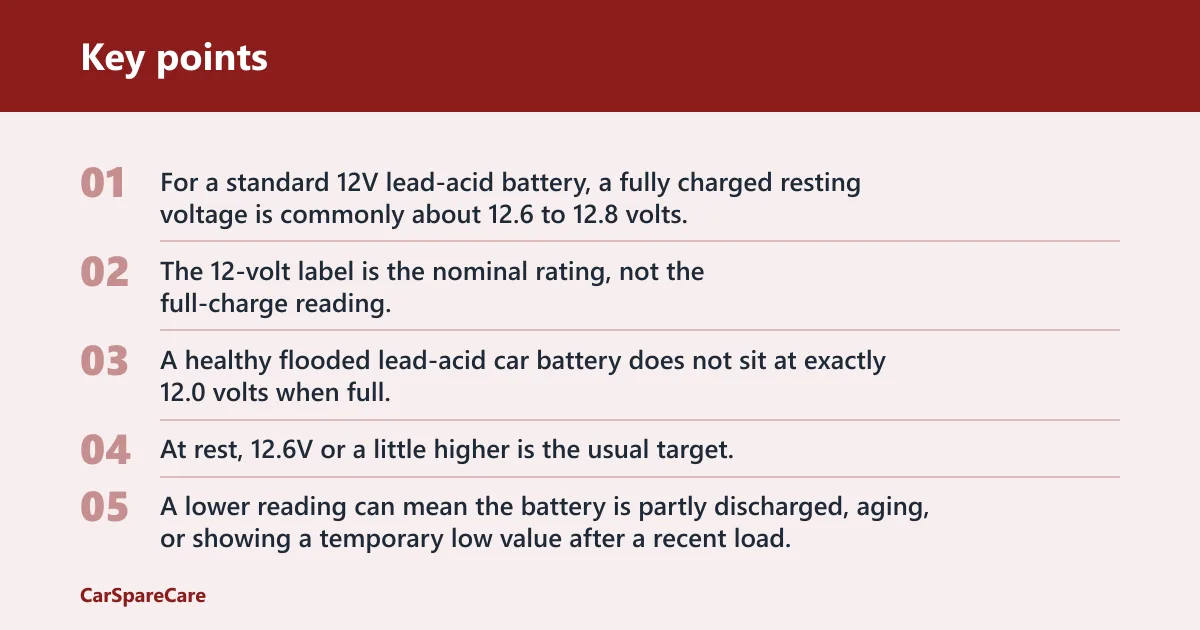


For a standard 12V lead-acid battery, a fully charged resting voltage is commonly about 12.6 to 12.8 volts. The 12-volt label is the nominal rating, not the full-charge reading. If the engine is off and the battery has had time to settle, that range usually means the battery is near 100% state of charge.
Standard 12V lead-acid battery
A healthy flooded lead-acid car battery does not sit at exactly 12.0 volts when full. At rest, 12.6V or a little higher is the usual target. A lower reading can mean the battery is partly discharged, aging, or showing a temporary low value after a recent load.
AGM and lithium differences
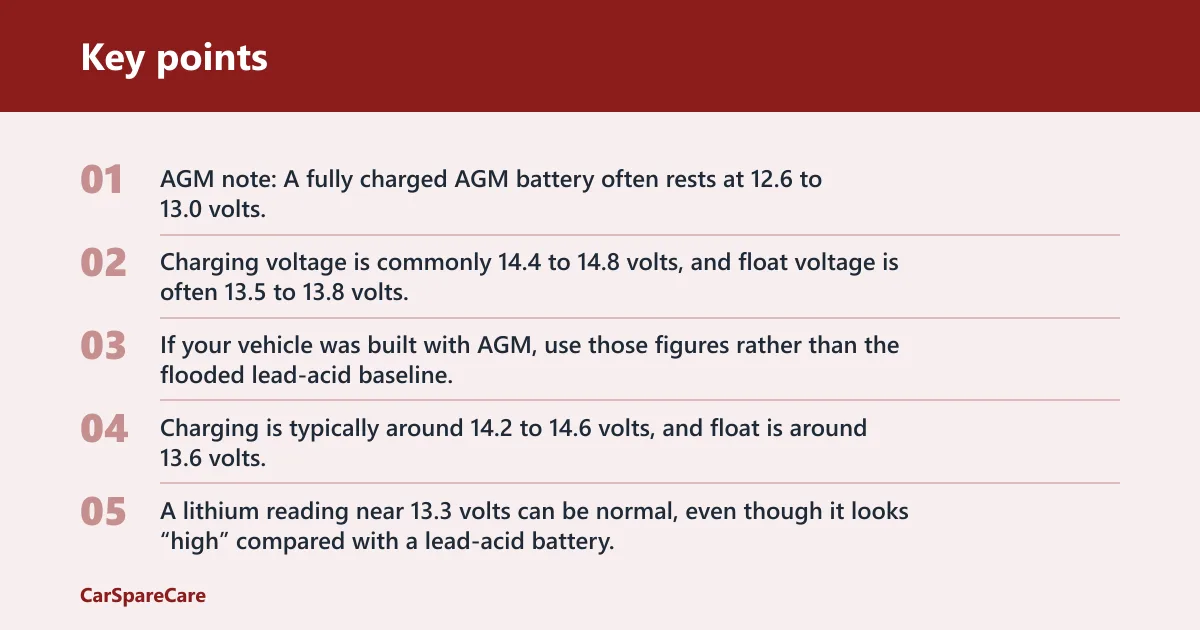
AGM batteries have a slightly different resting range. A fully charged AGM battery is often about 12.6 to 13.0 volts at rest, with charging voltage commonly around 14.4 to 14.8 volts and float voltage around 13.5 to 13.8 volts. LiFePO4 batteries are different again, with resting voltage around 13.3 to 13.4 volts, charging voltage around 14.2 to 14.6 volts, and float near 13.6 volts.
What voltage should it show at rest?
At rest, a standard 12V lead-acid battery should usually read about 12.6 to 12.8 volts after it has sat long enough for surface charge to fade. Resting voltage is the fastest clue to state of charge. A reading around 12.5 volts is borderline, not fully charged in the usual sense. State-of-charge voltage is only approximate, and temperature, battery age, and recent use can shift the reading.
How resting voltage maps to charge
Use this as a rough guide for a standard lead-acid battery at rest:
- 12.6V or higher: about 100%
- 12.4V: about 75%
- 12.2V: about 50%
- 12.0V: about 25%
- 11.8V or lower: about 0%
These numbers are approximate, but they are useful. A battery at 12.2 volts may still start the car on a mild day, yet it is already far from full charge.
Why 12.5V is borderline
12.5 volts often means the battery is partly charged rather than full. In real use, that can happen after short trips, cold weather, or a battery that is slowly losing capacity. It is not a dead battery by itself, but it is low enough to justify a closer look if starting is sluggish.
What voltage should it show while running?
With the engine running, the alternator raises system voltage above resting battery voltage. A commonly reported charging range for many vehicles is about 13.7 to 14.7 volts. If the running reading stays under 13.5 volts, the system may be undercharging. If it goes above 14.8 volts, overcharging is a concern.
Charging voltage by battery type
AGM batteries often accept a charging voltage around 14.4 to 14.8 volts, while flooded batteries commonly sit within the broader 13.7 to 14.7-volt vehicle range. LiFePO4 charging voltage is typically around 14.2 to 14.6 volts, with float around 13.6 volts. The battery type matters because the right charging target is not the same for every chemistry.
When to suspect alternator trouble
A running voltage below 13.5 volts can point to a weak alternator, poor wiring, belt issues, or a charging-control problem. A running reading above 14.8 volts can damage the battery over time and may point to a regulator fault. Either way, running voltage tells you more about the charging system than about the battery’s resting state of charge.
Cranking voltage check
Cranking voltage matters because a battery can read fine at rest and still fail when the starter asks for high current. During cranking, voltage should stay above 9.6 volts. If it drops below 9.6 volts, that is a failure signal for the starter-load check and often points to a weak battery, poor connections, or both.
-
Connect the multimeter.
Place the meter leads across the battery terminals, positive to positive and negative to negative. This gives the true battery reading for both resting and cranking checks. -
Read the resting voltage.
Check the battery with the engine off after it has sat long enough to settle. A healthy standard lead-acid battery should usually land around 12.6 to 12.8 volts. -
Watch the cranking drop.
Have someone start the engine while you watch the meter, or use a meter with a min/max function. The voltage should stay above 9.6 volts during the starter load. -
Compare the result.
If the battery drops under 9.6 volts, treat that as a problem even if the resting reading looked acceptable. That pattern often means the battery cannot hold voltage under load.
Say your battery reads 12.5 volts at rest on a mild morning, but it falls to 9.1 volts while cranking. That points to a battery that looks partly charged on paper but cannot supply enough current under load.
Surface charge and testing mistakes
A fresh drive or recent charge can leave surface charge on the battery plates. That can temporarily inflate the resting reading, so a battery may look healthier than it really is. Wait at least an hour before a true resting check, and headlights can help strip off some surface charge if you need the reading sooner.
-
Let the battery sit.
Wait at least one hour after driving or charging before checking resting voltage. This lets surface charge fade and makes the reading more reliable. -
Reduce surface charge.
If you need to test sooner, switch on the headlights for a short period, then turn them off and recheck. That load can help remove the temporary voltage bump. -
Retest across terminals.
Measure directly across the battery posts, not a nearby metal part. A clean terminal-to-terminal reading is the one that matters for diagnosis.
A common first-timer mistake is checking voltage right after a long drive and assuming 12.8 volts means the battery is perfect. That reading may be inflated. Wait for the battery to settle first, then read it again before making a decision.
Battery voltage guide table
Note: State-of-charge voltage is approximate and can vary with temperature, battery age, chemistry, and recent charging or load.
| Section | Reading | Test condition | What it means now | Likely action |
|---|---|---|---|---|
| Resting | 12.6 to 12.8V | Standard 12V lead-acid, engine off, after resting | Usually full or very near full | If starting is still weak, check cranking voltage and cable condition |
| Resting | 12.5V | Standard 12V lead-acid, engine off, after resting | Borderline charge | Recharge if the car has seen short trips or the battery is slow to crank |
| Resting | 12.4V | Standard 12V lead-acid, engine off, after resting | About 75% charged | Charge the battery and recheck before judging battery health |
| Resting | 12.2V | Standard 12V lead-acid, engine off, after resting | About 50% charged | Recharge soon and look for a charging-system or battery issue if it repeats |
| Resting | 12.0V | Standard 12V lead-acid, engine off, after resting | About 25% charged | Treat as deeply discharged and charge before further diagnosis |
| Resting | 11.8V or lower | Standard 12V lead-acid, engine off, after resting | Near empty or failed | Recharge and test again, and replace if it cannot recover |
| Cranking | Above 9.6V | Starter-load test | Usually acceptable | If the engine still struggles, inspect cables, starter, and grounds |
| Cranking | Below 9.6V | Starter-load test | Failure signal | Suspect weak battery, poor connections, or excessive starter draw |
| Running | 13.7 to 14.7V | Engine running on a typical charging system | Normal alternator output on many vehicles | No immediate concern if the battery and cables are in good condition |
| Running | Under 13.5V | Engine running | Possible undercharging | Check alternator, belt, wiring, and battery load |
| Running | Over 14.8V | Engine running | Possible overcharging | Stop and inspect the charging system soon |
AGM note: A fully charged AGM battery often rests at 12.6 to 13.0 volts. Charging voltage is commonly 14.4 to 14.8 volts, and float voltage is often 13.5 to 13.8 volts. If your vehicle was built with AGM, use those figures rather than the flooded lead-acid baseline.
LiFePO4 note: A lithium iron phosphate battery has a different resting voltage pattern, usually about 13.3 to 13.4 volts. Charging is typically around 14.2 to 14.6 volts, and float is around 13.6 volts. A lithium reading near 13.3 volts can be normal, even though it looks “high” compared with a lead-acid battery.
What to do with borderline readings
Borderline readings need a next step, not guesswork. A number like 12.5 volts is close enough to full that the battery may still work well, but it is low enough to justify a recharge or a retest after the car has sat. The same logic applies to 12.2 volts and 14.9 volts, which point in very different directions.
-
At 12.5 volts, retest later.
Wait after the car sits, then check again before deciding the battery is weak. If it stays at 12.5 volts and cranking is slow, a top-up charge is a sensible next move. -
At 12.2 volts, charge it.
Treat this as roughly half charged on a standard lead-acid battery. Charge the battery fully, then repeat the resting and cranking checks to see whether it recovers. -
At 14.9 volts, inspect charging.
Running voltage that high points toward overcharging on many vehicles. Check the alternator control system and battery type before the battery is damaged.
Suppose a car sits overnight and then reads 12.2 volts before start-up. That is not fully charged, even if the engine still starts. A recharge and a follow-up check are the right next steps because the battery is already near the middle of the state-of-charge scale.
Frequently asked questions
What if my battery reads 12.8V after driving?
12.8 volts right after driving can be a surface-charge reading, not a true resting reading. Let the battery sit, then test again after the voltage has had time to settle. If it stays near 12.8 volts at rest, that usually indicates a full or nearly full charge.
Can a battery show 12.6V and still be bad?
Yes. A battery can show 12.6 volts at rest and still fail under load if its internal capacity is weak. That is why cranking voltage matters so much. If the voltage drops below 9.6 volts while starting, the battery may be unable to deliver current even though the resting reading looks normal.
What voltage should a fully charged AGM car battery be?
A fully charged AGM car battery often reads about 12.6 to 13.0 volts at rest. Charging voltage is commonly 14.4 to 14.8 volts, and float voltage is often 13.5 to 13.8 volts. If the vehicle is AGM-equipped, those numbers are the better reference point.
What voltage should a car battery be charged at?
That depends on the battery chemistry. Many standard charging systems run around 13.7 to 14.7 volts while the engine is on, AGM batteries often charge around 14.4 to 14.8 volts, and LiFePO4 batteries often charge around 14.2 to 14.6 volts. Over 14.8 volts can be too high for many systems.
What does 9.6 volts during cranking mean?
9.6 volts is the common minimum threshold for a starter-load test. If the battery falls below that while cranking, the battery, cables, or starter draw should be checked. A resting voltage that looks fine does not override a failed cranking test.

Hi, I’m Melvin, an automobile engineer with extensive experience in automobile equipment. I currently work for a local automobile firm, where I specialize in the car parts industry. I’ve had the opportunity to collaborate with seasoned inspectors, gaining invaluable hands-on experience that goes beyond just theory.
My passion for automotive care started at a young age, which led me to create CarSpareCare. Through CarSpareCare, I share the knowledge and skills I’ve acquired over the years to help others navigate the world of car maintenance and repairs.
My goal is to provide practical tutorials, essential safety advice, and the latest industry insights so that anyone—whether a beginner or an expert—can confidently tackle their automotive projects.