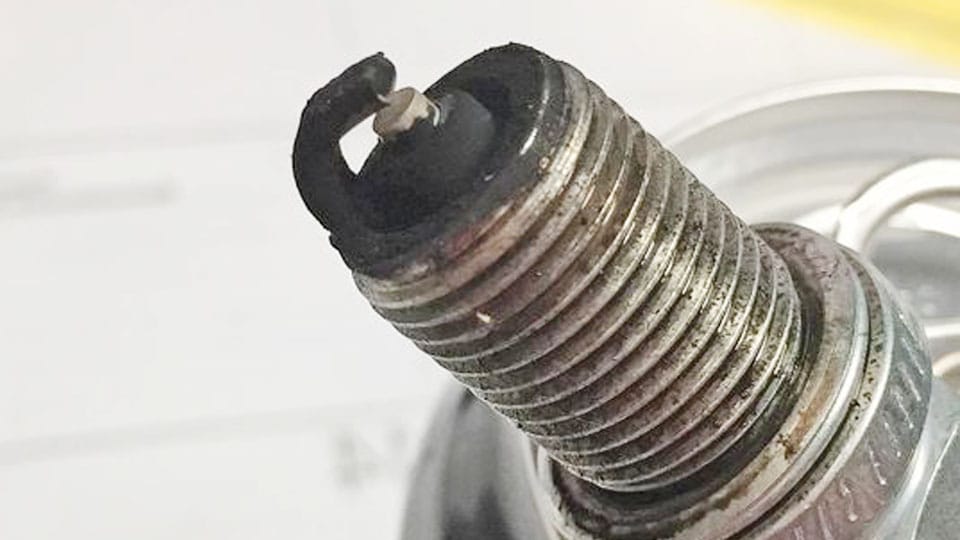
Replace turbo spark plugs sooner than the factory mileage if boost or tuning is higher: many tuned engines are commonly inspected at about 10,000 to 20,000 miles and replaced around 20,000 to 40,000 miles, while stock setups can often follow the OEM interval. Wait too long, or run the wrong gap or heat range, and misfires, knock, and catalytic-converter damage can follow. This guide explains interval, gap, heat range, and what to inspect when misfires start.
Turbo spark plug basics
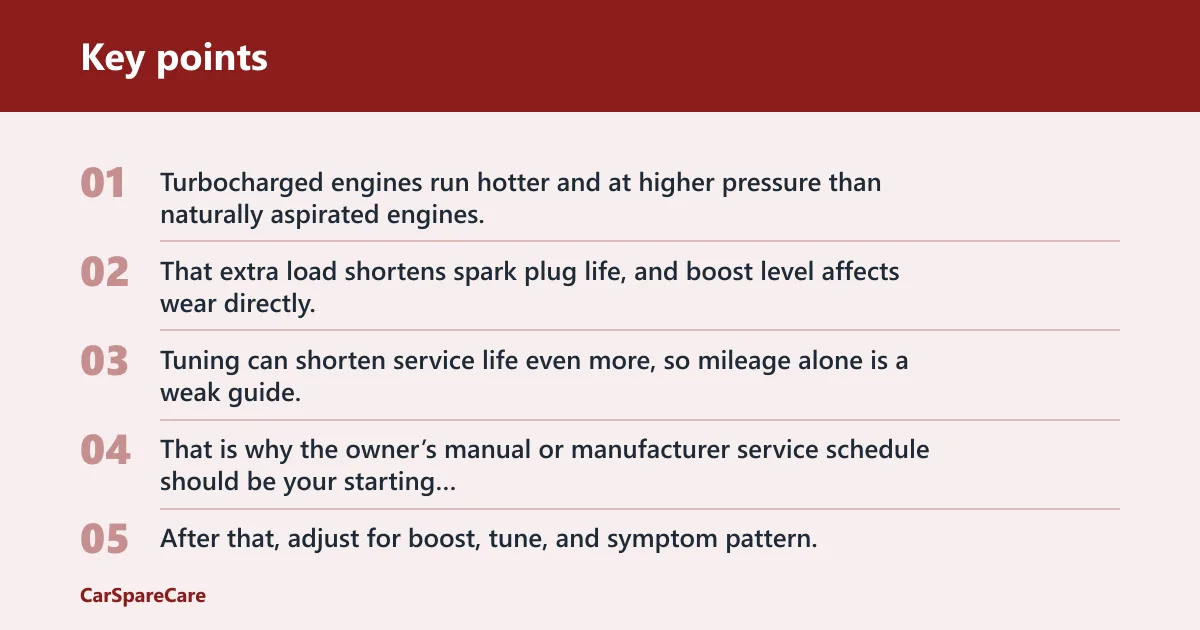


Turbocharged engines run hotter and at higher pressure than naturally aspirated engines. That extra load shortens spark plug life, and boost level affects wear directly. Tuning can shorten service life even more, so mileage alone is a weak guide.
That is why the owner’s manual or manufacturer service schedule should be your starting point for plug type, heat range, gap, and interval. After that, adjust for boost, tune, and symptom pattern. A turbo engine that sees frequent high-load pulls ages plugs faster than one that mostly cruises.
Why boost changes wear
Under boost, the plug must fire against denser air and a harsher in-cylinder environment. That can stress the plug’s electrode, the coil, and the boot. Frequent accelerations and high-load bursts stress plugs more than steady highway cruising.
PartsAvatar notes that turbocharged engines generate increased power output by about 30% to 40%, which helps explain why plug demand rises with boost. More cylinder pressure means the ignition system has to work harder every time the plug fires.
Why mileage alone is not enough
A turbo plug can be worn out before a “normal” mileage interval if the car runs more boost, richer fuel targets, or aggressive timing. It can also stay serviceable longer if the engine is stock and mostly driven gently. Mileage is only one input.
Use the schedule plus your actual use pattern. If the car is modified, has repeated misfires, or shows signs of fouling, the interval should move earlier than the book number.
How often should I replace spark plugs in a turbocharged engine?
There is no single interval for every turbo engine. Stock daily drivers can often follow the manufacturer schedule, while lightly tuned cars usually need shorter inspection windows and high-boost builds need earlier replacement. Plug material matters too: iridium and platinum usually last longer than copper.
Stock daily driver interval
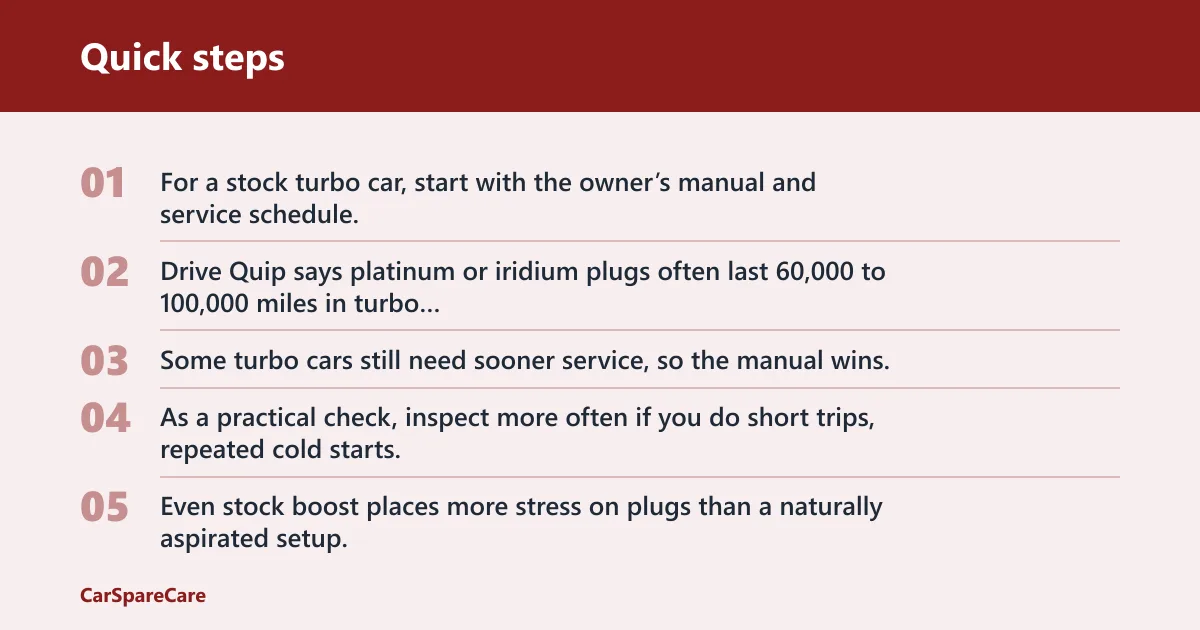
For a stock turbo car, start with the owner’s manual and service schedule. Drive Quip says platinum or iridium plugs often last 60,000 to 100,000 miles in turbo engines, and River Cities gives a 60,000 to 100,000 mile range for iridium or platinum under normal driving. Some turbo cars still need sooner service, so the manual wins.
As a practical check, inspect more often if you do short trips, repeated cold starts, or regular highway passes with hard acceleration. Even stock boost places more stress on plugs than a naturally aspirated setup.
Lightly tuned street turbo interval
A mild tune usually justifies earlier inspection. The same source says modified turbo cars may need earlier replacement than stock schedules.
Say your 2.0-liter turbo gets a mild boost increase and a more aggressive calibration. If the plug gap has opened slightly and the car begins to stumble on hard acceleration, the service interval has already become too long for that setup.
High-boost and performance interval
High-boost or track-focused turbo setups often need the shortest service life. Drive Quip and River Cities both point to earlier intervals in turbo use, and River Cities says turbo cars often need spark plugs every 30,000 to 60,000 miles. For a more aggressive build, the useful window can be much shorter than that.
Suppose a modified turbo car starts fouling plugs after repeated wide-open-throttle pulls. The issue may be heat, fuel, or gap, but the service interval is also too long for the way the engine is used.
Turbo spark plug decision table
| Setup | Inspection frequency | Typical replacement window | Gap-check priority | First component to inspect if misfires appear |
|---|---|---|---|---|
| Stock daily driver | At every scheduled service, then before the OEM interval ends | Follow the owner’s manual; many iridium or platinum plugs land in the 60,000 to 100,000 mile range | Medium; verify the factory spec before install | Ignition coil |
| Lightly tuned street turbo | Every 10,000 to 20,000 miles | About 20,000 to 40,000 miles, sooner if wear or fouling appears | High; confirm the gap before and after installation | Ignition coil |
| High-boost performance turbo | Every oil-service cycle or sooner if symptoms appear | Often earlier than 20,000 to 30,000 miles, depending on tune and use | Very high; small errors can cause load misfires | Ignition coil, then spark plug boots |
The table is a decision aid, not a replacement for the manual. The exact plug, gap, and service interval still depend on engine code, ignition system, and tuning strategy.
Do turbocharged engines need a different spark plug heat range?
Often, yes. The correct heat range matters more in a turbo engine because higher cylinder pressure and temperature change how the plug sheds heat. Too cold can cause unreliable firing and fouling. Too hot can raise pre-ignition risk.
When a colder plug helps
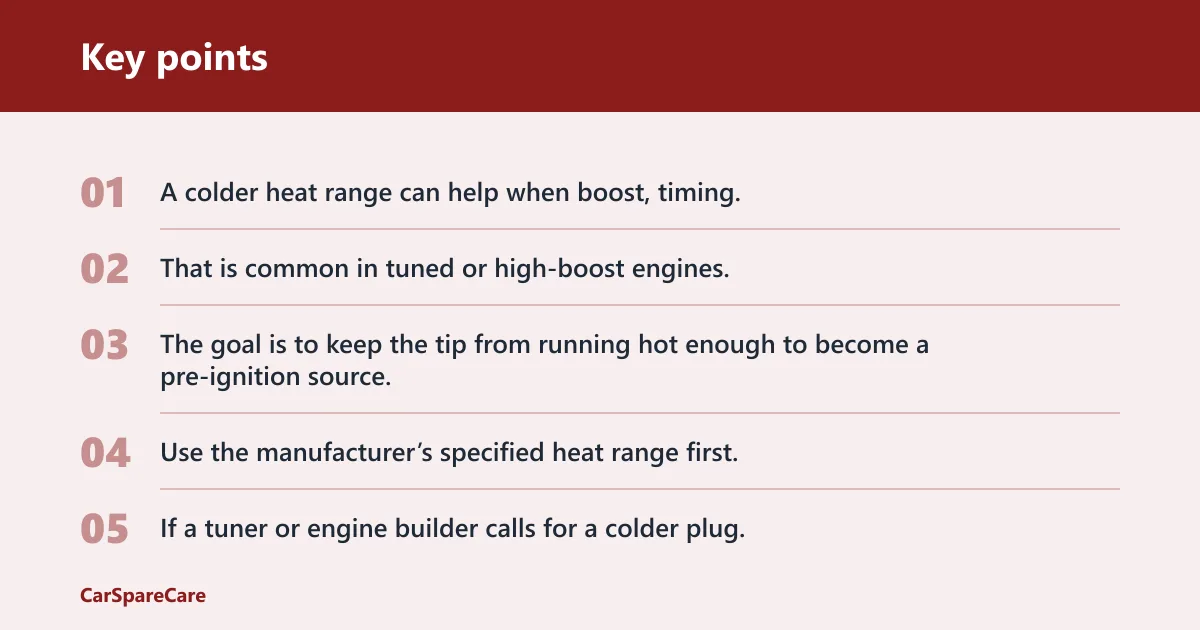
A colder heat range can help when boost, timing, or sustained load raises plug temperature beyond normal limits. That is common in tuned or high-boost engines. The goal is to keep the tip from running hot enough to become a pre-ignition source.
Use the manufacturer’s specified heat range first. If a tuner or engine builder calls for a colder plug, the change should match the actual calibration and fuel strategy, not a guess.
When a plug is too cold
If the plug is too cold for the engine’s use pattern, it may not clean itself well. That can lead to fouling, weak idle quality, and misfires after short trips or cold starts. River Cities says worn plugs can cause misfires especially under load or at startup.
That symptom pattern matters. If the car misfires mostly during cold idle and improves once warm, the plug may be too cold or already fouled. If the misfire appears only at high load, gap, coil output, or heat range should stay on the list.
When a plug is too hot
A plug that runs too hot can raise pre-ignition risk. In a turbo engine, that risk matters because boosted cylinders already work harder. If you see peppering, glazing, or abnormal electrode wear, the heat range may be wrong for the setup.
Check the plug number against the manufacturer and, if applicable, the tuner’s recommendation. Do not swap heat range by brand name alone; one company’s “equivalent” may not suit the same turbo calibration.
Should you change the gap for boost?
The gap must match the manufacturer specification, and precision matters more under boost. A wrong gap can cause weak ignition, misfires, or spark blowout under load. The same source says turbo engines may require precise gaps and recommends a feeler gauge.
Why the specified gap matters
Gap controls how hard the ignition system must work to jump the spark. In a turbo engine, the denser charge makes that demand higher. A small error can be harmless in a mild engine and a problem under boost.
Use a feeler gauge, not a guess. If a plug arrives pre-gapped, verify it anyway before install. Shipping and handling can change the opening.
What an unsafe gap looks like
An unsafe gap often shows up as load-related hesitation, a flutter on acceleration, or a misfire code after a hard pull. If the gap has opened beyond spec, the coil may struggle to fire the plug under boost even if idle seems fine.
A common first-timer mistake is assuming a smooth idle means the gap is correct. A turbo engine can idle cleanly and still miss under boost if the gap is too wide.
What happens if spark plug gap is too wide on a turbo car?
A gap that is too wide can make the spark harder to fire when cylinder pressure rises. That often shows up as misfires during acceleration, poor throttle response, and a rough feeling at higher load. The engine may feel normal at idle.
Check for a gap issue first if the car misfires only when boost climbs, especially if the plugs were just installed. If the problem started right after service, recheck the gap before replacing more parts.
Plug types and service life
Copper, platinum, and iridium plugs all have a place in turbo maintenance, but they do not age the same way. Copper is cheaper and usually wears faster. Platinum and iridium usually last longer, which is why they are common in turbo applications.
Copper plugs
Copper plugs have the shortest service life. The same source says copper plugs may need replacement every 30,000 to 60,000 miles, and River Cities gives the same range for many turbo cars. They can work well, but they need more frequent checks.
Use copper when the engine, tune, or maintenance plan calls for shorter intervals and you are willing to service them often. They are not a fit-and-forget choice.
Platinum plugs
Platinum plugs last longer than copper and are used in many turbo maintenance schedules. The same source says platinum or iridium plugs often last 60,000 to 100,000 miles in turbo engines. That longer life can reduce service frequency on a stock or mild setup.
They still need the correct heat range and gap. Longer life does not cancel a mismatch.
Iridium plugs
Iridium plugs are a common recommendation for turbo applications because they usually last longer than copper and hold their firing edge well. Many turbo owners choose them when they want a longer interval without giving up ignition quality.
Do not assume every iridium plug is right for every turbo engine. Thread size, reach, seat type, heat range, and gap still have to match the engine specification.
Misfire checks after plug service
If a turbo engine misfires after plug replacement, start with the coil, then inspect the boots. The same source says worn coils or boots can accelerate plug wear, and misfire codes in the P0300 series should prompt inspection. Do not blame the new plugs first.
- Scan for misfire codes, especially P0300-series codes.
- Test the ignition coil on the affected cylinder.
- Inspect the spark plug boot for cracks, carbon tracking, or looseness.
- Verify plug gap and heat range against the vehicle specification.
- Check the plug for oil fouling, fuel fouling, or signs of overheating.
Test the coil first
Worn coils can weaken spark energy and make plug problems worse on a turbo engine. If the misfire moves with the coil, the coil is likely part of the fault. That is especially important under boost, where spark demand is higher.
Inspect the boots
Damaged boots can leak spark to ground or fail to seat correctly. That can produce a misfire even when the new plugs are correct. Look for tears, oil contamination, swelling, and hardening.
Check for oil, fouling, or heat-range mismatch
Oil on the plug can point to valve cover leaks or ring wear. Dry black soot can point to rich running or a plug that is too cold. White blistering or unusual electrode wear can point to excess heat or the wrong heat range.
If the plugs were replaced and the misfire appeared afterward, the likely causes are installation error, coil weakness, boot damage, or an incorrect plug spec. The plug itself is only one part of the ignition system.
Frequently asked questions
Should I gap spark plugs differently for a turbo engine?
Do not change the gap by guesswork. The specified gap matters more under boost, and a precise gap helps the coil fire reliably when cylinder pressure rises. Use the vehicle specification and verify each plug with a feeler gauge before installation.
Can worn coils make spark plug problems worse on a turbo engine?
Yes. A weak coil can shorten plug life, cause weak spark, and make a correct plug look bad. If a turbo engine misfires after plug service, test the coil first, then inspect the boot and connector before replacing more plugs.
Should I replace all spark plugs at the same time on a turbo engine?
Yes, on multi-cylinder turbo engines, replace the full set at the same time unless the manufacturer gives a different procedure. Mixed-age plugs can create uneven firing and make diagnosis harder. Use a torque wrench so you do not crack the insulator or damage the seat or threads.

Hi, I’m Melvin, an automobile engineer with extensive experience in automobile equipment. I currently work for a local automobile firm, where I specialize in the car parts industry. I’ve had the opportunity to collaborate with seasoned inspectors, gaining invaluable hands-on experience that goes beyond just theory.
My passion for automotive care started at a young age, which led me to create CarSpareCare. Through CarSpareCare, I share the knowledge and skills I’ve acquired over the years to help others navigate the world of car maintenance and repairs.
My goal is to provide practical tutorials, essential safety advice, and the latest industry insights so that anyone—whether a beginner or an expert—can confidently tackle their automotive projects.