13 volts can charge a 12V car battery, but only when the reading comes from a running charging system. A resting battery at 13 volts is unusually high. Read it wrong, and you can chase a bad battery, miss a weak alternator, or overcharge the system. This guide separates resting voltage, charging voltage, and alternator output so you can judge the reading correctly.
This guide is part of our Car battery maintenance guide series.
Battery voltage chart
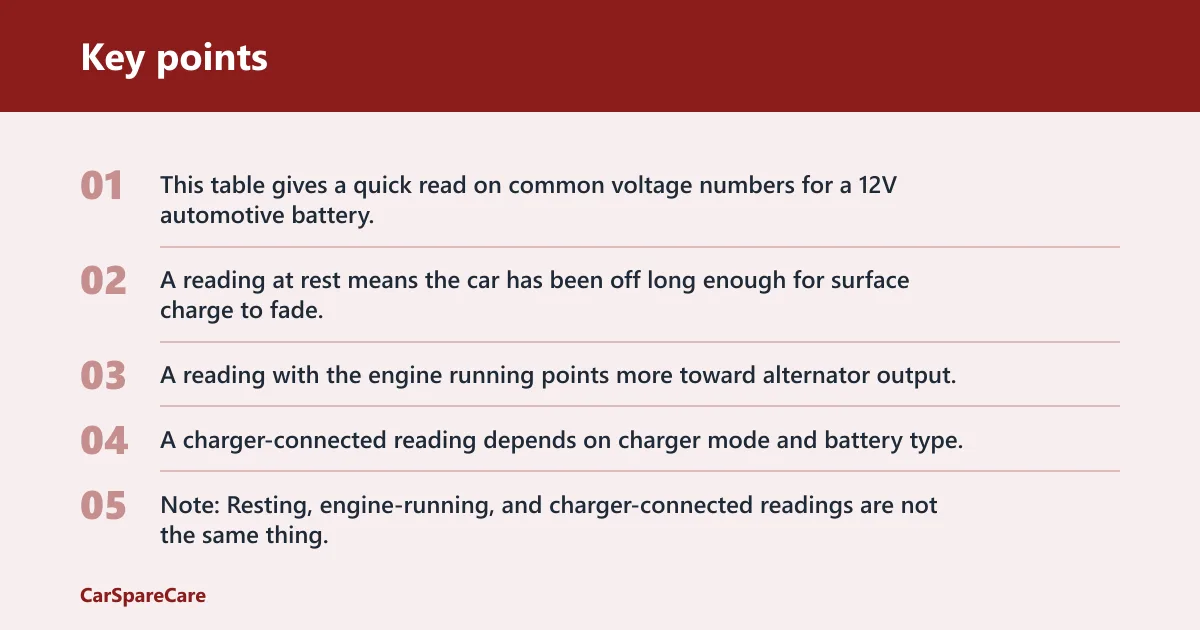


This table gives a quick read on common voltage numbers for a 12V automotive battery. Use it by context. A reading at rest means the car has been off long enough for surface charge to fade. A reading with the engine running points more toward alternator output. A charger-connected reading depends on charger mode and battery type.
| Measured voltage | Likely state | Next action |
|---|---|---|
| 12.2V | Low state of charge, around half full | Recharge and retest after the battery rests |
| 12.4V | Partially charged | Charge fully before judging the battery |
| 12.6V | Fully charged resting battery for many lead-acid systems | Check cranking performance and terminal condition if starting is still poor |
| 13.0V | High for a resting battery; often surface charge or charging voltage | Let the battery rest, then retest with a multimeter |
| 13.5V | Possible charging voltage; not a full-charge resting reading | Confirm whether the engine is running or a charger is connected |
| 14.2V | Common charging range for many 12V systems | Usually normal if the reading is taken while charging or running |
| 15.0V | High for most steady charging situations | Check the charger, alternator, battery type, and temperature compensation |
Note: Resting, engine-running, and charger-connected readings are not the same thing. A battery that reads 13V after a drive may settle lower after a rest period. A smart charger may also hold a higher absorption voltage for a while, especially with AGM batteries, so check the vehicle and charger manuals. For flooded lead-acid and AGM batteries, charging targets can differ, and many smart chargers follow different profiles for each type. Battery University notes that lead-acid charging stages and voltages vary by battery design, and NOCO’s charger guidance also distinguishes AGM and flooded settings.
How many volts to charge a car battery?
For most 12V lead-acid car batteries, the charging voltage needs to be higher than resting battery voltage. A typical charging range is about 13.8V to 14.7V, depending on the vehicle, battery type, and temperature. The Battery Council International explains that alternators commonly regulate in this general range, while many chargers use battery-specific targets. A charger set too low may undercharge the battery, while sustained voltage that is too high can risk damage or overcharge. Battery Council International
Resting voltage versus charging voltage
A resting battery voltage tells you charge level after the battery has had time to settle. Charging voltage is the applied voltage from a charger or alternator. Those numbers should not be compared as if they mean the same thing. A 13.0V resting reading is not the same as 13.0V from a charger.
For many 12V car batteries, about 12.6V to 12.8V at rest is commonly associated with a full-charge context. Around 12.2V is often closer to 50% state of charge. Battery University’s state-of-charge chart places roughly 12.2V near half charge for lead-acid batteries. If you see 13V at rest, think surface charge, recent charging, or a charging system issue before you think “fully charged.”
Is 13 volts enough to charge a car battery?
Usually, 13.0V is not enough for a full charge target on a 12V lead-acid battery. It can help maintain a battery or keep a lightly discharged one from falling further, but it is often closer to float or maintenance behavior than to the higher charging voltage many systems need for a full charge.
Why 13.0V is usually not a full-charge target
If a charger is holding a battery at 13.0V, the battery may charge slowly or stop short of full charge, especially if it is deeply discharged. That is why a battery can show 13V and still be weak. Voltage alone does not tell you how much current is moving into the battery, or whether the battery can accept it well.
Suppose a sedan battery reads 13.0V right after a short drive. That may be surface charge, not a full resting state. If you shut the car off, wait, and read it again later, the voltage may fall toward 12.6V or lower. That change tells you more than the first number did.
What a charger set to 13V may do
A charger set to 13V may be useful for maintenance on some batteries, but it is not the normal target for bringing a low battery back to full. Set the charger to the battery type and the mode listed in the manuals, especially for AGM batteries.
When 13V can still be useful
13V can still be useful as a maintenance reading or a brief surface-charge reading after charging or driving. It can also appear while an alternator is supporting the electrical system with the engine running. In those cases, the number is not a sign of a full battery at rest.
How many volts for a car battery?
For a 12V car battery, the right answer depends on the state you are checking. At rest, a healthy full battery is usually about 12.6V to 12.8V. While charging or with the engine running, voltage should rise above resting level. The charging range is not the same as the resting range.
How many volts is a car battery full charge?
A fully charged 12V lead-acid car battery is commonly about 12.6V to 12.8V at rest. That is the number to look for after the battery has sat long enough for surface charge to fade. A higher reading can happen, but it does not automatically mean the battery is “more than full.”
What about 12.4V and 12.2V?
About 12.4V usually means the battery is partly charged. Around 12.2V is near 50% state of charge. Those readings are useful because they tell you the battery may still start the car, but it is not at full capacity. That matters if the car has repeated short trips or sits unused.
Why 13V is not the same as full
Thirteen volts can look reassuring, but it can mean the battery just came off a charger or the alternator is still influencing the reading. A battery that truly rests at 13V is not giving you a normal settled lead-acid reading. Recheck after rest before making a call.
Why is my car battery showing over 13 volts?
A reading over 13V often means the battery is not at rest. It may be carrying surface charge after driving or charging, or the alternator may be supplying current with the engine running. Dirty terminals, sulfation, or weak cables can also confuse the diagnosis because voltage at the posts does not always reflect battery health under load.
Surface charge after charging or driving
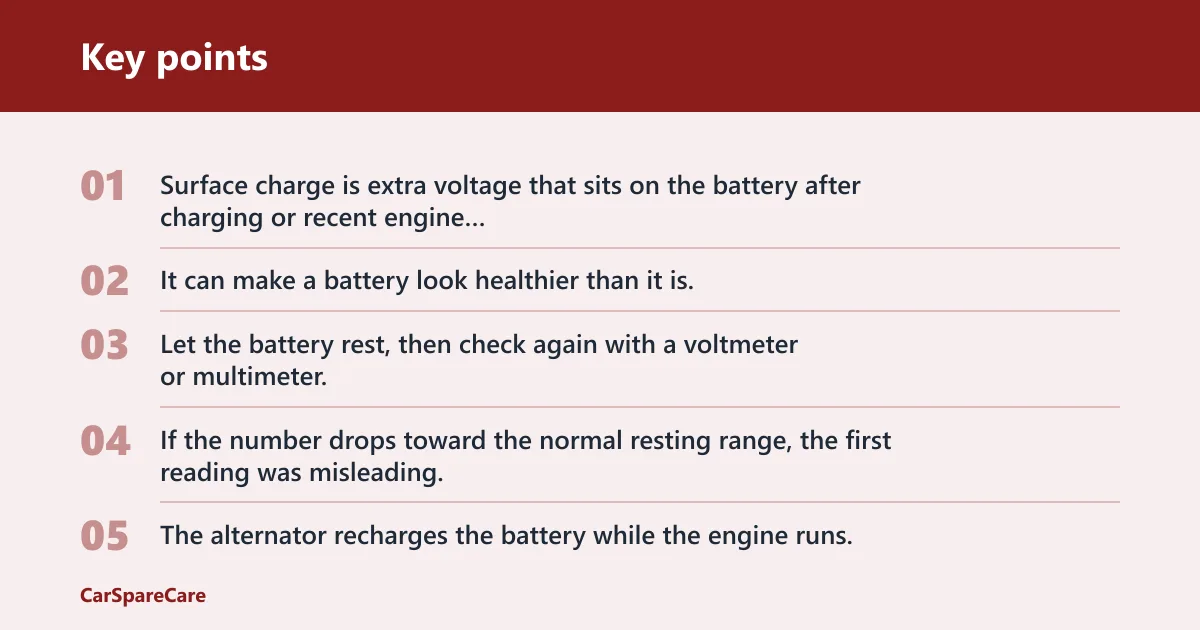
Surface charge is extra voltage that sits on the battery after charging or recent engine operation. It can make a battery look healthier than it is. Let the battery rest, then check again with a voltmeter or multimeter. If the number drops toward the normal resting range, the first reading was misleading.
Alternator output with the engine running
The alternator recharges the battery while the engine runs. That is why a healthy system can read above resting voltage when the car is on. Alternator voltage is not the same as a battery resting voltage, and it can also rise after a jump-start while the donor or the repaired vehicle is still running. According to AA1Car and battery charging references from major parts suppliers, charging voltage commonly falls in the low-to-mid 14-volt range for many vehicles.
Dirty terminals, sulfation, or cable problems
Battery terminal corrosion can hinder charging efficiency. If the posts or clamps are dirty, the battery may show a decent voltage and still struggle to crank. Weak cables or internal sulfation can do the same thing. A battery can show over 13V and still fail under starter load.
A common mistake is to spot 13.0 volts on a charger and assume the car battery is fully charged, even though it may still need more time or a higher charging voltage. A better next step is to let the battery sit, clean the terminals, and read it again before judging the charging system.
How to check the reading correctly
Use a voltmeter or multimeter for the check. Measure the battery at the posts, not on corroded cable ends. Then decide whether you are reading a resting battery, a charging battery, or an engine-running system. That context matters as much as the number.
- Wear safety goggles and gloves.
- Inspect the battery terminals and clean corrosion if needed.
- Make sure the battery connections are tight and free of damage.
- Turn the car off and let the battery rest before retesting.
- Read the voltage with a multimeter at the battery posts.
- Check the reading again with the engine running if you want to assess charging behavior.
- If you smell something unusual, see smoke, or notice sparks, disconnect at once and stop.
Use the correct charger settings for the battery type, keep the area ventilated, and avoid sparks near the battery. Follow the vehicle manual and the charger manual. Clean battery terminals before testing or charging so corrosion does not distort the reading or slow the charge.
Charging methods and what to expect
The best way to charge a car battery is a battery charger. It provides controlled charging and is safer and more effective than improvised methods. Other options can help in a pinch, but they do different jobs. A jump-start gets the car moving; it does not fully recharge a dead battery by itself.
Battery charger
A battery charger should be set to the correct voltage level for the battery and charger mode. That makes it the cleanest way to restore charge after a low-voltage reading. It also gives you a better chance to see whether the battery can hold voltage after charging.
If a charger reports 13.5V, that can be normal in some charging contexts, especially during a later charging stage or with certain battery types. It does not mean the battery is fully charged at rest. Recheck after the charger is removed and the battery has rested.
Jump-starting and the alternator
Jump-starting uses another vehicle’s battery to start your car. Still, follow the vehicle manual for the exact clamp order and procedure.
Jumper cables must connect the positive and negative terminals correctly. Dirty posts can weaken the result. Once the engine starts, let it run so the alternator can help recharge the battery. That step helps, but it does not replace a proper recharge with a charger.
Portable jump starter
Portable jump starters are also called booster packs. They are self-contained tools for starting a car without another vehicle. They are measured in peak amps, and many units range from 400 to 2000 peak amps. Check the manufacturer’s listing for your model before buying or using one.
Solar charger or solar panel
Solar chargers can be useful for emergency battery charging, but they are usually slow and often impractical for a dead battery. Solar panels convert sunlight into direct current power, yet the output is limited by panel size, sun angle, weather, and controller setup. A solar charge controller can prevent overcharging, and many setups need one. For a dead battery, solar is often a backup plan rather than the fastest fix.
How many volts is a car battery full charge?
A fully charged 12V car battery is commonly about 12.6V to 12.8V when it has rested. That is the number to trust for a settled battery. If the reading is over 13V, look for surface charge, charging activity, or a bad measurement point before calling it full.
AGM and flooded lead-acid differences
AGM and flooded lead-acid batteries may accept different charging targets, so check the vehicle and charger manuals. A smart charger may also use a different absorption profile for AGM batteries. Battery Tender and other charger manufacturers note that AGM batteries often use different charge settings than flooded batteries. That is one reason a single voltage number does not fit every charging situation.
What voltage is a fully charged car battery?
For most 12V automotive batteries, a fully charged resting voltage is about 12.6V to 12.8V. That is the cleanest answer for a settled battery. If your reading is much lower, the battery needs charging or further testing. If it is much higher, check whether the battery is still on charge or has surface charge.
Can a battery show over 13 volts and still fail to crank?
Yes. A battery can show over 13V and still fail to crank because of surface charge, sulfation, dirty terminals, weak cables, or internal failure under load. Voltage alone does not prove starting ability. If the starter still struggles, move from voltage checking to a load-related diagnosis.
Frequently asked questions
What voltage is right for charging a 12v car battery?
Many 12V systems charge in the rough range of about 13.8V to 14.7V, depending on vehicle, battery type, and temperature. The correct setting depends on the charger and the battery. Follow the manual rather than guessing, especially with AGM batteries or smart chargers.
What does battery at 13.1 volts mean?
It usually means the battery is not at a normal settled resting reading. The most common causes are surface charge, recent driving, or a charging system that is still active. Let the battery rest, then measure again with a multimeter to see whether it drops into the normal resting range.
Is a car battery at 13.5 volts charged?
It may be charging, but it is not the same as a fully charged resting battery. A 13.5V reading can be normal while the alternator or charger is active. After rest, a full battery usually settles closer to about 12.6V to 12.8V.
Can a car battery charging at 15 volts be normal?
Sometimes a smart charger may briefly rise to a higher voltage during a charging stage, but 15.0V is not normal as a steady reading for most systems. Consumer guidance from battery and charging suppliers commonly treats sustained 15V as a sign to check the charger, alternator, battery type, and temperature compensation. Stop if you notice heat, smell, smoke, or sparks.

Hi, I’m Melvin, an automobile engineer with extensive experience in automobile equipment. I currently work for a local automobile firm, where I specialize in the car parts industry. I’ve had the opportunity to collaborate with seasoned inspectors, gaining invaluable hands-on experience that goes beyond just theory.
My passion for automotive care started at a young age, which led me to create CarSpareCare. Through CarSpareCare, I share the knowledge and skills I’ve acquired over the years to help others navigate the world of car maintenance and repairs.
My goal is to provide practical tutorials, essential safety advice, and the latest industry insights so that anyone—whether a beginner or an expert—can confidently tackle their automotive projects.