Yes—bad spark plugs can cause a rough idle, especially if one cylinder misfires, the plugs are worn, fouled, cracked, or gapped wrong. Ignoring it can waste fuel, damage the catalytic converter, and hide a larger ignition or air-fuel problem. This guide shows when plugs are the likely cause, when they are not, and how to confirm it before you replace parts.
What a misfiring plug does at idle
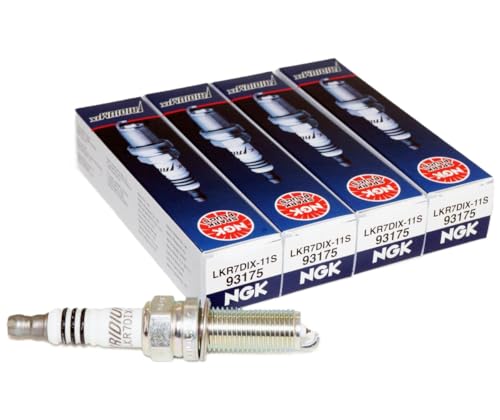


Yes. Spark plugs ignite the air-fuel mixture in each cylinder, and a weak or fouled plug can cause incomplete combustion at idle. That is why rough idle is often felt first when the engine is sitting around low RPM, where one weak cylinder stands out as vibration or shaking.
Bad plugs are most convincing as the cause when the idle fault lines up with a misfire pattern, worn plug tips, or a gap that no longer matches spec. If the rough idle stays after a plug check, the fault may be in a coil, wire, injector, vacuum leak, or compression problem instead.
What happens in the cylinder when a plug misfires
When a plug cannot fire the mixture cleanly, combustion is incomplete. That can happen from wear, fouling, damage, or a spark plug gap that is too wide for the ignition system to fire consistently. Too-wide gap raises voltage demand; too-narrow gap weakens the spark.
At idle, the engine has less rotational momentum to smooth out one weak cylinder. A single misfire can feel like a stumble, a steady shake, or an occasional dip in engine speed. An engine misfire may set P0300 through P0308 codes, but the light may not come on right away.
Why idle is the first place you notice it
Rough idle is often most noticeable because the engine is idling at low RPM, commonly around 600 to 900 RPM and sometimes around 600 to 800 RPM. At that speed, each combustion event matters more. If one cylinder drops out, the whole engine can feel uneven.
That same fault may be less obvious under light acceleration, because more throttle and higher RPM can hide the miss. The symptom can still return at a stoplight, in drive with the brake held, or when the air conditioning load comes on.
When rough idle points beyond the plugs
If the idle roughness affects several cylinders, appears only after recent plug work, or comes with fuel smell, coolant loss, or a wet plug tip, you should look past the plugs. A vacuum leak, faulty coil, injector issue, or low compression can mimic a plug problem.
Say your car starts and idles at 700 RPM, but the shake gets worse when you turn the steering wheel at a stop. That load change can expose a weak cylinder, but it can also reveal a vacuum leak or an ignition coil that fails when demand rises.
Rough idle triage by symptom pattern
| Symptom pattern | Likely cause | Quick check | Next action |
|---|---|---|---|
| Single-cylinder misfire | Bad spark plug, coil, wire, or injector on one cylinder | Read P0301 through P0308 and inspect that cylinder’s plug | Check gap and swap the coil to see whether the code moves |
| Multiple-cylinder misfire | Fuel delivery, vacuum leak, shared coil issue, or several worn plugs | Look for P0300 plus more than one cylinder code | Test for vacuum leaks, fuel issues, and common ignition faults |
| Cold-only rough idle | Weak plug, fouled plug, sticky injector, or intake air leak | Compare cold start behavior to warm idle after a few minutes | Inspect plugs first, then check for leaks or injector imbalance |
| Rough idle after plug replacement | Loose coil, damaged boot, wrong gap, wrong plug type, or cross-threading damage | Verify each coil pack is fully seated and plugs match spec | Recheck installation before buying more parts |
| Rough idle with no CEL | Early plug fouling, intermittent misfire, vacuum leak, or minor coil weakness | Scan for pending codes and misfire counters if available | Inspect plugs and ignition parts even without a warning light |
| Rough idle plus fuel smell | Misfire leaving unburned fuel, leaking injector, or rich running condition | Check for plug fouling and raw fuel smell at the tailpipe | Do not keep driving long enough to overheat the catalyst |
| Rough idle plus wet or oily plug | Oil entering the combustion chamber or valve cover tube seal leak | Inspect the plug tip and the well for oil contamination | Fix the oil source before installing new plugs |
| Rough idle plus coil swap code movement | Ignition coil is the true fault | Move the coil to another cylinder and rescan | If the code follows the coil, replace the coil |
What bad plugs feel like at idle
A rough idle often shows up as shaking, vibration through the seat or steering wheel, or erratic engine speed near a stop. Bad plugs can also lead to hard starts, fuel use that climbs, and sluggish acceleration. Those symptoms often travel together because the same misfire affects several driving conditions.
Stalling risk at stoplights
One weak plug may only cause a slight stumble. Two or more weak cylinders raise the chance of stalling when the engine is loaded by the alternator, A/C compressor, or power steering. That is why a rough idle that worsens in gear deserves faster attention.
If the check engine light flashes, treat it as an active misfire. A flashing light means the misfire is serious enough to threaten the catalytic converter if you keep driving. A steady light is less urgent, but it still needs diagnosis.
Other symptoms that often travel with a misfire
Worn or fouled plugs can make the engine feel lazy off the line and burn more fuel than normal. You may also notice hard starts after the engine sits, a slight fuel smell, or a hesitation when pulling away from a stop. Those signs do not prove the plugs are the only fault.
A common first-timer mistake is replacing plugs because of a rough idle and stopping there. If the engine still misfires, the plug may have been a bystander while the real fault sat in the coil, injector, or air leak path.
How to tell plugs from coils or wires
An OBD-II scanner is the fastest way to narrow the fault. Misfire codes often include P0300 through P0308, which can point to one cylinder or a random miss. That code pattern tells you where to look, but it does not prove the plug is bad.
Reading P0300 to P0308 with an OBD-II scanner
P0300 usually means random or multiple-cylinder misfire. P0301 through P0308 usually point to a specific cylinder. If the scanner shows one cylinder only, inspect that cylinder’s plug, coil, and wire or coil pack first. If several cylinders share the complaint, think fuel, vacuum, or shared ignition supply.
Swapping ignition coils to see whether the code moves
Ignition coil problems can look just like bad plugs at idle. A useful check is to swap the coil from the misfiring cylinder to another cylinder and rescan after a short run. If the code follows the coil, the coil is the likely cause.
If the misfire stays on the original cylinder, the plug, injector, compression, or wiring at that cylinder becomes more likely. This test is especially useful when the spark plug looks acceptable but the cylinder still misfires.
When plug wires or coil packs are the real fault
Spark plug wires and coil packs must be fully seated after installation. Loose, damaged, or misrouted parts can cause a rough idle immediately after service. A wire that is not snapped onto the plug, or a coil boot that is cracked, can produce a miss that feels like a bad plug.
Check the connectors, boot condition, and routing before replacing another part. If a vehicle uses plug wires, inspect for burn marks, torn insulation, and a loose fit at both ends. If it uses coil-on-plug units, make sure each coil is firmly locked in place.
How to check spark plug gap and condition
Use a feeler gauge to verify the spark plug gap against manufacturer specification. The gap is the distance between the center electrode and the ground electrode. If the gap is wrong, the ignition system may need more voltage than it can deliver, or the spark may be too weak to ignite the mixture cleanly.
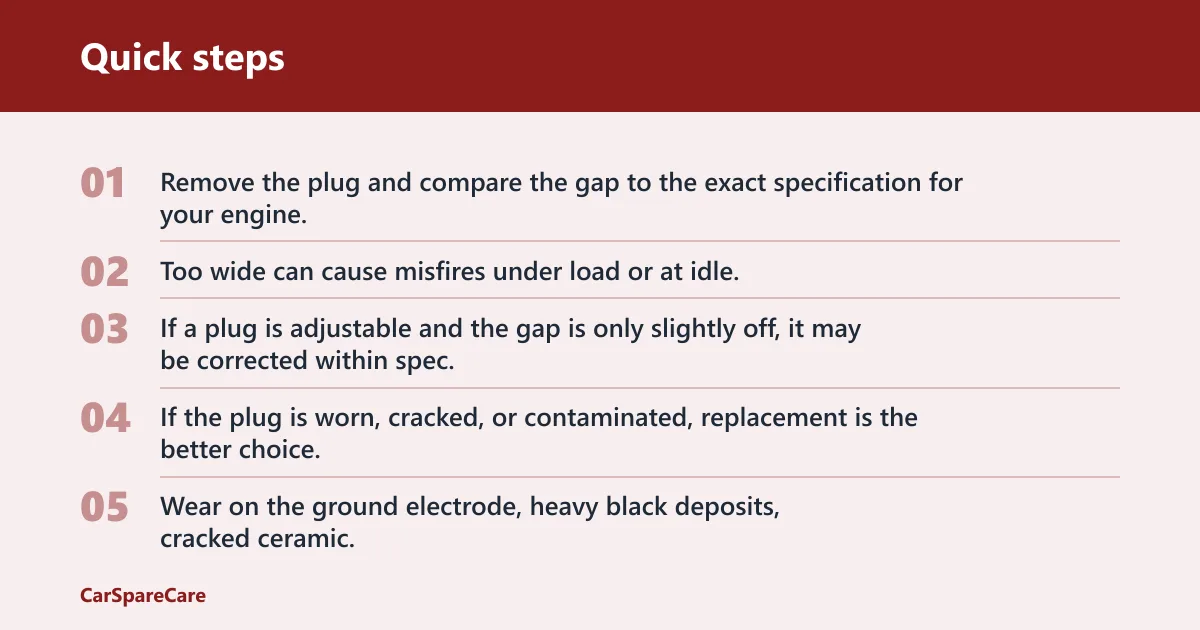
Using a feeler gauge against the spec
Remove the plug and compare the gap to the exact specification for your engine. A small change matters. Too wide can cause misfires under load or at idle, while too narrow can weaken ignition quality and make the plug less effective.
If a plug is adjustable and the gap is only slightly off, it may be corrected within spec. If the plug is worn, cracked, or contaminated, replacement is the better choice.
Reading worn, fouled, damaged, wet, or oily plugs
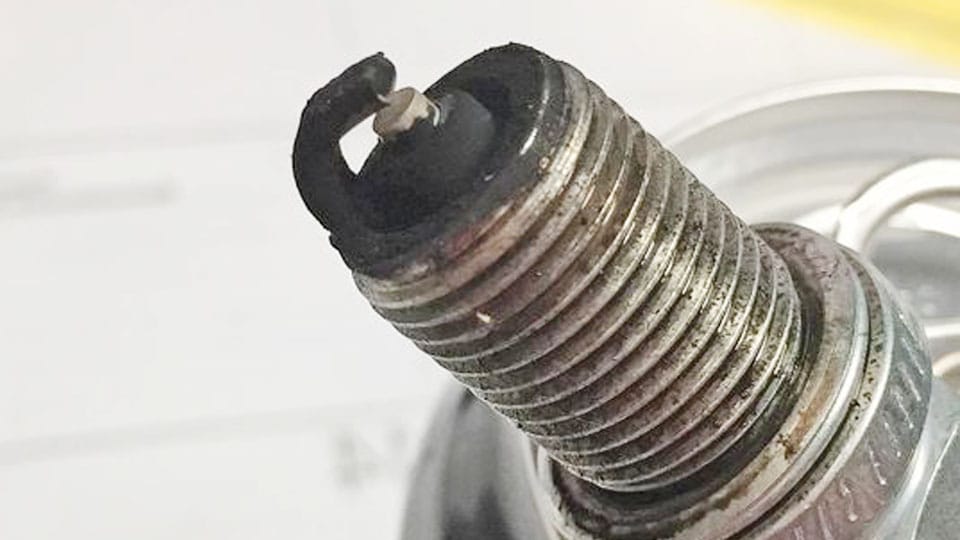
Wear on the ground electrode, heavy black deposits, cracked ceramic, or a damaged tip all point toward replacement. Foul-related misfires are common because the plug can no longer fire the mixture cleanly. A wet, oily spark plug tip can indicate oil entering the combustion chamber.
Oil on a plug is not a normal wear sign. It usually means the plug is reporting another problem, such as valve seal wear, ring wear, or a tube seal leak on engines with plug wells.
What plug color and deposits can suggest
Light tan or gray deposits are often less alarming than thick black soot or wet oil, but the exact interpretation depends on the engine. One dirty plug in one cylinder usually points to a localized issue. Several dirty plugs point more toward a system problem such as fuel mixture, leakdown, or long service life.
If the plugs are only lightly worn and the idle is still rough, keep looking. A plug can be present and still not be the root cause.
Did the plug change cause the rough idle?
A rough idle can start after a spark plug change if the installation is incomplete or the wrong parts were used. Loose coils, damaged boots, incorrect gap, wrong plug type, or cross-threading can all create a fresh misfire that was not there before service.
Loose coils and boot fitment
After installation, each coil pack or plug wire should be fully seated. A boot that is half on the plug can arc, misfire, and shake at idle. Damage to the boot from pulling it sideways or forcing it onto the wrong angle can produce the same symptom.
If the rough idle appeared right after a plug job, inspect the work before assuming the new plugs are defective. A connector left loose is far more common than a brand-new plug failing out of the box.
Cross-threading and torque errors
Use a spark plug socket and ratchet for removal and installation, and hand-thread the plug first to avoid cross-threading. Final tightening must follow the manufacturer torque specification. Overtightening can damage threads or the cylinder head, and a damaged seat can create a combustion leak.
If a plug feels wrong during hand-threading, stop. Forcing it can turn a simple service into head repair.
Wrong plug type or incorrect gap
Always match the exact plug type the engine calls for. Copper spark plugs typically last around 30,000 miles. Platinum spark plugs can last about 60,000 to 80,000 miles. Iridium spark plugs can last 100,000 miles or more. Those ranges are not a reason to delay inspection if the idle has already turned rough.
Recent plugs can still be wrong if the heat range, reach, thread, or gap does not match the engine. A plug that fits physically may still misfire at idle if it is not the specified part.
When to replace plugs and what type to use
Replace plugs when they are worn, fouled, damaged, or outside spec, not just because the idle is rough. If the plugs are due by mileage or appear worn on inspection, replacement makes sense. If they look good, confirm the gap and look for other faults before spending money on parts.
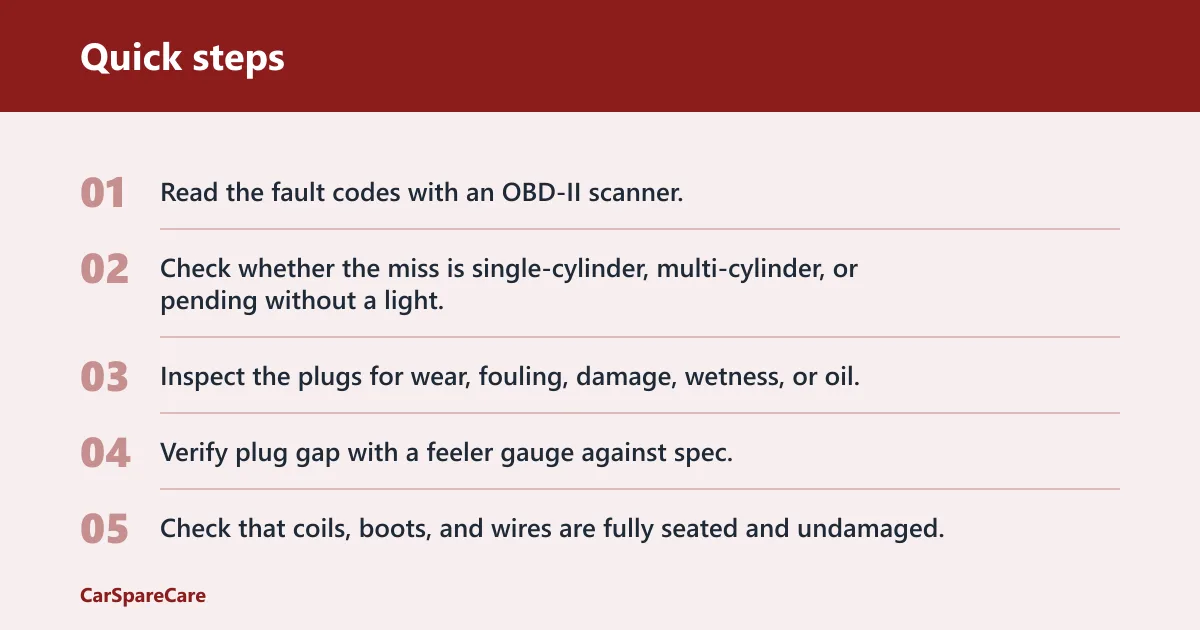
Choose the plug type the engine specifies. Copper plugs usually need shorter service intervals. Platinum and iridium plugs last longer, but they are not universal fixes for rough idle. The wrong gap or wrong heat range can still cause a miss even on a new set.
Suppose a sedan idles rough at 650 RPM after a plug change, and one coil connector is not fully latched. Fixing the connector may solve the shake in minutes. Replacing the plugs again would only repeat the same mistake.
- Read the fault codes with an OBD-II scanner.
- Check whether the miss is single-cylinder, multi-cylinder, or pending without a light.
- Inspect the plugs for wear, fouling, damage, wetness, or oil.
- Verify plug gap with a feeler gauge against spec.
- Check that coils, boots, and wires are fully seated and undamaged.
- Swap a suspect ignition coil to see whether the code moves.
- Only then replace parts that match the evidence.
Frequently asked questions
Can bad spark plugs cause rough idle and stalling?
Yes. A bad plug can cause incomplete combustion, and at idle that can be enough to make the engine shake or stall. The risk rises if more than one cylinder misfires, if the check engine light flashes, or if the engine already struggles at stoplights or in gear.
Can bad spark plugs cause rough idle?
Yes. Rough idle is one of the most common signs of a plug problem because the engine is more sensitive to a weak cylinder at low RPM. Worn, fouled, damaged, or incorrectly gapped plugs can all create that uneven idle feel.
Can one bad spark plug cause rough idle?
Yes. One bad plug can cause a single-cylinder misfire that shows up as a shake, stumble, or slight RPM drop. The engine may still run, but it will not idle smoothly. An OBD-II scanner often helps point to the affected cylinder.
Can bad spark plug wires cause rough idle?
Yes. Bad wires can leak spark, lose connection, or fail under load, which can feel the same as a bad plug. If the rough idle started after service, check that the wires or coil packs are fully seated and not damaged or misrouted.
How do I know if rough idle is from spark plugs or ignition coils?
Read the misfire code, inspect the plug on that cylinder, and swap the coil to another cylinder. If the code moves, the coil is likely bad. If it stays put, the plug, injector, wiring, or compression is more likely.
How do I check if spark plug gap is causing rough idle?
Remove the plug and measure the gap with a feeler gauge. Compare it to the vehicle’s specification. If the gap is too wide, the engine may need more voltage to fire the plug; if too narrow, the spark may be weaker than it should be.

Hi, I’m Melvin, an automobile engineer with extensive experience in automobile equipment. I currently work for a local automobile firm, where I specialize in the car parts industry. I’ve had the opportunity to collaborate with seasoned inspectors, gaining invaluable hands-on experience that goes beyond just theory.
My passion for automotive care started at a young age, which led me to create CarSpareCare. Through CarSpareCare, I share the knowledge and skills I’ve acquired over the years to help others navigate the world of car maintenance and repairs.
My goal is to provide practical tutorials, essential safety advice, and the latest industry insights so that anyone—whether a beginner or an expert—can confidently tackle their automotive projects.