Yes, bad spark plugs can cause pinging or rough-running misfire noises, but they usually do not cause true engine knock from internal damage. Ignoring a real knock can destroy bearings fast and turn a cheap tune-up into an engine rebuild. This guide shows how to tell spark-plug symptoms from true knock by sound, load, and quick checks.
What misfire noise really sounds like
Usually, no. Bad spark plugs more often cause misfires, rough idle, hesitation, hard starts, and poor acceleration than true engine knock. If the sound is a light ping under load, the cause may be combustion-related and ignition-related at the same time, but loud metallic knock points to a deeper mechanical problem that needs immediate attention.
What readers often hear instead
A misfiring cylinder can sound like a tick, puff, stumble, or uneven rattle, especially at idle or on light throttle. That noise comes from incomplete combustion, not from a bearing or piston striking metal. A check engine light with P0300 or a P030x code often fits that pattern better than true knock.
Say your 4-cylinder idles with a shake at a stoplight and the exhaust note has a sharp, uneven tick. If the sound fades as revs rise and the car accelerates normally after a plug replacement, that points toward misfire noise, not rod knock. Load matters as much as the sound.
What engine knock actually sounds like
Engine knock is a general term for two different problems. Combustion knock, often called detonation or pinging, is commonly described as abnormal burning in the cylinder. Mechanical knock is usually described as metal-to-metal noise from parts such as rods, bearings, pistons, valvetrain parts, or accessory hardware.
Combustion knock versus mechanical knock
Detonation usually shows up as a light metallic ping or marbles-in-a-can sound under load, climbing a hill, or accelerating in a high gear. Mechanical knock is usually louder, more repetitive, and often follows engine speed more closely. A misfire can make the engine run badly, but it does not usually create that deeper knock by itself.
Pre-ignition is different again. It means the air-fuel charge lights before the spark plug fires, often from a hot spot such as glowing carbon, a damaged plug tip, or an overheated part. Detonation happens after the spark fires, when part of the mixture burns too fast or too late. Both can damage parts quickly.
Load-related pinging, ticking, and rattling
Load-related pinging is the sound most often confused with plug trouble. It tends to appear when cylinder pressure is high, such as uphill driving or hard acceleration. Ticking at idle is more likely to come from valve train noise, an exhaust leak, injector clicking, or a misfire that makes each combustion event uneven.
Loud metallic knock that gets worse with throttle is a different category. That is the sound that should make you stop driving and shut the engine down. Continued operation can turn a salvageable fault into major internal damage.
Spark plug damage and misfire symptoms
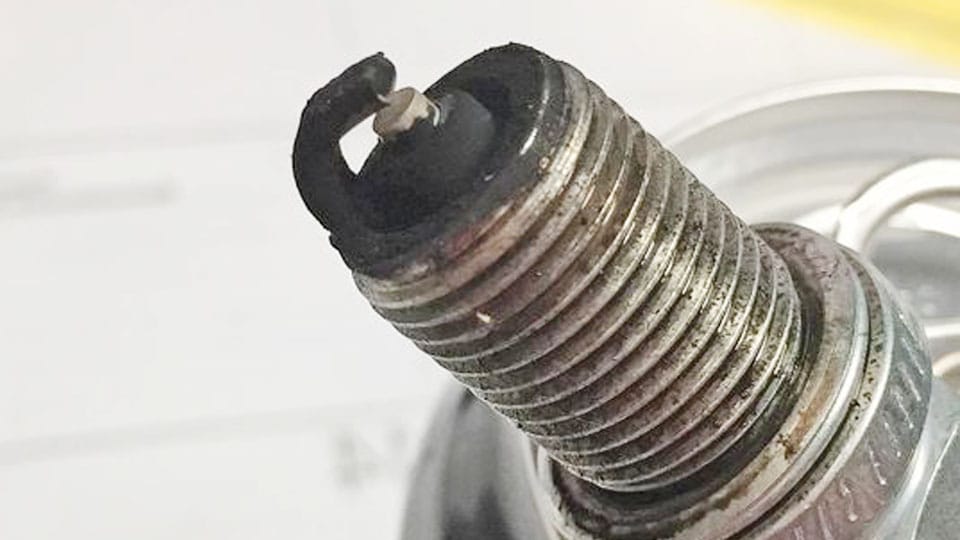
Worn, fouled, or misgapped spark plugs can weaken the spark and cause a cylinder to misfire. The result is usually rough idle, stumble on acceleration, longer cranking, and lower fuel economy. Most manufacturers list replacement intervals by mileage, and oil fouling or overheating can shorten that interval.
Worn electrodes, widened gaps, and fouling
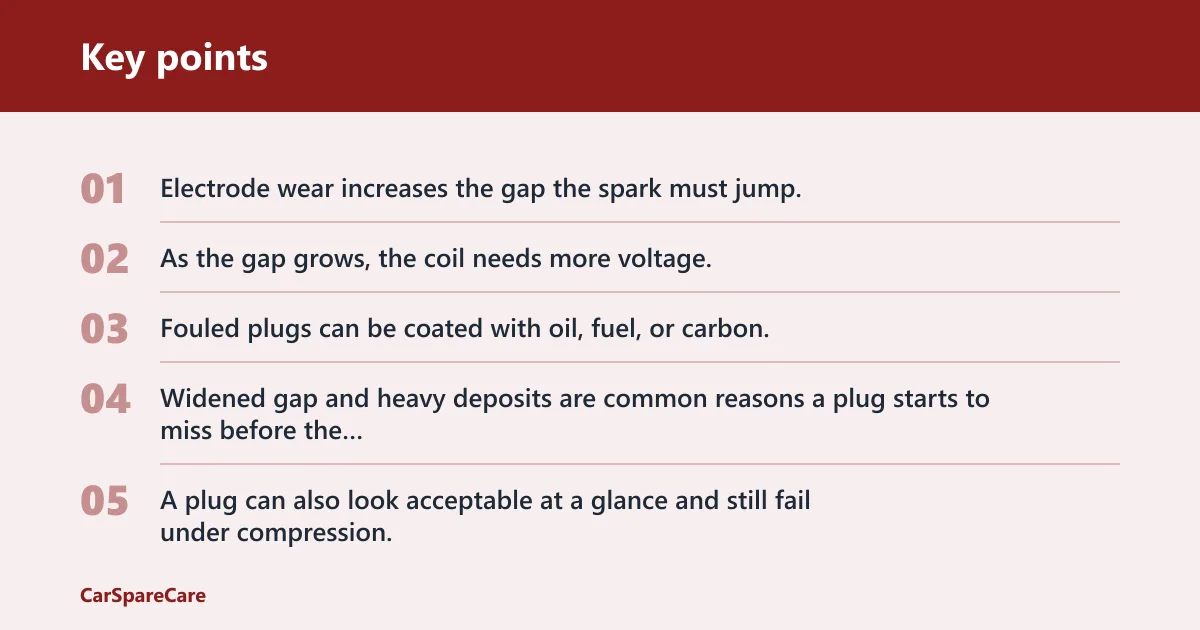
Electrode wear increases the gap the spark must jump. As the gap grows, the coil needs more voltage, and weak secondary ignition can show up first under load. Fouled plugs can be coated with oil, fuel, or carbon, and that contamination can short the spark path or make ignition inconsistent.
Widened gap and heavy deposits are common reasons a plug starts to miss before the scheduled service interval. A plug can also look acceptable at a glance and still fail under compression. That is why inspection should include condition, gap, and the firing tip, not just a quick look at the threads.
Cracked insulators and weak spark paths
A cracked porcelain insulator can leak spark to ground instead of firing the cylinder. That may create arcing, especially in damp conditions or under load. A plug with internal damage can cause a misfire with little visual warning, and the symptom may resemble a bad coil or wire more than a worn plug.
How misfires change idle, acceleration, and fuel use
Misfires often show up first at idle because the engine is least stable there. Under acceleration, a weak cylinder may hesitate, surge, or fall flat. Fuel economy can drop because unburned fuel passes through the cylinder, and the check engine light may flash if the misfire is severe enough to threaten the catalytic converter.
Can bad spark plug wires cause engine knock?
Bad spark plug wires can cause misfire symptoms and noises that sound like engine trouble, but they do not create true mechanical knock. Damaged ignition leads can arc, leak spark to ground, or crossfire to a nearby wire. That weakens combustion and can mimic a bad plug or coil, especially under load.
Arcing, crossfire, and insulation damage
Cracked insulation, burned boots, or poor routing can let the spark escape before it reaches the plug. In dark conditions, arcing may be visible as a small blue flash. Crossfire happens when one wire’s spark jumps into another wire, which can cause an erratic stumble, pop, or intermittent misfire.
Weak coils that look like bad plugs
An ignition coil can fail in a way that looks almost identical to a bad spark plug. Weak secondary ignition often shows up under load, at higher rpm, or when the engine is hot. A coil and a plug can also fail together, so replacing one part without checking the others can miss the root cause.
Suppose a V6 runs smoothly at idle but starts to buck at 50 mph in top gear, then sets P0302. If the plug on cylinder 2 looks normal but the coil tower shows tracking marks or the wire insulation is damaged, the problem may be ignition lead or coil weakness rather than the plug itself.
Carbon buildup and other lookalikes
Excess carbon in the combustion chamber can raise compression and create hot spots that promote detonation or pre-ignition. That can sound like pinging under load and be blamed on the spark plugs even when the plugs are only the messenger. Vacuum leaks, incorrect heat range, and low fuel octane can also shape the same complaint.
Pre-ignition and detonation explained
Pre-ignition and detonation are combustion faults, not misfire faults. A misfire means the cylinder failed to burn the charge properly. Detonation means the charge burned abnormally after ignition. Pre-ignition means the charge lit before the spark event. All three can cause damage, but they are not the same problem.
How they differ from a spark plug misfire
A misfire usually makes the engine run rough and may trigger P0300 or a cylinder-specific P030x code. Detonation often makes a light ping only under load, while pre-ignition can sound harsher and may happen before the throttle is fully opened. A plug can contribute to both if it is overheated, fouled, or the wrong heat range.
Why heat and load trigger damage
High load raises cylinder temperature and pressure. If fuel quality is poor, timing is too advanced, the cooling system is weak, or carbon deposits create hot spots, detonation can start. Pre-ignition can be even harder on parts because the mixture burns too early, pushing against the piston while it is still rising.
Bad spark plugs cause decision table
| Sound description | When it happens | Likely cause | First check |
|---|---|---|---|
| Ping under load | Hard acceleration, uphill driving, high gear, warm engine | Detonation, weak ignition, lean mixture, carbon buildup | Scan for knock and misfire codes, then inspect plugs and fuel quality |
| Tick at idle | Idle, cold start, light throttle, steady parking lot speed | Misfire, exhaust leak, injector noise, valve train tick | Listen near each cylinder, pull codes, and inspect plugs and wires |
| Rough running with no knock | Idle, takeoff, steady cruise | Misfire from plugs, wires, coil, vacuum leak, or fuel issue | Read P0300 through P030x codes and check live misfire data |
| Loud metallic knock that needs immediate shutdown | Any engine speed, often worse with throttle | Rod knock, bearing damage, piston damage, valvetrain failure | Shut the engine off and avoid further driving |
How to diagnose the noise fast
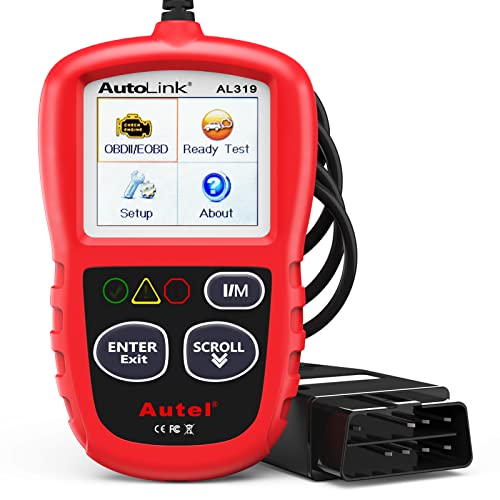
Start with an OBD-II scan tool. Read stored and pending codes, then watch live data if the tool supports misfire counters, fuel trims, and knock retard. P0300 is commonly used for a random misfire, while P0301 through P030x are used for a specific cylinder. Knock-related codes do not prove the spark plugs are bad.
Read codes with an OBD-II scan tool
A knock sensor code means the engine control module saw a signal outside its expected range, not necessarily that a spark plug failed. The sensor can react to real knock, false knock from mechanical noise, wiring faults, or sensor issues. Timing retard on live data can also show the computer is trying to protect the engine.
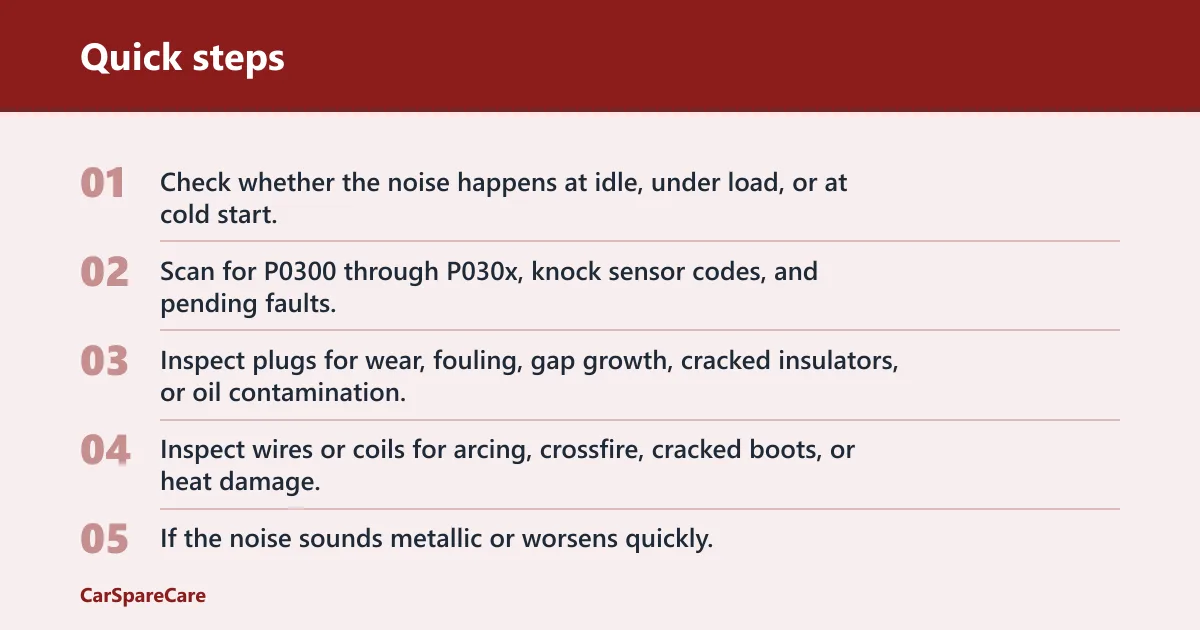
- Check whether the noise happens at idle, under load, or at cold start.
- Scan for P0300 through P030x, knock sensor codes, and pending faults.
- Inspect plugs for wear, fouling, gap growth, cracked insulators, or oil contamination.
- Inspect wires or coils for arcing, crossfire, cracked boots, or heat damage.
- If the noise sounds metallic or worsens quickly, stop driving and rule out mechanical damage.
Use compression or leak-down testing when symptoms point deeper
If one cylinder keeps misfiring after plug, wire, and coil checks, a compression test or leak-down test helps rule out valve, ring, or head gasket problems. Low compression can mimic ignition trouble and can also create a rough, uneven sound that gets mistaken for knock. These tests help separate cylinder-specific engine damage from a simple ignition fault.
Picture a pickup that pings only when towing and sets no misfire code, but one cylinder also shows lower compression than the others. That combination means the spark plug may not be the main problem. A weak cylinder can trigger knock-like symptoms under load and still need deeper diagnosis.
Frequently asked questions
Can bad spark plugs cause engine noise?
Yes, but the noise is usually misfire-related rather than true engine knock. A bad plug can make the idle uneven, create a light tick-like exhaust note, or cause stumble and hesitation. Loud metallic knocking is a different warning sign and should be treated as a possible internal engine problem.
Can bad spark plugs cause engine ticking?
They can cause a tick-like sound if the cylinder misfires, especially at idle or during cold starts. That sound often comes from uneven combustion or exhaust pulses. If the tick is sharp, rhythmic, and tied to engine speed, check for valve train noise, an exhaust leak, or injector clicking too.
Can bad spark plugs cause engine rattle?
Sometimes, yes, if the misfire or weak spark leads to pinging under load. That kind of rattle is usually combustion-related and shows up during acceleration or climbing a hill. A true loose-part rattle, though, may come from heat shields, exhaust components, or internal engine wear.
Will bad spark plugs cause engine knock?
Bad plugs usually do not cause true mechanical knock. They are far more likely to cause misfires, rough idle, and hesitation. They can contribute to combustion pinging if the engine is already running hot, lean, or with the wrong plug heat range, but that is different from rod knock.
Can bad spark plugs cause loud engine noise?
They can cause a loud rough-running sound, especially if the engine is misfiring badly, but that is not the same as loud metallic knock. If the noise is harsh, repetitive, and gets worse with throttle, shut the engine down and inspect for mechanical damage before driving farther.

Hi, I’m Melvin, an automobile engineer with extensive experience in automobile equipment. I currently work for a local automobile firm, where I specialize in the car parts industry. I’ve had the opportunity to collaborate with seasoned inspectors, gaining invaluable hands-on experience that goes beyond just theory.
My passion for automotive care started at a young age, which led me to create CarSpareCare. Through CarSpareCare, I share the knowledge and skills I’ve acquired over the years to help others navigate the world of car maintenance and repairs.
My goal is to provide practical tutorials, essential safety advice, and the latest industry insights so that anyone—whether a beginner or an expert—can confidently tackle their automotive projects.