
Power steering and brake problems are mechanically linked mainly in two setups: a vacuum fault that makes the brake pedal hard and can also upset idle-related steering assist, or a hydraulic hydroboost fault that affects both systems at once. Read that pattern wrong and you may keep driving with reduced assist, longer stopping distances, or a failing belt, pump, or engine vacuum source. This guide matches symptom pairings to shared causes, separates coincidence from a real link, and shows the safe checks to make before you drive any farther.
Most vehicles do not share power steering fluid and brake fluid, and the hydraulic power steering pump does not directly operate the service brakes on a typical passenger car. What feels like one combined failure is often belt loss, an engine stall, vacuum loss, weak system voltage, or front-end or brake hardware that shows up through both the steering wheel and the brake pedal.
Power steering and brakes: actually connected or not?



Usually, no. The brake hydraulic system and the steering assist system are separate on most vehicles, but a few shared inputs can make both feel wrong at the same time: engine vacuum, engine operation, electrical supply, or in some designs a hydroboost unit. The pattern of symptoms tells you more than the simple fact that both complaints started together.
Why the systems are usually separate
The brake hydraulic system uses brake fluid and pressure to stop the car. Low or leaking brake fluid can cause pressure loss, with a soft pedal, sinking pedal, or warning light. Those are brake faults first, and they are safety-critical.
Power steering systems rely on hydraulic fluid to function. On many vehicles, a belt-driven hydraulic power steering pump creates the pressure that helps turn the wheels, and a failing power steering pump often makes the steering wheel harder to turn. Wise Car Care says hydraulic systems use fluid pressure to assist steering wheel movement, while electric systems use an electric motor instead of hydraulic fluid.
The few true shared links
Hard steering plus a hard brake pedal can point to an engine stall or a vacuum problem. If the engine stops, brake booster vacuum drops, and steering assist may also lessen or stop, either because pump speed is gone on hydraulic systems or because assist logic changes on electric systems.
On some vehicles with hydroboost, brake assist uses power steering hydraulic pressure. In that setup, one hydraulic fault can raise steering effort and reduce brake assist at the same time. That is a real mechanical link, but it is not the default layout on most passenger cars.
Electrical supply is another overlap on newer vehicles. An electric power steering warning with normal brakes usually points to an EPS or charging fault, not a brake hydraulic failure, but ABS and stability-control warnings can appear at the same time if system voltage is low.
Why drivers often experience both anyway
One fault can show itself through two touch points without the systems feeding each other. Brake rotor thickness variation or uneven friction deposits can shake the steering wheel only during braking. A sticking brake caliper can make the vehicle pull, feel draggy, and mimic steering trouble. A worn steering rack and pinion can add looseness or wandering that becomes more obvious during a stop.
Power steering problems can make it hard to control your vehicle. FixMyCar says a steering problem may feel stiff and extremely difficult to use. That heavy feel can distract you from a separate brake issue, or the brake issue can make the steering symptom seem worse than it is.
When drilled or slotted rotors actually make sense
This article breaks down the real tradeoff: for everyday commuting, solid rotors usually do the job, while drilled and slotted rotors are mainly about heat and surface management rather than a dramatic stopping-distance upgrade. If you’re deciding whether the extra cost is justified, it explains what each design is meant to do and where the practical benefits stop.
It also covers the downsides that matter, especially cracking risk with drilled designs and the conditions where drilled vs slotted rotors can help with fade control and water shedding. That makes the article useful if you tow, drive mountain roads, or just want to know whether the upgrade is performance or appearance first.
Which combinations point to a shared cause?
Some pairings should immediately raise suspicion of a shared cause, while others usually mean two nearby faults or one system making the other feel involved. The strongest shared-cause combinations are hard steering plus a hard brake pedal, assist loss right after belt squeal or an engine stumble, and warning lights tied to charging or control systems.
Hard steering plus hard brake pedal
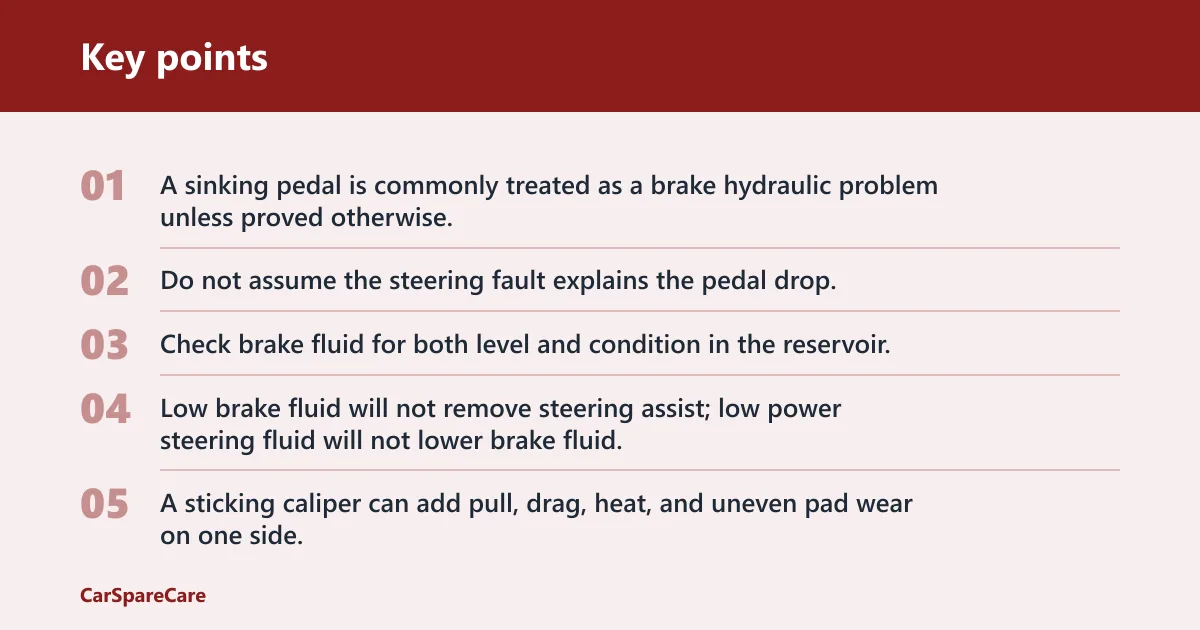
This is the classic engine-off or vacuum-loss pattern. If the brake pedal goes firm at the same time the steering gets heavy, suspect a stalled engine, failed vacuum supply, or a belt-related event on a hydraulic-steering vehicle. That combination is different from a soft pedal, which points back toward brake hydraulics.
Suppose the engine stumbles at a stoplight, the battery light flashes, the wheel suddenly needs both hands to turn, and the brake pedal goes hard on the next push. That stack of symptoms fits lost engine operation or a belt or charging event far better than a bad brake caliper.
Loss of steering assist plus sinking or soft pedal
A sinking pedal is commonly treated as a brake hydraulic problem unless proved otherwise. If steering assist disappears at the same time, the overlap may be an engine-off event, a major fluid leak affecting what you can see under the car, or two failures happening together. Do not assume the steering fault explains the pedal drop.
Check brake fluid for both level and condition in the reservoir. If the level is below the MIN mark, or the pedal slowly sinks under steady pressure, suspect an external leak or an internal hydraulic fault and stop driving; if the fluid is dark, service may be overdue, but color alone does not explain a sinking pedal. Low brake fluid will not remove steering assist; low power steering fluid will not lower brake fluid.
Steering wheel shake only while braking
If the wheel shakes mainly during braking and feels normal while cruising, the likely fault is in the brakes or front end, not in the power steering pump. Brake rotor surface condition matters more than the label “warped.” Thickness variation, uneven deposits, or loose front-end hardware can all send shake into the wheel.
A sticking caliper can add pull, drag, heat, and uneven pad wear on one side. That can make the vehicle feel as if the steering is darting or fighting back, when the source is brake drag at one front wheel.
Warning lights with normal pedal feel
If an electric steering warning light appears but pedal feel stays normal, the best fit is usually EPS or electrical supply trouble rather than a brake hydraulic fault. ABS or vehicle-control lights can overlap with braking complaints, but warning lights need scan-tool diagnosis because the same dashboard pattern can mean very different failures.
Picture a cold morning start where the EPS light and traction-control light stay on, steering assist fades in and out at parking-lot speed, but the brake pedal remains firm and stopping distance feels unchanged. That points first to voltage, charging, wheel-speed data, or EPS faults, not to low brake fluid.
Steering and brake triage matrix
| Symptom pattern | Most likely shared cause | Immediate next check |
|---|---|---|
| Hard steering plus hard braking | Engine stall, brake booster vacuum loss, or hydroboost/pump supply fault | Confirm whether the engine is still running smoothly; check for a brake-booster hiss, vacuum-hose issue, or sudden belt failure |
| Steering noise plus brake pulsation | Front-end load transfer exposing separate brake rotor/caliper and steering wear issues | Road-test only if safe, then inspect front rotors, caliper movement, tie-rod play, and wheel-bearing looseness |
| Brake pedal sink plus steering assist loss | Brake hydraulic fault with a simultaneous engine-off event, or two faults at once | Stop driving; check brake-fluid level, look for leaks at wheels and master cylinder area, then confirm engine operation |
| Belt squeal plus loss of assist | Slipping or broken power steering belt, or broader serpentine-belt failure | Inspect belt presence, tension, glazing, and whether the alternator and water pump are still being driven |
| Electric steering warning light with normal brakes | EPS fault, weak battery, charging problem, or control-module issue | Check battery and charging warnings, then scan EPS, ABS, and stability-control modules |
| Heavy steering only at idle with hard pedal after repeated brake use | Low engine vacuum, rough idle, or near-stall condition | Listen for vacuum leaks, note idle quality, and see whether symptoms improve above idle speed |
| Visible fluid under the car with heavy steering and normal pedal | Power steering leak at hose, pump, or rack seals | Check power steering fluid level, reservoir foam, hoses, and rack boots for wetness |
| Visible fluid under the car with soft pedal and normal steering | Brake hydraulic leak | Do not drive; check brake-fluid reservoir, backing plates, calipers, and brake lines for wetness |
| Vehicle pulls to one side while braking and steering feels twitchy | Sticking brake caliper or uneven front brake torque | Check for one hot wheel, uneven pad wear, and drag when the wheel is spun |
| Intermittent assist loss with ABS or battery light | Low system voltage, charging fault, or belt slip affecting multiple systems | Inspect belt drive and battery terminals, then test charging output and scan stored faults |
Does the power steering pump affect the brakes?
Usually, no. A hydraulic power steering pump affects steering assist, not the service brakes, on most vehicles. The exceptions are hydroboost designs and broader failures where a slipping belt, stalled engine, or vacuum loss makes the brake pedal feel different at the same time the pump can no longer supply steering assist.
What the pump does inside the steering system
The hydraulic power steering pump is belt-driven on many vehicles and creates hydraulic pressure for assist. If it fails, steering can become heavy or difficult, and whining or squealing when turning can indicate the steering system is struggling. Sea Foam says noise or weak assist is often caused by internal parts sticking due to degraded fluid.
Low or dirty power steering fluid can cause weak assist, and contaminated fluid can damage components over time. If air enters the system, the fluid can aerate or foam, which changes both noise and assist feel. A pump that is starving for fluid may groan while parking and feel better once engine speed rises.
When a pump-related problem can feel bigger than steering alone
If the same belt also drives the alternator, a slipping or broken belt can turn a steering issue into a broader vehicle-control problem. Battery voltage may fall, warning lights can appear, and modern assist systems may cut back. That still does not mean the pump powers the brakes directly.
The same source says diagnosing power steering can be difficult without special pressure equipment, and complete loss of assist or a leak usually means parts replacement. A visible puddle under the car is a common leak warning sign, and fluid leaks under the vehicle are a common sign of power steering trouble.
Engine and vacuum cases that create overlap
If the engine stalls, steering assist can drop because the hydraulic pump stops turning. At the same time, brake booster vacuum gets used up after one or two pedal applications, making the pedal hard. That shared loss comes from the engine and vacuum source, not because the steering pump is feeding the brake hydraulics on a normal vacuum-boosted car.
Can low fluid cause both steering and brake symptoms?
It can cause both categories of complaint only if two reservoirs are low for separate reasons. Low power steering fluid affects steering assist and pump noise; low brake fluid affects pedal feel and stopping safety. One low reservoir does not explain the other, and the fluids are not shared in normal passenger vehicles.
What low power steering fluid does
Low power steering fluid can cause weak assist, noise on turns, and a reservoir full of foam if air is being pulled into the system. Failing power steering pumps often cause difficulty turning the wheel, but the root cause may be fluid loss from a hose, pump seal, or leaks at steering rack seals or boots.
The steering rack and pinion converts steering input into wheel movement. Wear can cause looseness, wandering, or delayed response. Rack leaks often show up as wet boots or fluid collecting around seal areas, but a rack fault usually does not directly create a soft brake pedal.
What low brake fluid does
Low brake fluid points to pad wear, a leak, or another brake-side issue that needs inspection. Symptoms include a soft pedal, a sinking pedal, longer stopping distance, or warning lights. Brake issues are safety-critical even when the steering complaint arrived first and seems louder.
What dark or degraded fluid suggests
Dark power steering fluid can point to age, contamination, or overheated fluid. Dark brake fluid suggests moisture absorption and overdue service. Neither reservoir should be topped off blindly if there is an active leak. Fix the reason the level dropped, then refill with the correct specified fluid.
When a worn ball joint is the real problem
If your steering feels loose, you hear a clunk over bumps, or the tires are wearing unevenly, the issue may be a ball joint rather than the brake or power steering system. The supporting guide explains how to spot a bad ball joint diagnosis using simple visual checks, safe play tests, and basic clues that help separate ball joint wear from a tie rod end or wheel bearing fault.
That matters because a worn joint can keep damaging tires and steering parts, and in severe cases it can fail suddenly. The article also covers how to judge severity so you can decide whether the car needs prompt repair or should stay parked.
Tie rod ends: when steering play comes from the linkage
If the steering feels loose, wanders, or clunks when you turn, the issue may be a worn tie rod end rather than a power-steering or brake problem. The supporting guide on tie rod end diagnosis explains the most useful checks: where wheel play shows up, how to inspect the boot, and how to tell outer wear from inner wear. That matters because a bad tie rod end can mimic other front-end faults, send you after the wrong repair, and quickly damage tires and alignment.
Use it when you want a fast, practical way to separate steering-linkage wear from other causes before you replace parts.
Parts that mimic a shared failure
Brake caliper pull mistaken for steering trouble
A sticking brake caliper can create pull, drag, noise, heat, and uneven wear. If one front brake grabs harder than the other, the steering wheel may tug during braking and the car may drift after release. That feels like a steering fault even though the brake caliper is the source.
Brake rotor surface variation that shakes the steering wheel
Many drivers call this warped rotors, but the more useful description is rotor thickness variation or uneven friction deposits. Under braking, that variation changes brake torque once per wheel revolution, and the shake feeds into the steering wheel. Normal steering while coasting is the clue that points back to brake hardware.
Steering rack looseness or leaks confused with brake instability
A worn steering rack and pinion or loose tie-rod hardware can make the car wander and delay response. Braking shifts weight onto the front axle, so the looseness feels worse during a stop. Galaxy Auto Parts identifies the torsion bar as part of how steering input is sensed in steering operation, which is another reason worn internal steering parts can change assist feel without creating an actual brake hydraulic fault.
What to check first at home
Driveway triage steps
- Confirm engine status. Start with the simplest split: engine running normally, stumbling, or stalled. If the engine is off or barely idling, both steering assist and brake booster performance can change fast, so this check tells you whether to suspect a shared engine or vacuum cause first.
- Compare pedal behavior. Press the brake pedal once with the engine off, then once with the engine running if the vehicle can be started safely. A hard pedal that improves when the engine starts suggests booster vacuum is involved; a pedal that sinks under steady foot pressure points toward brake hydraulics and is reason to stop there.
- Inspect the belt. On belt-driven hydraulic steering, look for a missing belt, glazing, frayed edges, rib damage, or obvious slack. Belt squeal plus sudden loss of assist strongly suggests slip, and if the same belt drives the alternator or water pump the problem is larger than steering alone.
- Check warning lights. Note whether the dash shows brake, ABS, stability-control, battery, or EPS warnings. Warning-light combinations matter: EPS plus battery suggests voltage or charging trouble, while brake plus ABS with altered pedal feel puts more weight on the brake side.
- Check both fluids. Inspect power steering fluid only if the vehicle has a hydraulic reservoir, and inspect brake fluid in its own reservoir. Low power steering fluid can explain noise, foam, and heavy steering; low brake fluid can explain a soft pedal, but one low reservoir does not explain the other.
- Look for fresh leaks. Check under the front of the car, around the pump and hoses, around steering rack boots, and behind the wheels or calipers. FixMyCar includes a visible puddle under the car as a leak warning sign, and brake fluid leakage means the vehicle should not be driven.
- Feel for wheel heat. If the vehicle was just moved a short distance, carefully compare front wheel heat without touching the rotor face directly. One much hotter wheel supports a sticking caliper or brake drag diagnosis, which can make the steering feel wrong even when assist is normal.
What can be inspected safely and what cannot?
Fluid level, belt condition, warning lights, and obvious leaks are reasonable driveway checks. Pressure-testing a hydraulic power steering pump, confirming internal rack leakage, or proving an ABS or EPS fault usually needs better tools. The same source says diagnosing power steering can be difficult without special pressure equipment.
Say your reservoir is low, the fluid is tan and foamy, and the steering groans only at full lock while the brake pedal feels normal. That pattern fits steering-side aeration far better than a combined steering-and-brake failure. The next move is leak inspection, not chasing brake hydraulics.
Is it safe to drive if both feel wrong?
No, not if the symptoms include hard braking, a sinking pedal, repeated steering assist loss, major leaks, or warning lights paired with changed pedal feel. Those combinations can reduce control and increase stopping distance. Limited driveway checks are reasonable, but road testing a car with both systems feeling wrong is a poor gamble.
Stop-driving signs that call for a tow
- Hard steering and poor braking at the same time
- Brake pedal that sinks or goes soft under steady pressure
- Repeated loss of steering assist while driving
- Brake, ABS, or stability lights with altered pedal feel
- Major fluid leaks or a visible puddle from the brake or steering area
- Broken or slipping belt with charging or overheating risk
Cases that may allow limited driveway inspection only
An EPS warning light with normal pedal feel, a steering groan with no brake symptom, or brake pulsation with otherwise normal steering may allow a short, stationary inspection at home. That is inspection only, not “drive it and see.” Once hard braking, a sinking pedal, or repeated assist loss enters the picture, towing is the safer call.
What to tell a shop after triage
Report the exact pattern: engine running or stalled, hard or soft pedal, warning lights present, steering assist lost all at once or only at idle, and whether belt squeal happened first. Mention any fresh puddle, foamy power steering fluid, one hot wheel, or steering wheel shake only during braking. That description narrows the first checks.
Repair cost can vary widely by part and vehicle. The same source lists a £103.19 average quote for power steering repair, but combined steering-and-brake complaints can range from fluid service and a belt replacement to rack, caliper, booster, or electrical diagnosis.
Why a car wanders on the road
A car that wanders usually points to road crown, tramlining, tire pressure problems, alignment issues, or wear in steering and suspension parts. The key is to notice how the symptom behaves: if the car changes direction mainly with lane changes, road crown is often involved, while a tire that follows grooves or pavement seams is more likely experiencing tramlining. The supporting guide on car wandering explains those differences clearly so you can narrow the cause before paying for unnecessary repairs.
That matters because wandering can speed up tire wear, make the car feel less stable, and signal a mechanical issue that will only get worse.
Frequently asked questions
Are power steering and brakes connected?
Usually they are separate. Drivers feel them together when a shared input fails, such as engine vacuum, engine operation, electrical supply, or on some vehicles a hydroboost unit. If one symptom is a soft pedal and the other is heavy steering, treat that as possible overlap, not proof of one shared fluid system.
Does power steering affect brakes?
On most vehicles, power steering does not directly affect the service brakes. A steering problem can coincide with harder braking if the engine stalls, vacuum drops, or a belt failure affects several systems. That is different from saying the steering fluid or pump normally powers the brakes.
Why did my power steering and brakes go out?
Start with the symptom pattern. Hard steering plus a hard pedal suggests engine stall, vacuum loss, or hydroboost trouble. Heavy steering plus a soft or sinking pedal points to a brake hydraulic fault first, with either a separate steering issue or two failures at once. Warning lights can shift suspicion toward voltage or control-system faults.
What can cause hard steering and hard braking at the same time?
The main causes are engine stall, loss of brake booster vacuum, a shared hydroboost hydraulic fault, or a belt-related event that left the engine running poorly and removed hydraulic steering assist. This is a stop-driving pattern because it cuts assist where you need it most, at low speed and during stopping.

Hi, I’m Melvin, an automobile engineer with extensive experience in automobile equipment. I currently work for a local automobile firm, where I specialize in the car parts industry. I’ve had the opportunity to collaborate with seasoned inspectors, gaining invaluable hands-on experience that goes beyond just theory.
My passion for automotive care started at a young age, which led me to create CarSpareCare. Through CarSpareCare, I share the knowledge and skills I’ve acquired over the years to help others navigate the world of car maintenance and repairs.
My goal is to provide practical tutorials, essential safety advice, and the latest industry insights so that anyone—whether a beginner or an expert—can confidently tackle their automotive projects.

